Loading...
Done
Freida Pinto as Jas Mitra in Showtime's “Guerrilla”, 2016. (Photo by Sky UK Limited/SHOWTIME)

Freida Pinto as Jas Mitra in Showtime's “Guerrilla”, 2016. (Photo by Sky UK Limited/SHOWTIME)
Details
28 Jan 2017 07:23:00
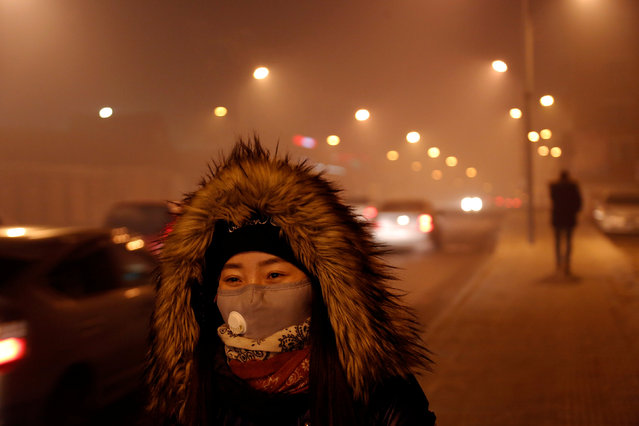
A woman wears a face mask in the part of the city near neighbourhoods known for burning coal for heating in Ulaanbaatar, Mongolia January 26, 2017. Not many people in Ulaanbaatar wear masks to protect themselves against pollution. (Photo by B. Rentsendorj/Reuters)

A woman wears a face mask in the part of the city near neighbourhoods known for burning coal for heating in Ulaanbaatar, Mongolia January 26, 2017. Not many people in Ulaanbaatar wear masks to protect themselves against pollution. (Photo by B. Rentsendorj/Reuters)
Details
09 Feb 2017 00:00:00
View of an American marine as he lies in a foxhole and whistles at a husky, one of the scouting dogs used during the landing on Guam, August 1944. (Photo by W. Eugene Smith/Time & Life Pictures/Getty Images)

View of an American marine as he lies in a foxhole and whistles at a husky, one of the scouting dogs used during the landing on Guam, August 1944. (Photo by W. Eugene Smith/Time & Life Pictures/Getty Images)
Details
25 Feb 2017 00:04:00
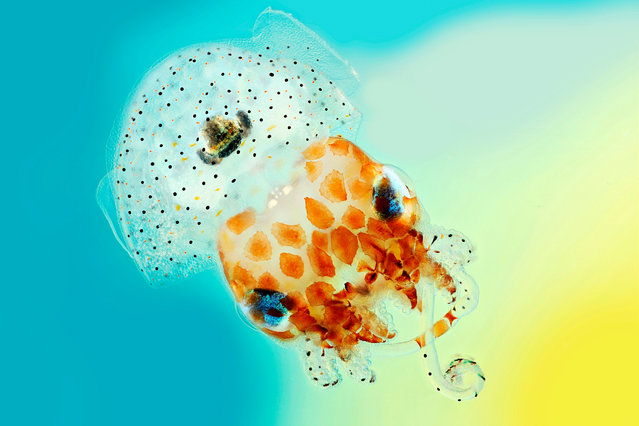
With its huge eyes, comical name and diminutive size, Mark R. Smith’s image of a baby Hawaiian bobtail squid can’t help but raise a smile. A curiously endearing creature, the cephalopod is just 1.5cm across, its mantle cavity bearing more than a passing resemblance to a rather natty shower cap. But it is also a beautiful example of symbiosis – nature’s version of “I’ll scratch your back if you scratch mine” – for on the underside of the squid is a light organ which houses bioluminescent bacteria. The squid offers the bacteria protection and food, while the bacteria emit a glow – a handy trait that the squid uses to offset its silhouette, helping it to evade predators in the depths below. Mark R. Smith’s entry combines several images of a Hawaiian bobtail squid with different focus lengths to create a final picture with greater depth of field than normal. (Photo by Mark R. Smith/Wellcome Images/Macroscopic Solutions)


With its huge eyes, comical name and diminutive size, Mark R. Smith’s image of a baby Hawaiian bobtail squid can’t help but raise a smile. A curiously endearing creature, the cephalopod is just 1.5cm across, its mantle cavity bearing more than a passing resemblance to a rather natty shower cap. But it is also a beautiful example of symbiosis – nature’s version of “I’ll scratch your back if you scratch mine” – for on the underside of the squid is a light organ which houses bioluminescent bacteria. The squid offers the bacteria protection and food, while the bacteria emit a glow – a handy trait that the squid uses to offset its silhouette, helping it to evade predators in the depths below. Mark R. Smith’s entry combines several images of a Hawaiian bobtail squid with different focus lengths to create a final picture with greater depth of field than normal. (Photo by Mark R. Smith/Wellcome Images/Macroscopic Solutions)
Details
08 Mar 2017 00:05:00
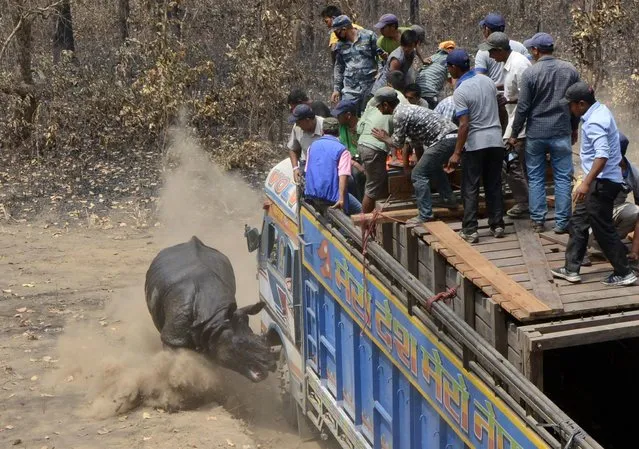
A Nepalese vetinary and technical team release a rhino after it is relocated in Chitwan National Park some of 250 Kilometer South of Kathmandu on April 4, 2017. Conservationists on April 3 captured a rare one-horned rhinoceros in Nepal as part of an attempt to increase the number of the vulnerable animals, which are prized by wildlife poachers. Five rhinos – one male and four female – will be released into a national park in Nepal's far west over the coming week in the hope of establishing a new breeding group. (Photo by Prakash Mathema/AFP Photo)

A Nepalese vetinary and technical team release a rhino after it is relocated in Chitwan National Park some of 250 Kilometer South of Kathmandu on April 4, 2017. Conservationists on April 3 captured a rare one-horned rhinoceros in Nepal as part of an attempt to increase the number of the vulnerable animals, which are prized by wildlife poachers. Five rhinos – one male and four female – will be released into a national park in Nepal's far west over the coming week in the hope of establishing a new breeding group. (Photo by Prakash Mathema/AFP Photo)
Details
05 Apr 2017 09:19:00
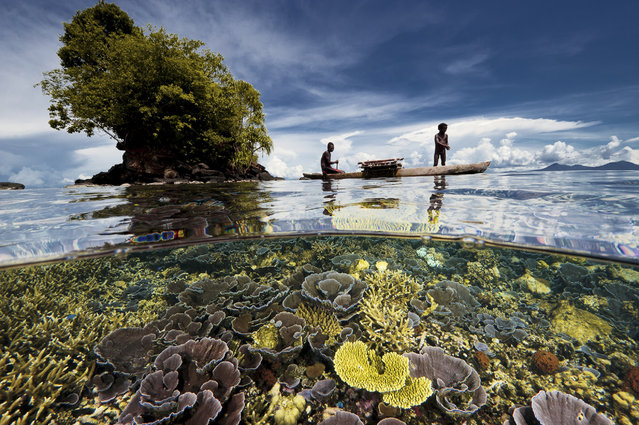
From the “Paradise Revisited” story in the November 2013 issue of National Geographic magazine, this image is a beautiful vision of father and son fishermen as they move through the multicolored coral gardens of Kembe Bay, Papua New Guinea, in a traditional outrigger canoe. (Photo by David Doubilet/National Geographic Creative)

From the “Paradise Revisited” story in the November 2013 issue of National Geographic magazine, this image is a beautiful vision of father and son fishermen as they move through the multicolored coral gardens of Kembe Bay, Papua New Guinea, in a traditional outrigger canoe. (Photo by David Doubilet/National Geographic Creative)
Details
29 Apr 2017 07:28:00
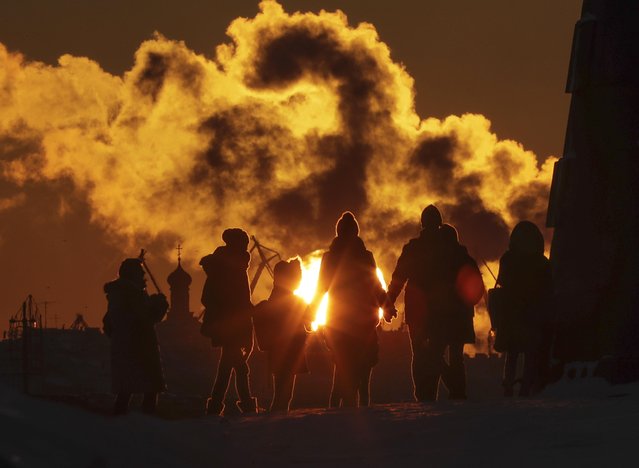
People walk along the Neva River at sunset in St.Petersburg, Russia, Tuesday, December 6, 2016. The temperature in St.Petersburg is -9C ( 15.8 °F). (Photo by Dmitri Lovetsky/AP Photo)

People walk along the Neva River at sunset in St.Petersburg, Russia, Tuesday, December 6, 2016. The temperature in St.Petersburg is –9C ( 15.8 °F). (Photo by Dmitri Lovetsky/AP Photo)
Details
10 Jun 2017 08:38:00
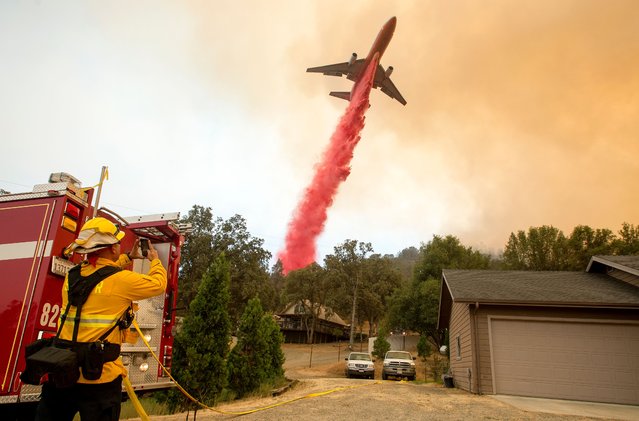
An air tanker drops fire retardant on flames as firefighters continue to battle against the Detwiler fire in Mariposa, California on July 19, 2017. The Detwiler fire is currently at 7 percent containment and has burned more than 45,000 acres and destroyed eight structures. (Photo by Josh Edelson/AFP Photo)

An air tanker drops fire retardant on flames as firefighters continue to battle against the Detwiler fire in Mariposa, California on July 19, 2017. The Detwiler fire is currently at 7 percent containment and has burned more than 45,000 acres and destroyed eight structures. (Photo by Josh Edelson/AFP Photo)
Details
22 Jul 2017 08:38:00