A girl lights a candle as she marks the anniversary of 2015 Nepal earthquake, at Boudhanath stupa in Kathmandu, Nepal April 25, 2017. (Photo by Navesh Chitrakar/Reuters)
Japanese Yuuka Hasumi, 17, and Ibuki Ito, 17, also from Japan, who want to become K-pop stars, perform at an Acopia School party in Seoul, South Korea, March 16, 2019. Acopia is a prep school offering young Japanese a shot at K-pop stardom, teaching them the dance moves, the songs and also the language. (Photo by Kim Hong-Ji/Reuters)
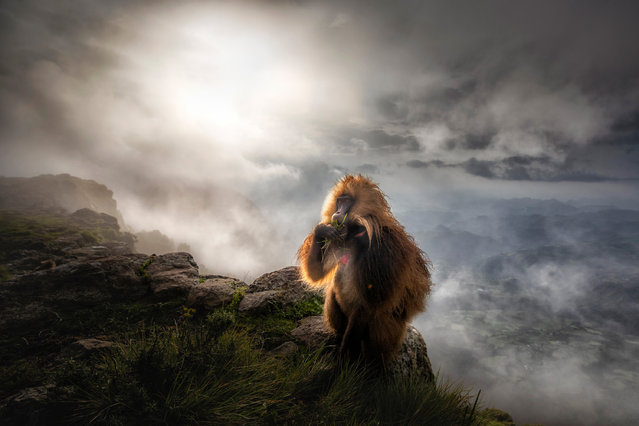
Highly commended, mammals: Gelada after the storm – Marco Gaiotti (Italy). “Gelada baboons are the only monkey species in the world that feed on grasses. They are native to the tableland of Ethiopia. Every morning large family groups wander from their sleeping places in the steep rock face, up to 1,000 metres high, to the feeding grounds at the tablelands. This image clearly depicts their feeding strategy: they pull out bunches of grass, sort the stalks and then lift them to their mouth. This shot was taken towards the end of the rainy season after a heavy storm”. (Photo by Marco Gaiotti/2019 GDT European Wildlife Photographer of the Year)
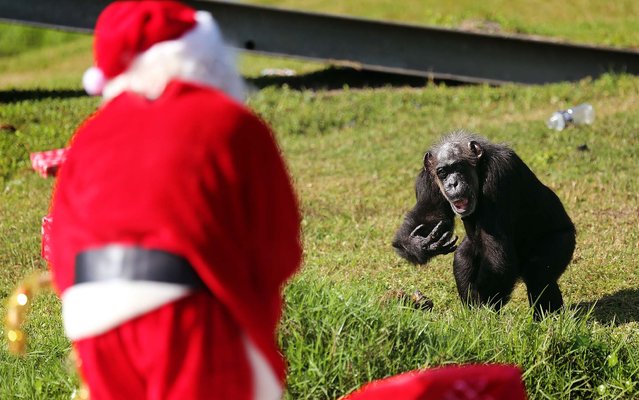
A chimp motions for Santa to deliver his gift during Lion Country Safari's annual Christmas with the Chimps on Thursday, December 20, 2012. (Photo by Bruce R. Bennett/The Palm Beach Post)
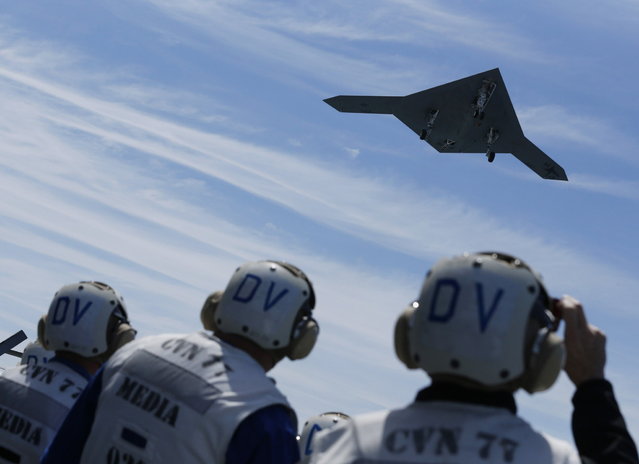
The X-47B prototype on Tuesday flew off an aircraft carrier and into the history books. Today's achievement, the first-ever catapult launch of an unmanned aircraft from the flight deck of a carrier, promises to open up a new chapter in the annals of naval aviation. Photo: An X-47B pilot-less drone combat aircraft is launched for the first time off an aircraft carrier, the USS George H. W. Bush, in the Atlantic Ocean off the coast of Virginia, May 14, 2013. The U.S. Navy made aviation history on Tuesday by catapulting an unmanned jet off an aircraft carrier for the first time, testing a long-range, stealthy, bat-winged plane that represents a jump forward in drone technology. (Photo by Jason Reed/Reuters)
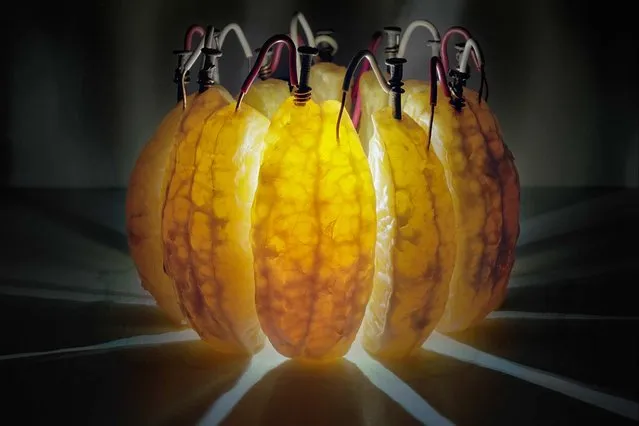
Wedges of an orange generate enough current and electrical juice – 3.5 volts – to power an LED. The fruit’s citric acid helps electrons flow from galvanized nails to copper wire in this 14-hour exposure. This image was published in September’s Visions of Earth, a trio of photos that appear in each issue of National Geographic. (Photo by Caleb Charland/National Geographic)
An Afghan National Army (ANA) soldier assigned to the Mobile Strike Force Kandak fires a RPG-7 rocket-propelled grenade launcher during a live-fire exercise supervised by the Marines with the Mobile Strike Force Advisor Team on Camp Shorabak, Helmand province, Afghanistan, May 20, 2013. The Marines with the Mobile Strike Force Advisor Team instructed and mentored their ANA counterparts on how to properly utilize their weapons systems. (Photo by SSgt Ezekiel R. Kitandwe/RCT 7)
Street fighting in Berlin between Government troops and Spartacists, during the Spartacist uprising which followed Germany's defeat in World War I. (Photo by Keystone/Getty Images). 1919