Loading...
Done
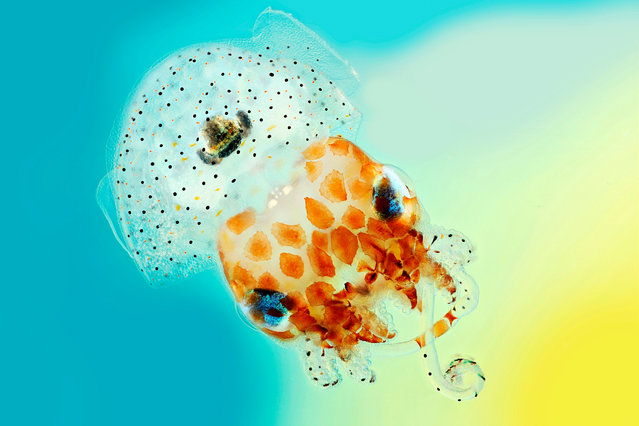
With its huge eyes, comical name and diminutive size, Mark R. Smith’s image of a baby Hawaiian bobtail squid can’t help but raise a smile. A curiously endearing creature, the cephalopod is just 1.5cm across, its mantle cavity bearing more than a passing resemblance to a rather natty shower cap. But it is also a beautiful example of symbiosis – nature’s version of “I’ll scratch your back if you scratch mine” – for on the underside of the squid is a light organ which houses bioluminescent bacteria. The squid offers the bacteria protection and food, while the bacteria emit a glow – a handy trait that the squid uses to offset its silhouette, helping it to evade predators in the depths below. Mark R. Smith’s entry combines several images of a Hawaiian bobtail squid with different focus lengths to create a final picture with greater depth of field than normal. (Photo by Mark R. Smith/Wellcome Images/Macroscopic Solutions)

With its huge eyes, comical name and diminutive size, Mark R. Smith’s image of a baby Hawaiian bobtail squid can’t help but raise a smile. A curiously endearing creature, the cephalopod is just 1.5cm across, its mantle cavity bearing more than a passing resemblance to a rather natty shower cap. But it is also a beautiful example of symbiosis – nature’s version of “I’ll scratch your back if you scratch mine” – for on the underside of the squid is a light organ which houses bioluminescent bacteria. The squid offers the bacteria protection and food, while the bacteria emit a glow – a handy trait that the squid uses to offset its silhouette, helping it to evade predators in the depths below. Mark R. Smith’s entry combines several images of a Hawaiian bobtail squid with different focus lengths to create a final picture with greater depth of field than normal. (Photo by Mark R. Smith/Wellcome Images/Macroscopic Solutions)
Details
08 Mar 2017 00:05:00
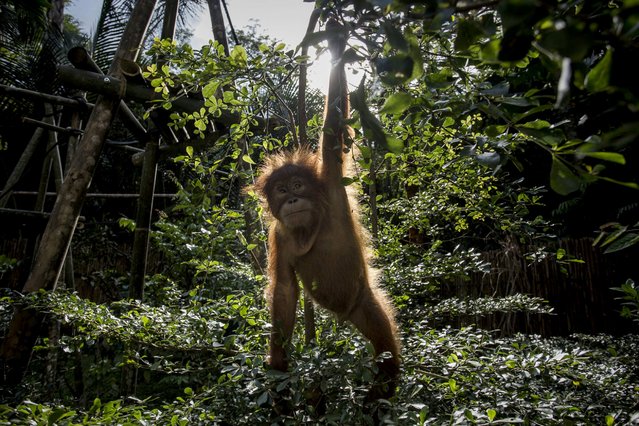
A Baby sumatran orangutan (Pongo abelii) plays around in a tree as they train at Sumatran Orangutan Conservation Programme's rehabilitation center on November 12, 2016 in Kuta Mbelin, North Sumatra, Indonesia. The Orangutans in Indonesia have been known to be on the verge of extinction as a result of deforestation and poaching. Found mostly in South-East Asia, where they live on the islands of Sumatra and Borneo, the endangered species continue to lose their habitat as a result of corporate expansion in a developing economy. Indonesia approved palm oil concessions on nearly 15 million acres of peatlands over the past years and thousands of square miles have been cleared for plantations, including the lowland areas that are the prime habitat for orangutans. (Photo by Ulet Ifansasti/Getty Images)

A Baby sumatran orangutan (Pongo abelii) plays around in a tree as they train at Sumatran Orangutan Conservation Programme's rehabilitation center on November 12, 2016 in Kuta Mbelin, North Sumatra, Indonesia. The Orangutans in Indonesia have been known to be on the verge of extinction as a result of deforestation and poaching. Found mostly in South-East Asia, where they live on the islands of Sumatra and Borneo, the endangered species continue to lose their habitat as a result of corporate expansion in a developing economy. Indonesia approved palm oil concessions on nearly 15 million acres of peatlands over the past years and thousands of square miles have been cleared for plantations, including the lowland areas that are the prime habitat for orangutans. (Photo by Ulet Ifansasti/Getty Images)
Details
16 Nov 2016 11:14:00
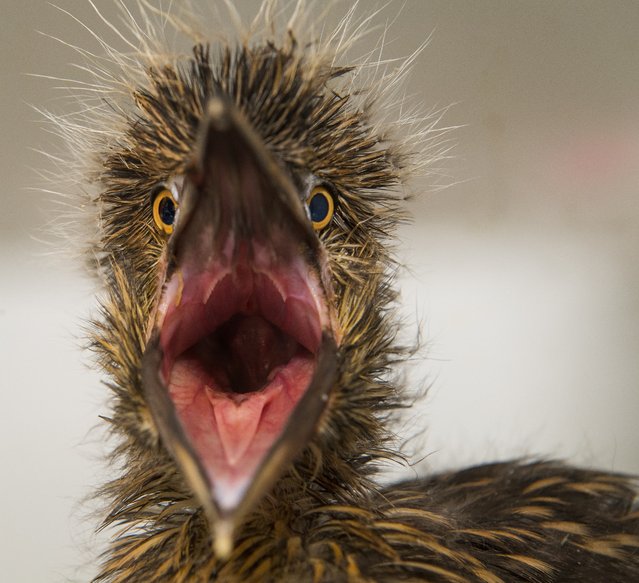
A baby Black-crowned Night Heron squawks in its incubator while being cared for at City Wildlife rescue and rehabilitation center in Washington, DC on May 31, 2017. The heron is one of several that have been brought to CW by the staff at The National Zoo over the past few years. The heron is a native bird and has made an established rookery inside the zoo grounds over a hundred years ago.  Every year at this time, some of the chicks get pushed or fall out of the nest and require human care.  Because the birds are native and not part of the Smithsonian collection, they partnered with CW to rehabilitate the herons for re-release back to the flock inside Zoo. They're reintroduced back to their flock so that they can migrate together in the Fall. The Black-crowned heron usually migrates from the DC area down to southeast North Carolina, some going as far as Jacksonville, FL in winter. The Black-crowned heron is the species of greatest conservation need in the District of Columbia because their numbers are in such rapid decline due to habitat loss. (Photo Linda Davidson/The Washington Post)

A baby Black-crowned Night Heron squawks in its incubator while being cared for at City Wildlife rescue and rehabilitation center in Washington, DC on May 31, 2017. The heron is one of several that have been brought to CW by the staff at The National Zoo over the past few years. (Photo Linda Davidson/The Washington Post)
Details
04 Jun 2017 08:04:00
A pregnant woman poses on June 19, 2018 in Vertou, western France. France had an estimated population of 68.4 million by January 1, 2024, representing a further year-on-year increase of 0.3 percent, limited by a marked drop in the birth rate, the INSEE national statistics bureau of France reported on January 16, 2024. In 2023, 678,000 babies were born in France, 6.6 percent fewer than the previous year, the lowest number of births in any year since 1946. Over the same period, there were 631,000 deaths, down 6.5 percent on 2022, a year marked by the consequences of the Covid-19 pandemic and episodes of extreme heat. (Photo by Loic Venance/AFP Photo)

A pregnant woman poses on June 19, 2018 in Vertou, western France. France had an estimated population of 68.4 million by January 1, 2024, representing a further year-on-year increase of 0.3 percent, limited by a marked drop in the birth rate, the INSEE national statistics bureau of France reported on January 16, 2024. In 2023, 678,000 babies were born in France, 6.6 percent fewer than the previous year, the lowest number of births in any year since 1946. Over the same period, there were 631,000 deaths, down 6.5 percent on 2022, a year marked by the consequences of the Covid-19 pandemic and episodes of extreme heat. (Photo by Loic Venance/AFP Photo)
Details
27 Feb 2024 07:29:00
Paper Coffee Cup Art By Miguel Cardona

San Francisco-based design professor Miguel Cardona is selling his custom-drawn “Sketchcups” at Café Sophie for US$20 a piece to benefit Project Night Night, a charity that donates baby blankets, books, and toys to children in homeless shelters. Cardona discusses the project in an interview with Coolhunting. If you'd like to purchase or commission one of Cadona's pieces for yourself, you can do so for US$30 at his Sketchcups Store.
Details
31 Mar 2014 11:55:00
Unlikely Friendship Of A Kitten And Ferrets

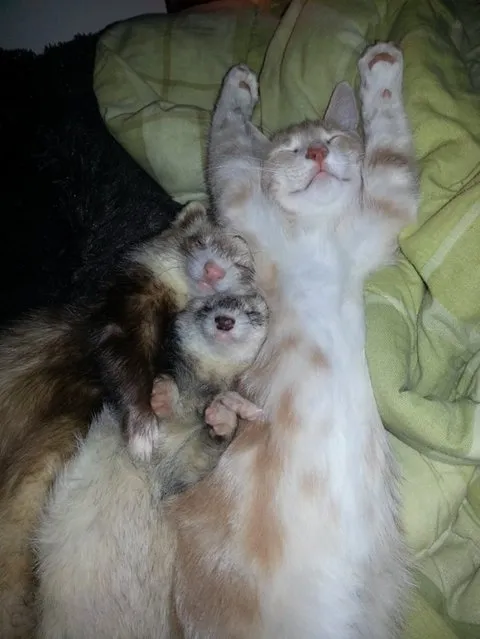
In June, Mallory Gaudet picked up a little ginger kitten on the street and took him home. Mallory worried that the baby will not be able to get along with her ​​two other pets – ferrets, and they will hurt him. But it turned out that the new member of the family, named Ned, could get used to this neighborhood very fast. Moreover – these three animals became really best friends. Now kitten and ferrets play, eat and sleep all together. But the most touching thing is when Ned “washes” the ferrets. Interspecific and intergeneric animals’ friendship – is a rare phenomenon. But ginger kitten and two of his fellows break all the stereotypes.
Details
16 Apr 2014 15:24:00


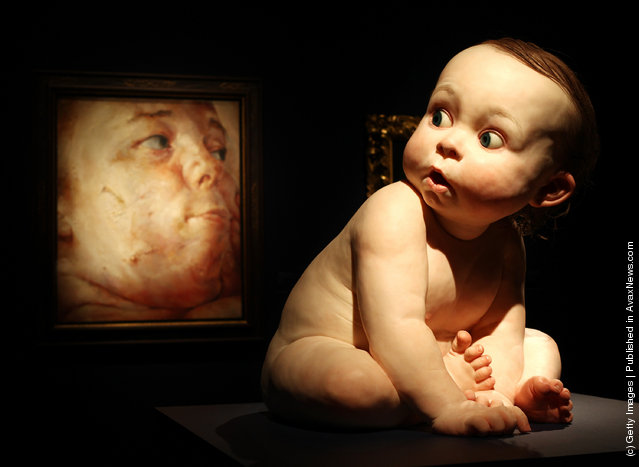
Ron Mueck's “Big Baby” sculpture appears to look round at Jenny Saville's painting “Interfacing” at the Masterpieces Exhibition at Christie's on June 13, 2011 in London, England. The painting and sculpture feature in the exhibition, open to the public from 13th–15th June 2011, which showcases some of the Ј250 million worth of art for sale over the next four weeks. Artists including Michelangelo, Gainsborough, Goya, Stubbs, Monet, Picasso and Renoir are represented. (Photo by Peter Macdiarmid/Getty Images)
Details
14 Jun 2011 09:42:00


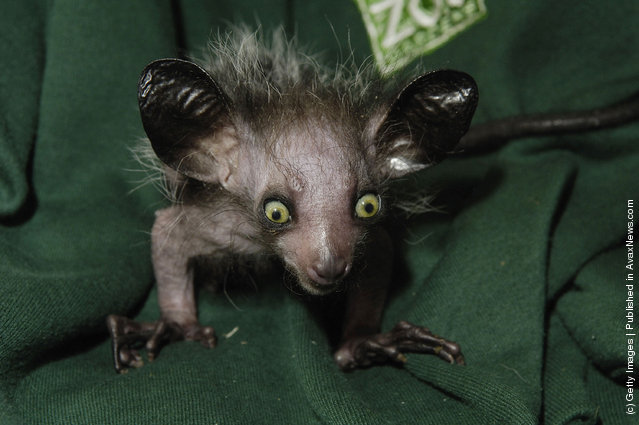
“The aye-aye (Daubentonia madagascariensis) is a lemur, a strepsirrhine primate native to Madagascar that combines rodent-like teeth and a special thin middle finger to fill the same ecological niche as a woodpecker. It is the world's largest nocturnal primate, and is characterized by its unusual method of finding food; it taps on trees to find grubs, then gnaws holes in the wood and inserts its narrow middle finger to pull the grubs out. The only other animal species known to find food in this way is the striped possum. From an ecological point of view the aye-aye fills the niche of a woodpecker as it is capable of penetrating wood to extract the invertebrates within”. – Wikipedia

Photo: In this handout image from Bristol Zoo is seen the first captive bred aye-aye in the UK named “Kintana” (meaning star in Malagasy) April 15, 2005 at Bristol Zoo Gardens, England. The zoo announced today only the second baby aye-aye to be hand-reared in the world (the first was in Jersey Zoo) and has now made his first public appearance since his birth on 11 February 2005. (Photo by Rob Cousins/Bristol Zoo via Getty Images)
Details
13 Apr 2011 13:33:00