Loading...
Done


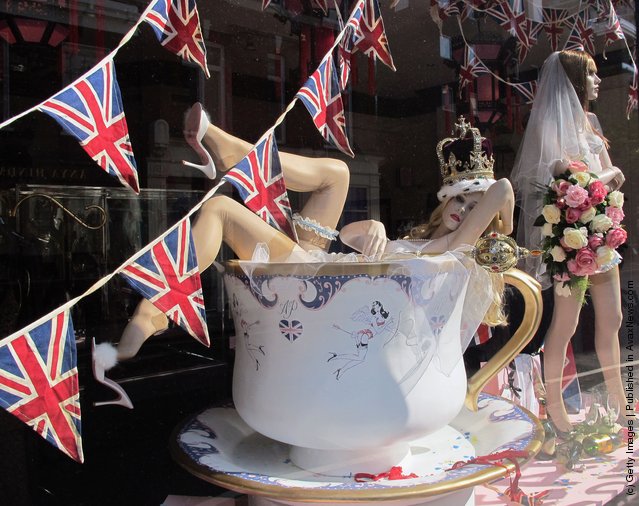
A general view of a royal wedding themed window display at Agent Provocateur in Pont Street, Chelsea on April 29, 2011 in London, England. The marriage of the second in line to the British throne is to be led by the Archbishop of Canterbury and will be attended by 1900 guests, including foreign Royal family members and heads of state. Thousands of well-wishers from around the world have also flocked to London to witness the spectacle and pageantry of the Royal Wedding. (Photo by Adrian Murrell/Getty Images)
Details
29 Apr 2011 09:08:00
Winners celebrate after the annual Lelo match in the village of Shukhuti, Georgia, May 1, 2016. (Photo by David Mdzinarishvili/Reuters)

Winners celebrate after the annual Lelo match in the village of Shukhuti, Georgia, May 1, 2016. The villagers of Zemo (upper) Shukhuti and Kvemo (lower) Shukhuti have played the game every Easter Sunday for generations, with each side trying to carry the 16-kilogram ball to their end of the neighbouring villages. (Photo by David Mdzinarishvili/Reuters)
Details
02 May 2016 11:01:00
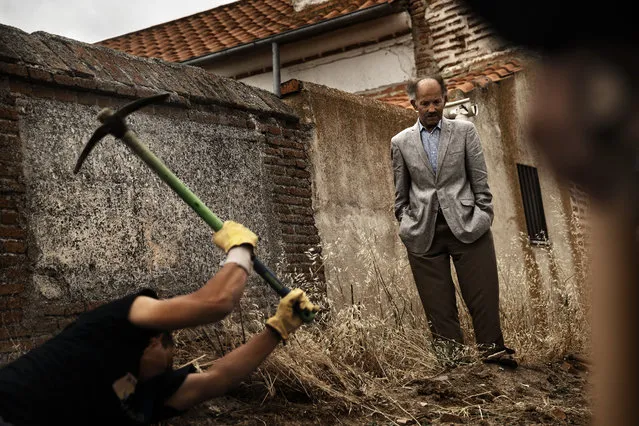
In this photo taken on July 19, 2014, a man looks at an excavation as an A.R.M.H., Association for the Recovery of Historical Memory, volunteer digs on the search for the body of Perfecto de Dios, in a hidden grave in Chaherrero, Spain. Across Spain, volunteer teams of archeologists, anthropologists and forensic scientists head out every year on expeditions to dig for suspected mass graves – a legacy of Spain's fascist past during the time of General Francisco Franco. (Photo by Daniel Ochoa de Olza/AP Photo)

In this photo taken on July 19, 2014, a man looks at an excavation as an A.R.M.H., Association for the Recovery of Historical Memory, volunteer digs on the search for the body of Perfecto de Dios, in a hidden grave in Chaherrero, Spain. Across Spain, volunteer teams of archeologists, anthropologists and forensic scientists head out every year on expeditions to dig for suspected mass graves – a legacy of Spain's fascist past during the time of General Francisco Franco. (Photo by Daniel Ochoa de Olza/AP Photo)
Details
26 Dec 2014 14:54:00
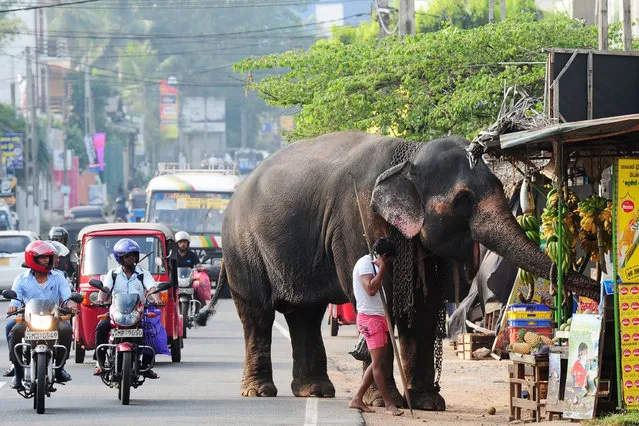
A Sri Lankan elephant, accompanied by his mahout, browse through a roadside fruit stall in Colombo on January 19, 2015. The Sri Lankan elephant is listed as endangered by the International Union for Conservation of Nature (IUCN) as the population has declined by at least 50 percent over the last three generations, with the species threatened by habitat loss, degradation and fragmentation. (Photo by Lakruwan Wanniarachchi/AFP Photo)

A Sri Lankan elephant, accompanied by his mahout, browse through a roadside fruit stall in Colombo on January 19, 2015. The Sri Lankan elephant is listed as endangered by the International Union for Conservation of Nature (IUCN) as the population has declined by at least 50 percent over the last three generations, with the species threatened by habitat loss, degradation and fragmentation. (Photo by Lakruwan Wanniarachchi/AFP Photo)
Details
23 Jan 2015 13:21:00
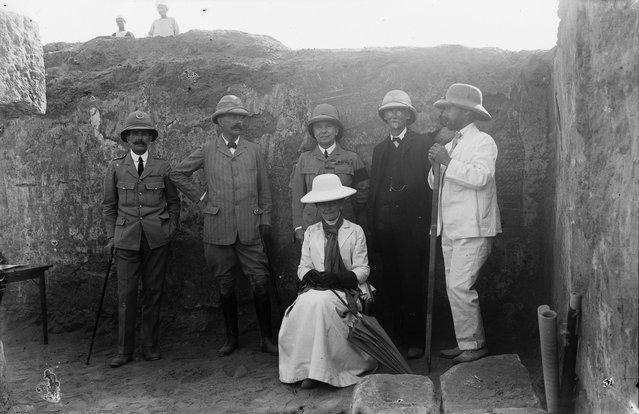
Remarkable discoveries were made, like the decapitated head of a bronze statue of Roman emperor Augustus, sacked from a raid on Roman garrisons further north in Egypt. Here: A group visiting the excavations at Meroë, including (from left) Midwinter Bey, director of Sudan Railways; Lord Kitchener; General Sir Francis Reginald Wingate, Sirdar of the Egyptian Army; Professor Archibald Sayce; John Garstang; and Lady Catherine Wingate, 1911. (Photo by Garstang Museum of Archaeology)

The city of Meroë laid undiscovered for two millennia before British archaeologist John Garstang excavated it in the early 20th century. Garstang took the radical decision to document his discoveries with photography – and immortalised an ancient world. “Meroë: Africa’s Forgotten Empire” is being shown until 14 September at Garstang Museum of Archaeology, Liverpool. Here: A group visiting the excavations at Meroë, including (from left) Midwinter Bey, director of Sudan Railways; Lord Kitchener; General Sir Francis Reginald Wingate, Sirdar of the Egyptian Army; Professor Archibald Sayce; John Garstang; and Lady Catherine Wingate, 1911. (Photo by Garstang Museum of Archaeology)
Details
15 Jun 2016 14:49:00
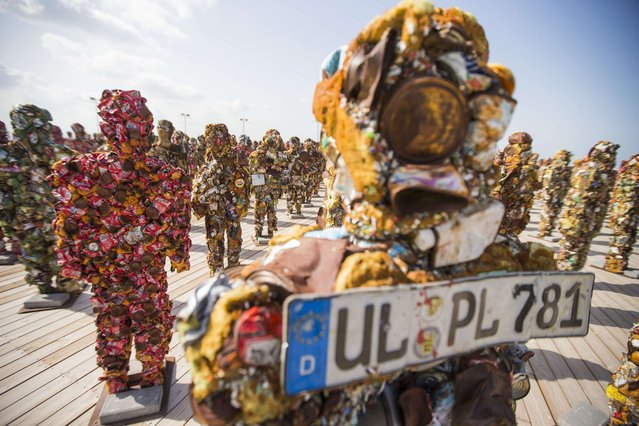
A general view shows sculptures made of waste material titled “Trash People” by German Artist HA Schult (unseen), on April 2, 2014 in Ariel Sharon Park, in the suburbs of Tel Aviv. Hundreds of human-size figures constructed from 20 tons of recycled material, including iron, glass, computer parts, cans and more, will dominate the sky line of Tel-Aviv city and be placed in the park. (Photo by Jack Guez/AFP Photo)

A general view shows sculptures made of waste material titled “Trash People” by German Artist HA Schult (unseen), on April 2, 2014 in Ariel Sharon Park, in the suburbs of Tel Aviv. Hundreds of human-size figures constructed from 20 tons of recycled material, including iron, glass, computer parts, cans and more, will dominate the sky line of Tel-Aviv city and be placed in the park. (Photo by Jack Guez/AFP Photo)
Details
03 Apr 2014 10:53:00
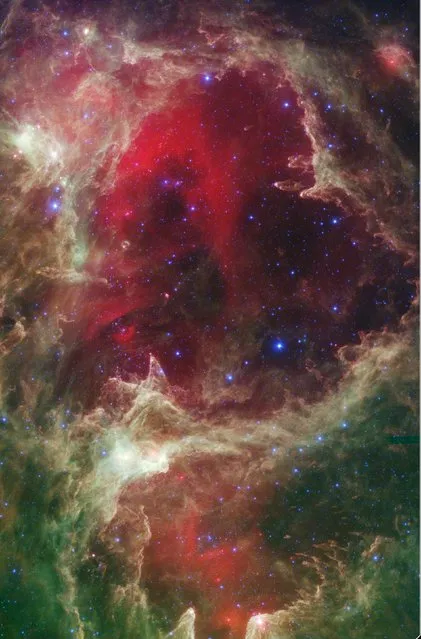
An infrared portrait from NASA's Spitzer Space Telescope which shows generations of stars is seen in this undated NASA handout image released February 14, 2013. In this wispy star-forming region, called W5, the oldest stars can be seen as blue dots in the centers of the two hollow cavities (other blue dots are background and foreground stars not associated with the region). Red shows heated dust that pervades the region's cavities, while green highlights dense clouds. (Photo by NASA/Reuters/JPL-Caltech/Harvard-Smithsonian/Handout)

An infrared portrait from NASA's Spitzer Space Telescope which shows generations of stars is seen in this undated NASA handout image released February 14, 2013. In this wispy star-forming region, called W5, the oldest stars can be seen as blue dots in the centers of the two hollow cavities (other blue dots are background and foreground stars not associated with the region). Red shows heated dust that pervades the region's cavities, while green highlights dense clouds. (Photo by NASA/Reuters/JPL-Caltech/Harvard-Smithsonian/Handout)
Details
03 Mar 2013 08:44:00
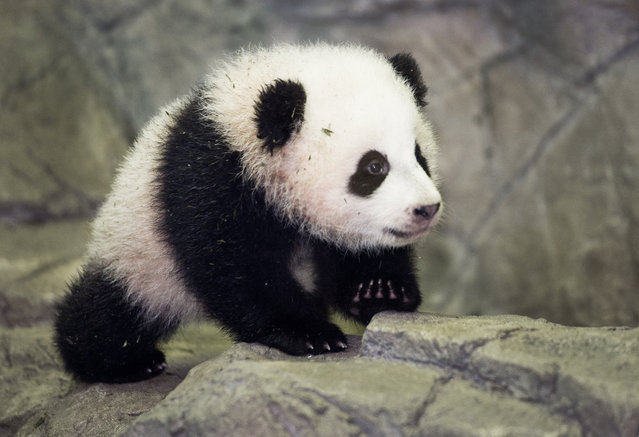
Bao Bao, the Giant Panda cub is seen by the media for the first time January 6, 2014 inside his glass enclosure at the Smithsonian's National Zoo in Washington, DC, a few days before going on display to the general public. Bao Bao was born at the Smithsonian's National Zoo August 2, 2013. (Photo by Paul J. Richards/AFP Photo)

Bao Bao, the Giant Panda cub is seen by the media for the first time January 6, 2014 inside his glass enclosure at the Smithsonian's National Zoo in Washington, DC, a few days before going on display to the general public. Bao Bao was born at the Smithsonian's National Zoo August 2, 2013. (Photo by Paul J. Richards/AFP Photo)
Details
07 Jan 2014 08:58:00