Loading...
Done
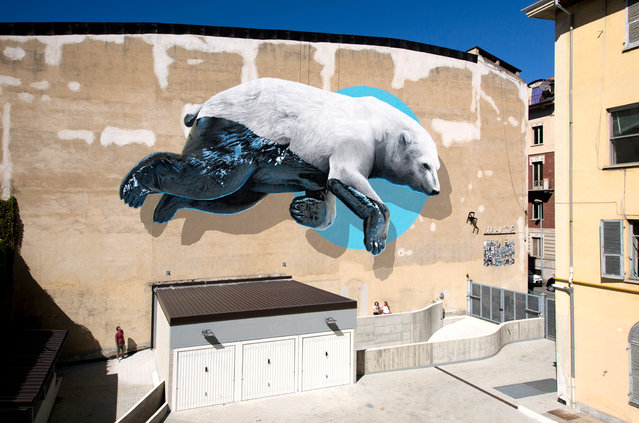
A polar bear whose bottom half is caked in oily black gunk. A whale wrapped in striped fabric: a pseudo straightjacket. These are the messes climate change leaves behind, the things we know are happening but often don’t have the opportunity to see with our own eyes. Swiss street art duo Christian Rebecchi and Pablo Togni, otherwise known as NeverCrew, met in art school when they were 15 and started making work together soon after. As a team, the artists adorn the world with eye-popping and gut-wrenching images depicting the consequences of humanity’s actions on earth. Here: “Black machine” mural painting and installation on the Colosseo theater in Turin, Italy, in September 2015. (Photo by NeverCrew/The Huffington Post)

A polar bear whose bottom half is caked in oily black gunk. A whale wrapped in striped fabric: a pseudo straightjacket. These are the messes climate change leaves behind, the things we know are happening but often don’t have the opportunity to see with our own eyes. Swiss street art duo Christian Rebecchi and Pablo Togni, otherwise known as NeverCrew, met in art school when they were 15 and started making work together soon after. As a team, the artists adorn the world with eye-popping and gut-wrenching images depicting the consequences of humanity’s actions on earth. (Photo by NeverCrew/The Huffington Post)
Details
13 Aug 2016 11:09:00
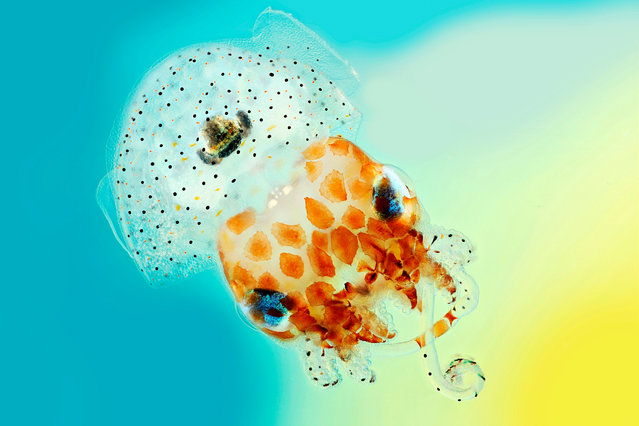
With its huge eyes, comical name and diminutive size, Mark R. Smith’s image of a baby Hawaiian bobtail squid can’t help but raise a smile. A curiously endearing creature, the cephalopod is just 1.5cm across, its mantle cavity bearing more than a passing resemblance to a rather natty shower cap. But it is also a beautiful example of symbiosis – nature’s version of “I’ll scratch your back if you scratch mine” – for on the underside of the squid is a light organ which houses bioluminescent bacteria. The squid offers the bacteria protection and food, while the bacteria emit a glow – a handy trait that the squid uses to offset its silhouette, helping it to evade predators in the depths below. Mark R. Smith’s entry combines several images of a Hawaiian bobtail squid with different focus lengths to create a final picture with greater depth of field than normal. (Photo by Mark R. Smith/Wellcome Images/Macroscopic Solutions)

With its huge eyes, comical name and diminutive size, Mark R. Smith’s image of a baby Hawaiian bobtail squid can’t help but raise a smile. A curiously endearing creature, the cephalopod is just 1.5cm across, its mantle cavity bearing more than a passing resemblance to a rather natty shower cap. But it is also a beautiful example of symbiosis – nature’s version of “I’ll scratch your back if you scratch mine” – for on the underside of the squid is a light organ which houses bioluminescent bacteria. The squid offers the bacteria protection and food, while the bacteria emit a glow – a handy trait that the squid uses to offset its silhouette, helping it to evade predators in the depths below. Mark R. Smith’s entry combines several images of a Hawaiian bobtail squid with different focus lengths to create a final picture with greater depth of field than normal. (Photo by Mark R. Smith/Wellcome Images/Macroscopic Solutions)
Details
08 Mar 2017 00:05:00
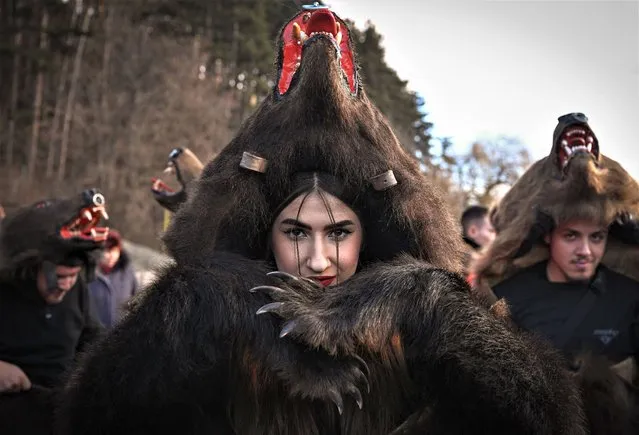
A reveller wearing a bearskin costume poses during the Bearskin Parade in Comanesti, Romania, on December 30, 2022. More than two hundred “bears” and dozens of musicians, surrounded by police and tourists, took part in the end-of-the-year parade. Young men and women dressed in real bearskin and traditional costumes paraded to chase away the evil spirits of the coming year. In all regions of Romania similar events exist but it is in this historical region of Moldova that they are the most developed. Comanesti has become the centre, attracting more and more troupes of dancers every year. (Photo by Daniel Mihailescu/AFP Photo)

A reveller wearing a bearskin costume poses during the Bearskin Parade in Comanesti, Romania, on December 30, 2022. More than two hundred “bears” and dozens of musicians, surrounded by police and tourists, took part in the end-of-the-year parade. Young men and women dressed in real bearskin and traditional costumes paraded to chase away the evil spirits of the coming year. In all regions of Romania similar events exist but it is in this historical region of Moldova that they are the most developed. Comanesti has become the centre, attracting more and more troupes of dancers every year. (Photo by Daniel Mihailescu/AFP Photo)
Details
07 Mar 2024 06:20:00
The Wolf Man

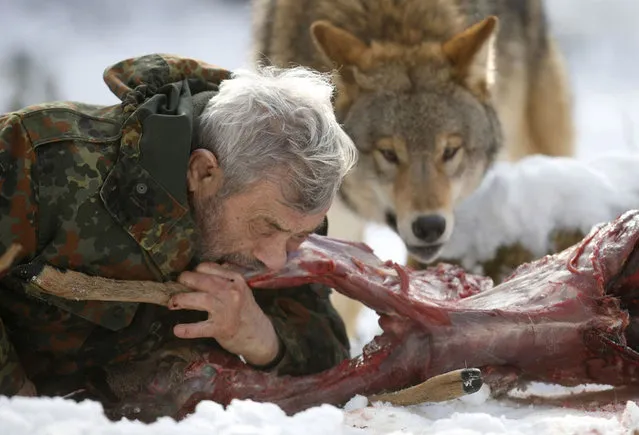
Wolfspark Werner Freund is a wolf sanctuary spread over 25 acres in western Germany. It is home to 29 wolves -- six distinct packs hailing from Europe, Siberia, Canada, the Arctic, and Mongolia. Researcher Werner Freund, 79, a former German paratrooper, established the sanctuary in 1972 and has raised more than 70 animals there over the last 40 years. He acquired the wolves as cubs from zoos or animal parks and has reared them mostly by hand. Werner has also taken to living closely with his wolves, behaving as an alpha male to earn their acceptance and respect. Reuters photographer Lisi Niesner recently spent some time with Freund and his wolves, capturing the interactions between these old friends.
Details
31 Jan 2013 15:50:00


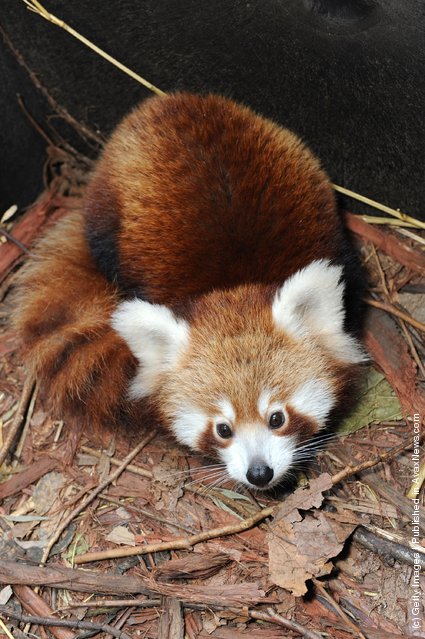
“The red panda (Ailurus fulgens, or shining-cat), is a small arboreal mammal native to the eastern Himalayas and southwestern China. It is the only species of the genus Ailurus. Slightly larger than a domestic cat, it has reddish-brown fur, a long, shaggy tail, and a waddling gait due to its shorter front legs. It feeds mainly on bamboo, but is omnivorous and may also eat eggs, birds, insects, and small mammals. It is a solitary animal, mainly active from dusk to dawn, and is largely sedentary during the day”. – Wikipedia

Photo: In this handout image provided by Taronga Zoo, Seba, a baby Red Panda, explores his new home at Taronga Zoo on April 7, 2011 in Sydney, Australia. The Red Panda cub was born at Christmas and is the 45th to be born at the zoo since 1977. (Photo by Peter Hardin/Taronga Zoo via Getty Images)
Details
07 Apr 2011 08:51:00
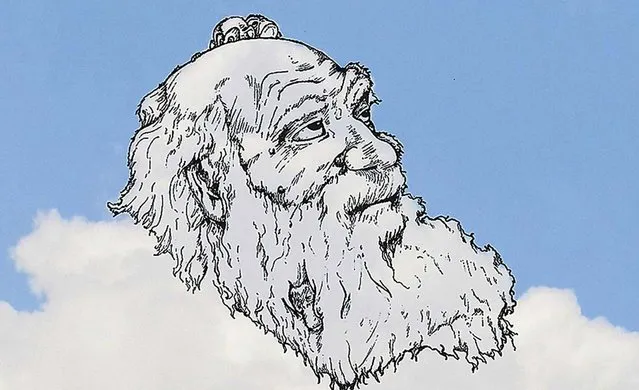
Illustrations Out Of Clouds By Martin Feijoo

Few things are more beautiful than puffy white clouds floating in the bright blue sky. Do you remember the time when you would lay on the soft green grass, look up at the sky, and try to recognize shapes in the clouds floating overhead? Wasn’t it wonderful, just lying there, letting the wind caress your skin, as you imagine that the clouds in the sky are actually mystical or not-so-mystical creatures? Dragons, ducks, teddy bears, dinosaurs, everything was up there. It was good old times. As adults we forget about simple pleasures of life. However, an Argentinian artist Martin Feijoo didn’t forget those times, and took them a step further. After imagining what a particular cloud looks like, he draws that particular shape over the picture of the cloud, allowing the entire world to see what goes on in his mind. (Photo by Martin Feijoo)
Details
02 Nov 2014 10:44:00
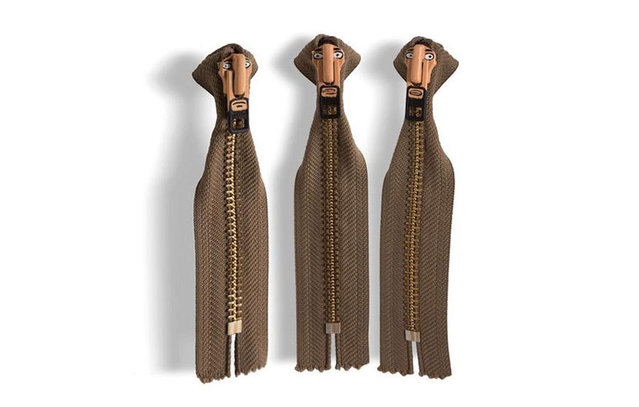
Everyday Objects Into Cute Characters By Gilbert Legrand Part 1

French artist Gilbert Legrand’s new series takes everyday objects like corkscrews, tape measures, and more and turns them into hilariously cute characters that almost make you forget their original purpose. Skillfully using each object’s natural shape, he crafts a character full of whimsy and personality. Each is painted to detail, with even the tiniest of characters bearing an expression which leaves no doubt as to their feelings about the situation. It truly takes a talented hand and imagination to turn paint brushes and zippers into humorous characters with surprisingly huge personalities.


See Also: Psrt 2 _ Part 3
Details
08 Jul 2014 10:29:00


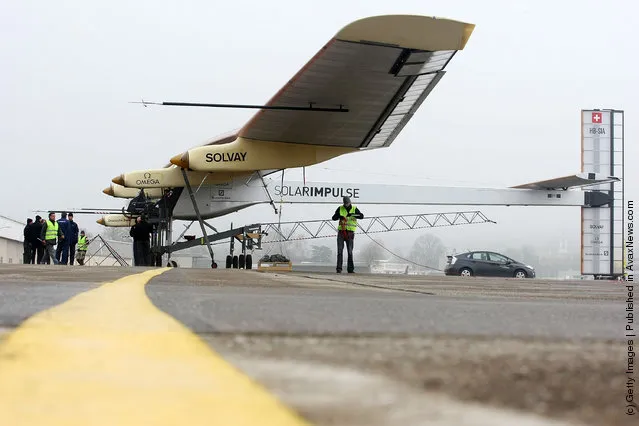
“Solar Impulse is a European long-range solar powered plane project being undertaken by Bertrand Piccard and André Borschberg. The project eventually hopes to succeed in the first circling of the earth with a piloted fixed-wing aircraft using only solar power. The first aircraft, bearing the Swiss aircraft registration code of HB-SIA, is a single-seater, capable of taking off under its own power, and intended to remain airborne up to 36 hours. This aircraft first flew an entire diurnal solar cycle, including nearly 9 hours of night flying, in a 26-hour flight on 7–8 July 2010”. – Wikipedia


Photo: Workers prepare the Solar Impulse airplane HB-SIA for a first runway test on November 19, 2009 in Dubendorf, Switzerland. Solar Impulse chairman Bertrand Piccard, psychatrist and aeronaut, who made the first non-stop round-the-world balloon flight, and CEO and former fighter pilot Andrй Borschberg plan a round-the-world flight, driven only by solar energy, for 2012. (Photo by Johannes Simon/Getty Images)
Details
16 May 2011 08:13:00