Loading...
Done
«Underwater». Laurie Simmons discovered this silicone s*x doll in a shop while on holiday in Japan and was immediately interested in the type of generic beauty their looks could add to her work. She went on to create the Love Doll series, in which she places silicone s*x dolls in positions that explore a woman’s interior life. (Photo by Laurie Simmons/Salon 94/The Guardian)

«Underwater». Laurie Simmons discovered this silicone sеx doll in a shop while on holiday in Japan and was immediately interested in the type of generic beauty their looks could add to her work. She went on to create the Love Doll series, in which she places silicone sеx dolls in positions that explore a woman’s interior life. (Photo by Laurie Simmons/Salon 94/The Guardian)
Details
28 Sep 2017 07:38:00
A supporter of the Houthis has a poster attached to his waist of Iranian Major-General Qassem Soleimani, head of the elite Quds Force, who was killed in an air strike at Baghdad airport, during a rally to denounce the U.S. killing, in Saada, Yemen January 6, 2020. The writing on the poster reads: “God is the Greatest, Death to America, Death to Israel, Curse on the Jews, Victory to Islam”. (Photo by Naif Rahma/Reuters)

A supporter of the Houthis has a poster attached to his waist of Iranian Major-General Qassem Soleimani, head of the elite Quds Force, who was killed in an air strike at Baghdad airport, during a rally to denounce the U.S. killing, in Saada, Yemen January 6, 2020. The writing on the poster reads: “God is the Greatest, Death to America, Death to Israel, Curse on the Jews, Victory to Islam”. (Photo by Naif Rahma/Reuters)
Details
08 Jan 2020 00:05:00
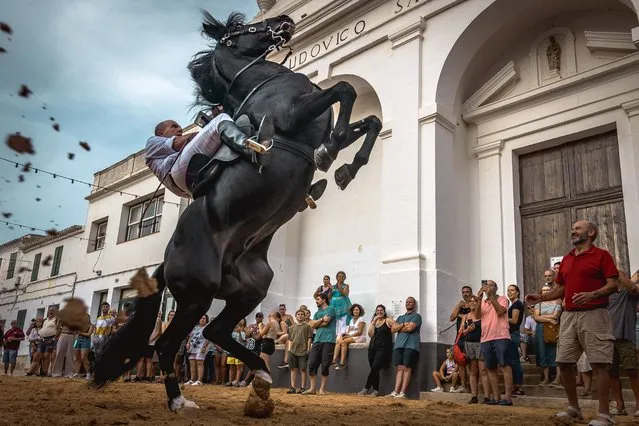
A “caixer” (horse rider) rears up on his horse during the traditional “Jaleo” at the Sant Lluiset Festival in Sant Lluis, Spain on September 3, 2022. (Photo by Matthias Oesterle/Rex Features/Shutterstock)

A “caixer” (horse rider) rears up on his horse during the traditional “Jaleo” at the Sant Lluiset Festival in Sant Lluis, Spain on September 3, 2022. (Photo by Matthias Oesterle/Rex Features/Shutterstock)
Details
03 Dec 2023 03:28:00
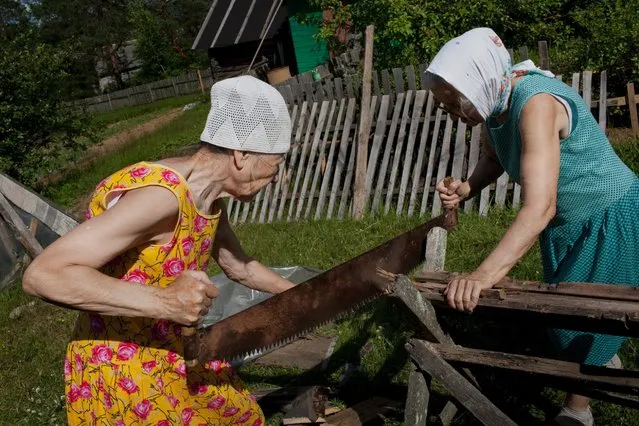
“Two-Handed Saw, 2014”. “Most of the neighbors have switched to power tools to run their households, the buzz of chain saws and weed-whackers overpowering the quieter sounds of country life, but my aunts hold on to the two-handed saw that's decades old, the sickle and scythe that need to be sharpened and polished after each use, the old axe that's becoming heavier each year. Each of these objects is familiar, holding memories of their brother, who succumbed to cancer a few years ago, of days before my grandfather lost his vision in the 50's, of busier days and longer futures”, Sablin told. (Photo by Nadia Sablin)

In northwest Russia, in a small village called Alekhovshchina, Nadia Sablin's aunts spend the warmer months together in the family home and live as the family has always lived, chopping wood to heat the house and making their own clothes. Sablin's book of photographs, “Aunties: The Seven Summers of Alevtina and Ludmila”, is published by Duke University Press. Here: “Two-Handed Saw, 2014”. (Photo by Nadia Sablin)
Details
25 Feb 2016 12:12:00
“Catch of the Decade”. Can you guess what happened next? Photo location: Katmai National Park, Alaska, USA. (Photo and caption by Aaron Baggenstos/National Geographic Photo Contest)

“Catch of the Decade”. Can you guess what happened next? Photo location: Katmai National Park, Alaska, USA. (Photo and caption by Aaron Baggenstos/National Geographic Photo Contest)
Details
30 Sep 2014 08:47:00
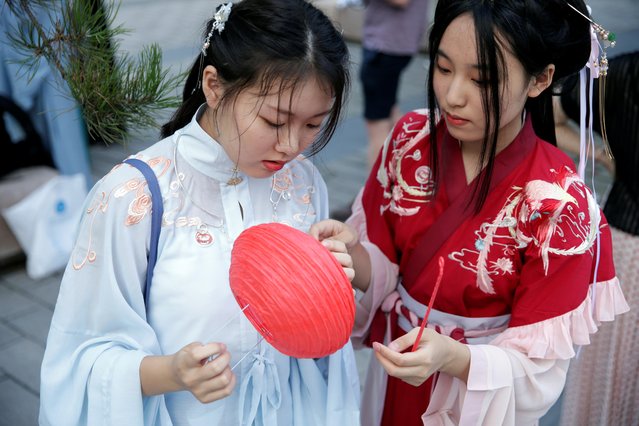
Girls dressed in “Hanfu”, or Han clothing, prepare for an event to mark the traditional Qixi festival, the Chinese equivalent of Valentine's Day, at a park in Beijing, China, August 7, 2019. Chinese for “Han clothing”, “Hanfu” is based on the idea of donning costumes worn in bygone eras by China's dominant Han ethnicity. Some of the most popular styles are from the Ming, Song and Tang dynasties. Hanfu enthusiasts doubled to two million in 2018 from a year earlier, according to a survey by Hanfu Zixun, a popular community account on the Wechat social media platform. (Photo by Jason Lee/Reuters)

Girls dressed in “Hanfu”, or Han clothing, prepare for an event to mark the traditional Qixi festival, the Chinese equivalent of Valentine's Day, at a park in Beijing, China, August 7, 2019. Chinese for “Han clothing”, “Hanfu” is based on the idea of donning costumes worn in bygone eras by China's dominant Han ethnicity. Some of the most popular styles are from the Ming, Song and Tang dynasties. Hanfu enthusiasts doubled to two million in 2018 from a year earlier, according to a survey by Hanfu Zixun, a popular community account on the Wechat social media platform. (Photo by Jason Lee/Reuters)
Details
23 Sep 2019 00:05:00
This area of the hospital was last used as a day care center in the early 2000s. (Photo by Will Ellis/Caters News)

A spooky sight to behold! This is what a psychiatric hospital that has been abandoned for years looks like. Complete with bowling alley and a theater, the hospital shows just how much nature has weathered it over time as paint peels from the walls and the mattress gather dust. Here: This area of the hospital was last used as a day care center in the early 2000s. (Photo by Will Ellis/Caters News)
Details
03 Dec 2015 08:01:00
Kyaiktiyo, Burma, 1978. The Golden Rock at Shwe Pyi Daw (the Golden Country), the Buddhist holy place. Hiroji Kubota writes: “I was desperate to keep a distance from America for a while; luckily, I found Burma and its gentle and compassionate people. In the spring of 1978, on the top of the hill where I took this photo, I had two Leica bodies: the one with Tri-X and the other with Kodachrome 64. Soon after, I realised that the colour one looked very colourful and was more powerful. That was my decisive moment, to become a colour photographer”. (Photo by Hiroji Kubota/Magnum Photos)

Kyaiktiyo, Burma, 1978. The Golden Rock at Shwe Pyi Daw (the Golden Country), the Buddhist holy place. Hiroji Kubota writes: “I was desperate to keep a distance from America for a while; luckily, I found Burma and its gentle and compassionate people. In the spring of 1978, on the top of the hill where I took this photo, I had two Leica bodies: the one with Tri-X and the other with Kodachrome 64. Soon after, I realised that the colour one looked very colourful and was more powerful. That was my decisive moment, to become a colour photographer”. (Photo by Hiroji Kubota/Magnum Photos)
Details
10 Jun 2016 13:30:00