Loading...
Done
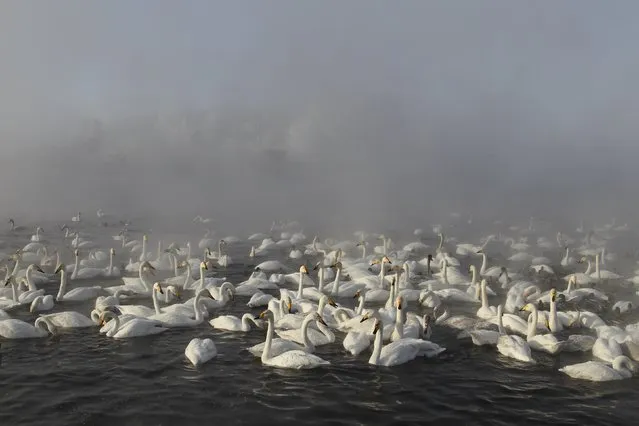
Swans swim over a lake, with the air temperature at about minus 35 degrees Celsius (minus 31 degrees Fahrenheit) as steam ascends above the water during sunset near the village of Urozhainy, Sovetsky district of Altai region, January 26, 2015. (Photo by Andrei Kasprishin/Reuters)

Swans swim over a lake, with the air temperature at about minus 35 degrees Celsius (minus 31 degrees Fahrenheit) as steam ascends above the water during sunset near the village of Urozhainy, Sovetsky district of Altai region, January 26, 2015. About 600 swans annually migrate to the lake, which is heated by warm springs, where they spend their winter being fed by yagers, which helps them to survive the severe cold. (Photo by Andrei Kasprishin/Reuters)
Details
28 Jan 2015 11:40:00
“The Sunsetter”. An EF-4 tornado rips through the open space of farmland near Rozel, Kansas. This tornado moves slowly but powerful towards the setting sun an gets its beautiful color right before sunset. Storm Chasers are spotting on the left side. Photo location: Rozel, Kansas. (Photo and caption by Dennis Oswald/National Geographic Photo Contest)

“The Sunsetter”. An EF-4 tornado rips through the open space of farmland near Rozel, Kansas. This tornado moves slowly but powerful towards the setting sun an gets its beautiful color right before sunset. Storm Chasers are spotting on the left side. Photo location: Rozel, Kansas. (Photo and caption by Dennis Oswald/National Geographic Photo Contest)

ATTENTION! All pictures are presented in high resolution. To see Hi-Res images – just TWICE click on any picture. In other words, click small picture – opens the BIG picture. Click BIG picture – opens VERY BIG picture.
Details
01 Dec 2013 11:03:00
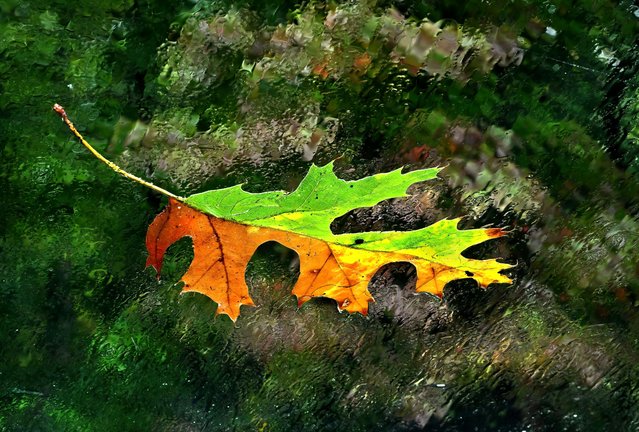
Today is what is known as the equilux and it happens when day and night are equal and occurs a few days before the spring equinox, and a few days after the autumn equinox. What appears to be a floating leaf is actually a stray sticking to a wet car windshield in a park in Scaggsville, Maryland on September 25, 2024. Today sunrise was at 7:02am and  sunset took place at 7:02pm. The green and orange colored leaf (about half for each color) seems to represent the transition from Summer to Fall. (Photo by Michael S. Williamson/The Washington Post)

Today is what is known as the equilux and it happens when day and night are equal and occurs a few days before the spring equinox, and a few days after the autumn equinox. What appears to be a floating leaf is actually a stray sticking to a wet car windshield in a park in Scaggsville, Maryland on September 25, 2024. Today sunrise was at 7:02am and sunset took place at 7:02pm. The green and orange colored leaf (about half for each color) seems to represent the transition from Summer to Fall. (Photo by Michael S. Williamson/The Washington Post)
Details
03 Oct 2024 04:12:00
Paintings By John Al Hogue

Meeting of Hawaii artist, John Al Hogue. Known as the "Modern Master of Light", he is one of the best selling nature artists in Hawaii, Florida, and Japan. Al uses light and detailed brush strokes to allow you, the viewer, to experience the feeling of stepping into his paintings. His artwork features seascapes, cityscapes, moonscapes, sunsets, wildlife and seal life subjects.
Details
07 Jun 2014 11:04:00
Highly commended birds : Crested guan by Tim Hunt (UK). ‘This photo shows a crested guan in the cloud forests of Costa Rica as it pauses while foraging on a lone branch. Due to the clouds that are so typical for this habitat, I could often only photograph the bird’s silhouette against a grey sky. (Photo by Tim Hunt/GDT European Wildlife Photographer of the Year 2015)

Highly commended birds : Crested guan by Tim Hunt (UK). ‘This photo shows a crested guan in the cloud forests of Costa Rica as it pauses while foraging on a lone branch. Due to the clouds that are so typical for this habitat, I could often only photograph the bird’s silhouette against a grey sky. But then, for a short moment only, the sun broke through the clouds, and I overexposed the image by over two stops in order to blow out the background and allow this beautifully marked bird to stand out’. (Photo by Tim Hunt/GDT European Wildlife Photographer of the Year 2015)
Details
24 Nov 2015 08:01:00
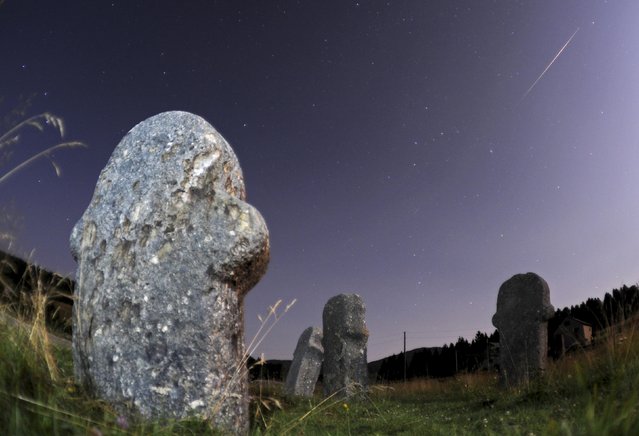
A meteor streaks over the sky during the Perseid meteor shower at the Maculje archaeological site near Novi Travnik August 12, 2014. According to NASA, the annual Perseid meteor shower reaches its peak on August 12 and 13 in Europe. The fireballs from the meteorites are fast and plentiful, although a nearly full moon (Supermoon) makes it difficult to view them this year, the agency adds. (Photo by Dado Ruvic/Reuters)

A meteor streaks over the sky during the Perseid meteor shower at the Maculje archaeological site near Novi Travnik August 12, 2014. According to NASA, the annual Perseid meteor shower reaches its peak on August 12 and 13 in Europe. The fireballs from the meteorites are fast and plentiful, although a nearly full moon (Supermoon) makes it difficult to view them this year, the agency adds. (Photo by Dado Ruvic/Reuters)
Details
14 Aug 2014 10:45:00
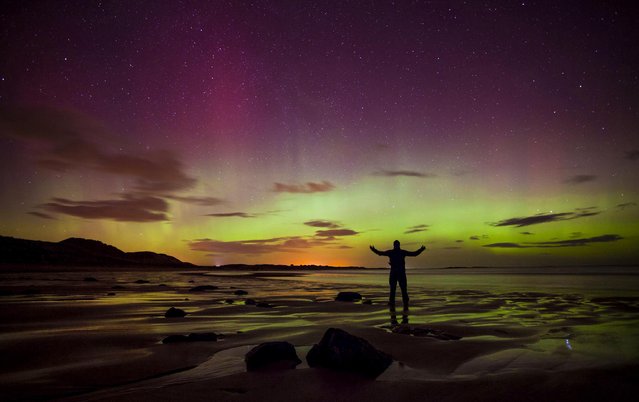
A man poses standing on a rock looking at the aurora borealis, or northern lights, illuminating the night sky at Embleton Bay in Northumberland, England, on February 27, 2014. The northern lights is a fantastical natural light display with fast moving light effects caused by particles charged by the sun colliding with particles in Earth's upper atmosphere. (Photo by Tom White/PA Wire)

A man poses standing on a rock looking at the aurora borealis, or northern lights, illuminating the night sky at Embleton Bay in Northumberland, England, on February 27, 2014. The northern lights is a fantastical natural light display with fast moving light effects caused by particles charged by the sun colliding with particles in Earth's upper atmosphere. (Photo by Tom White/PA Wire)
Details
02 Mar 2014 10:12:00
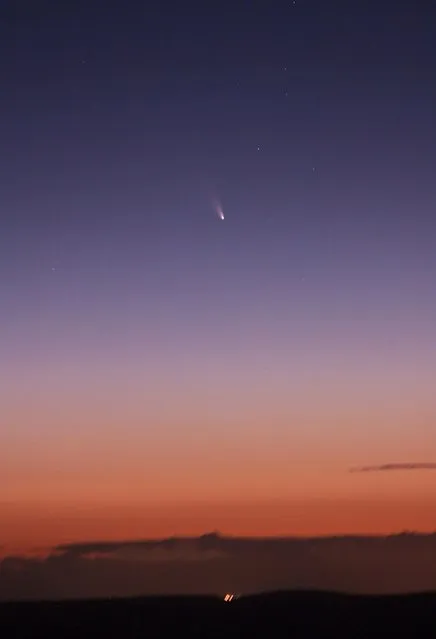
This image provided by NASA shoaws the comet PANSTARRS as seen from Mount Dale, Western Australia on March 5, 2013. According to NASA on March 10, it will make its closest approach to the sun about 28 million miles (45 million kilometers) away. As it continues its nightly trek across the sky, the comet may get lost in the sun's glare but should return and be visible to the naked eye by March 12. (Photo by AP Photo/NASA)

It’s time to start watching for Comet PANSTARRS, one of two comets to get excited about in 2013. Photo: This image provided by NASA shoaws the comet PANSTARRS as seen from Mount Dale, Western Australia on March 5, 2013. According to NASA on March 10, it will make its closest approach to the sun about 28 million miles (45 million kilometers) away. As it continues its nightly trek across the sky, the comet may get lost in the sun's glare but should return and be visible to the naked eye by March 12. (Photo by AP Photo/NASA)
Details
13 Mar 2013 08:03:00