Loading...
Done
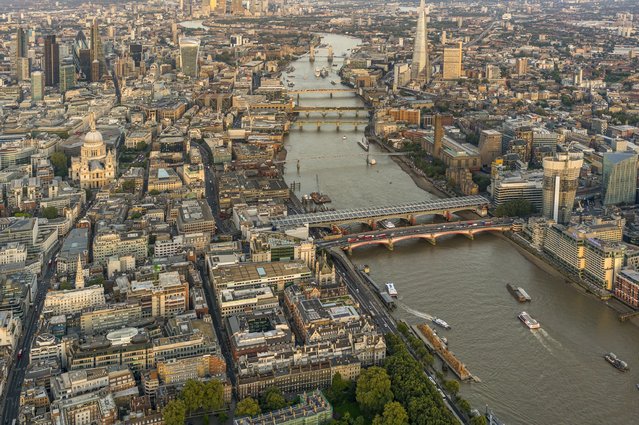
Jeffrey Milstein captured these stunning images through the door of a helicopter hovering over central London. (Photo by Jeffrey Milstein/Rex Features/Shutterstock)

High-flying photographer Jeffrey Milstein, renowned for his aerial photos of US cities, snaps landmarks through the open door of a helicopter. This month he hired a chopper in London and amazingly he had just an hour to cover all the buildings he wanted to capture including Buckingham Palace, the London Eye, the glass roof of the British Museum and the Gherkin and Walkie Talkie towers in the City. Here: Jeffrey Milstein captured these stunning images through the door of a helicopter hovering over central London. (Photo by Jeffrey Milstein/Rex Features/Shutterstock)
Details
29 Sep 2016 09:22:00
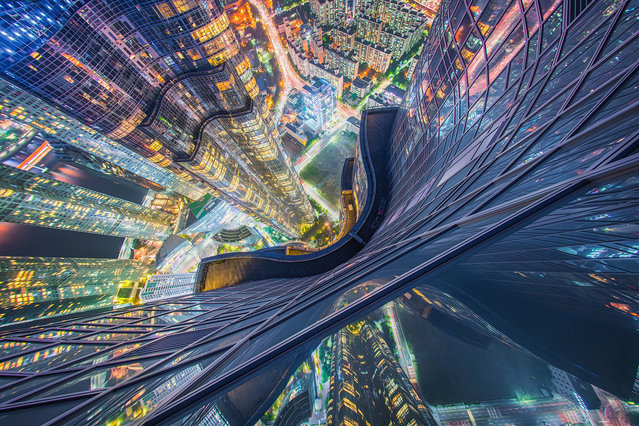
Scared of Heights. “Taken from the highest residential building in Asia: the Zenith in Busan. This was taken with official permission (which took me months to get) and safety measures were taken. I had to hang myself over the edge to get this shot. Not for the faint of heart! But when you’re at a height like this, the world below you just seems different. It takes away the fear one would normally have, and gives a sense of peace instead”. (Photo by Albert Dros/NatGeo Cities Travel Photographer of the Year 2017)

Scared of Heights. “Taken from the highest residential building in Asia: the Zenith in Busan. This was taken with official permission (which took me months to get) and safety measures were taken. I had to hang myself over the edge to get this shot. Not for the faint of heart! But when you’re at a height like this, the world below you just seems different. It takes away the fear one would normally have, and gives a sense of peace instead”. (Photo by Albert Dros/NatGeo Cities Travel Photographer of the Year 2017)
Details
03 Jul 2017 08:55:00
Felix Guirola, 52, rides a homemade bike with an advertising banner in Havana, Cuba, July 20, 2016. (Photo by Alexandre Meneghini/Reuters)

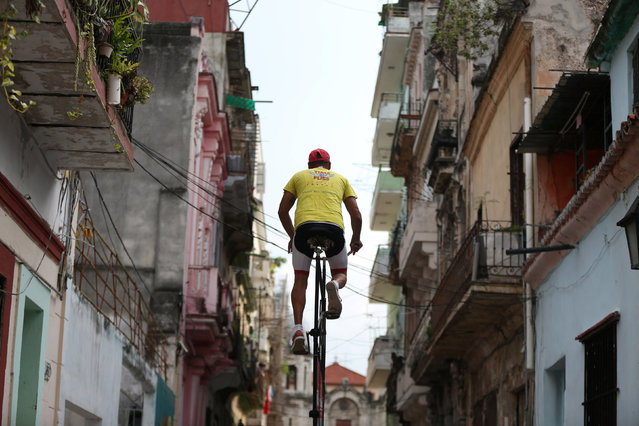
Felix Guirola, 52, rides a homemade bike with an advertising banner in Havana, Cuba, July 20, 2016. The handyman, who loves heights, provides advertising space for companies on homemade bikes that tower up to 7.5 meters (24.61 ft). He rides them around Havana in an ingenious way of getting around strict marketing regulations in the Communist-ruled island. (Photo by Alexandre Meneghini/Reuters)
Details
10 Jan 2017 13:46:00
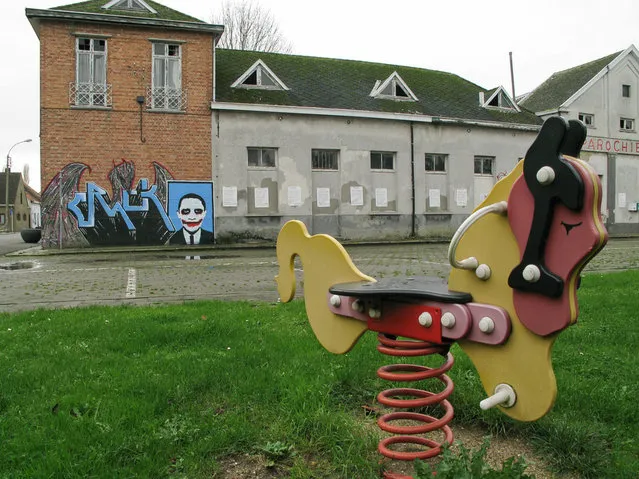
Abandon Village: Doel, Belgium

Doel is a 700 year old village on the river Scheldt in Belgium. Near to the local nuclear power plant, with its two giant cooling towers, it became the target for demolition not once but twice in order to make way for the ever expanding harbor. The successful protest groups of the seventies could not compete in the 90's and as residents began to leave, the government refused to rent out the properties again and instead let them fall into disrepair. On the 23rd of March 2007, the government decided that the village would be demolished by 2009 and in June 2008, residents received a letter informing them that they were to vacate their homes by the 1st of September 2009.
Details
20 Mar 2013 11:33:00
Washington National Cathedral Inspected For Earthquake Damage

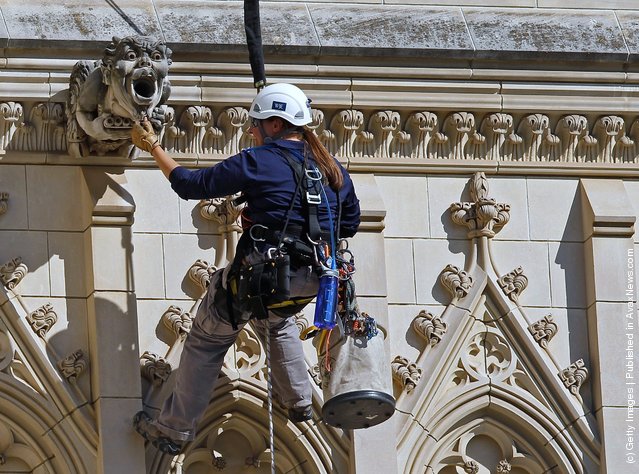
Katie Francis, a member of the Difficult Access Team from Wiss, Janney, Elstner Associates, inspects a gargoyle while rapelling down one of the north tower on the west front of the National Cathedral while looking for damage from August's magnitude 5.8 earthquake and high winds from Hurricane Irene October 17, 2011 in Washington, DC. DAT members used cameras, cell phones and iPad computers to record places on the cathedral's west front where damage was apparent. (Photo by Chip Somodevilla/Getty Images)
Details
18 Oct 2011 08:38:00
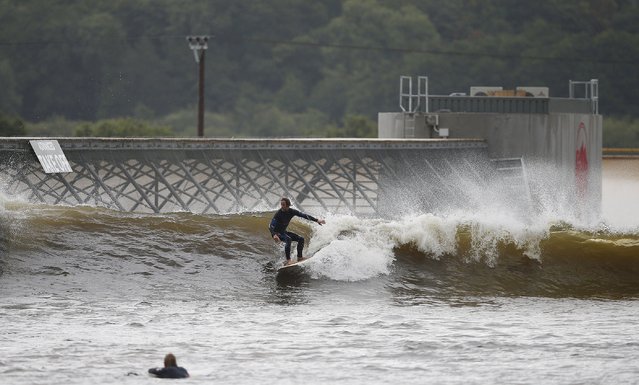
Surfers surf at Surf Snowdonia in Conwy, North Wales, September 3, 2015. (Photo by Andrew Yates/Reuters)

Surfers surf at Surf Snowdonia in Conwy, North Wales, September 3, 2015. The surf park, which cost $22.8 million, opened on August 1 and is the world's first commercial artificial surfing lake, according to the company.The pool is 300 metres (980 ft) long and 110 metres (360 ft) wide, containing a total of six million gallons of water. A bi-directional snowplough-shaped wave-generation mechanism, towed on a cable between the two central towers, moves up and down the pool on a three-rail track, generating the waves. (Photo by Andrew Yates/Reuters)
Details
04 Sep 2015 12:26:00
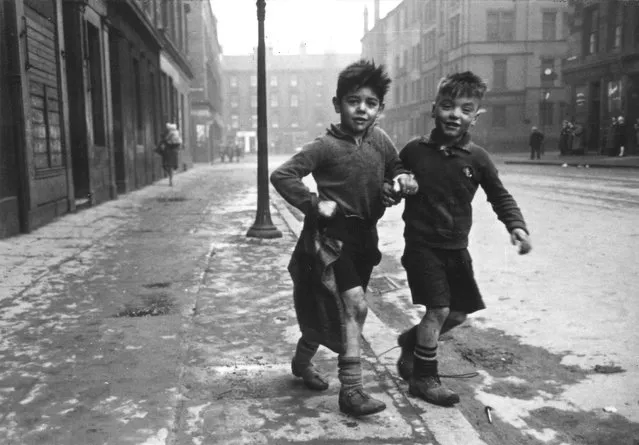
Two boys in the Gorbals area of Glasgow, UK on January 31, 1948. The Gorbals tenements were built quickly and cheaply in the 1840s, providing housing for Glasgow's burgeoning population of industrial workers. Conditions were appalling; overcrowding was standard and sewage and water facilities inadequate. The tenements housed about 40,000 people with up to eight family members sharing a single room, 30 residents sharing a toilet and 40 sharing a tap. By the time this photograph was taken 850 tenements had been demolished since 1920. Redevelopment of the area began in the late 1950s and the tenements were replaced with a modern tower block complex in the sixties. (Photo by Bert Hardy/Getty Images)

Two boys in the Gorbals area of Glasgow, UK on January 31, 1948. The Gorbals tenements were built quickly and cheaply in the 1840s, providing housing for Glasgow's burgeoning population of industrial workers. Conditions were appalling; overcrowding was standard and sewage and water facilities inadequate. The tenements housed about 40,000 people with up to eight family members sharing a single room, 30 residents sharing a toilet and 40 sharing a tap. By the time this photograph was taken 850 tenements had been demolished since 1920. Redevelopment of the area began in the late 1950s and the tenements were replaced with a modern tower block complex in the sixties. (Photo by Bert Hardy/Getty Images)
Details
09 Mar 2017 00:03:00
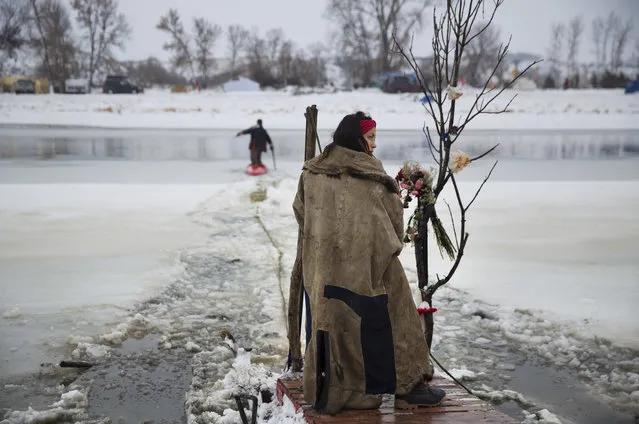
In this Thursday, December 1, 2016 photo, Cat Bigney, part of the Oglala Native American tribe, waits on the shore of the Cannonball river for travelers to arrive by canoe at the Oceti Sakowin camp where people have gathered to protest the Dakota Access oil pipeline in Cannon Ball, N.D. So far, those at the camp have shrugged off the heavy snow, icy winds and frigid temperatures. But if they defy next week's government deadline to abandon the camp, demonstrators know the real deep freeze lies ahead. Life-threatening wind chills and towering snow drifts could mean the greatest challenge is simple survival. (Photo by David Goldman/AP Photo)

In this Thursday, December 1, 2016 photo, Cat Bigney, part of the Oglala Native American tribe, waits on the shore of the Cannonball river for travelers to arrive by canoe at the Oceti Sakowin camp where people have gathered to protest the Dakota Access oil pipeline in Cannon Ball, N.D. So far, those at the camp have shrugged off the heavy snow, icy winds and frigid temperatures. But if they defy next week's government deadline to abandon the camp, demonstrators know the real deep freeze lies ahead. Life-threatening wind chills and towering snow drifts could mean the greatest challenge is simple survival. (Photo by David Goldman/AP Photo)
Details
06 Dec 2016 10:22:00