Loading...
Done
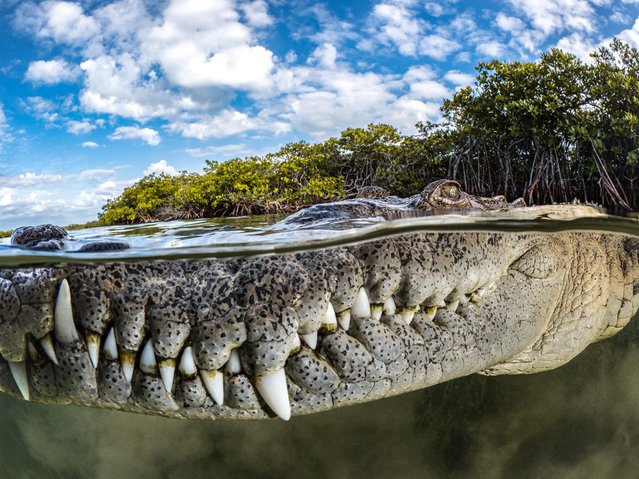
Guardian of the Mangroves – Overall Winner. Tanya Houppermans, Cuba. A curious American crocodile (Crocodylus acutus) swims right up to Tanya, at Gardens of the Queen (Jardines De La Reina), an archipelago off the coast of Cuba. It has been strictly protected since 1996, and is one of the most untouched marine ecosystems in the world. ‍ “The healthy population of American crocodiles is down to the pristine condition of the mangroves and I wanted to capture close ups of this gentle giant in its natural habitat. I hope this image can illustrate that protecting areas like this is so critical”. (Photo by Tanya Griffin Houppermans/Mangrove Photographer of the Year)

Guardian of the Mangroves – Overall Winner. Tanya Houppermans, Cuba. A curious American crocodile (Crocodylus acutus) swims right up to Tanya, at Gardens of the Queen (Jardines De La Reina), an archipelago off the coast of Cuba. It has been strictly protected since 1996, and is one of the most untouched marine ecosystems in the world. ‍ “The healthy population of American crocodiles is down to the pristine condition of the mangroves and I wanted to capture close ups of this gentle giant in its natural habitat. I hope this image can illustrate that protecting areas like this is so critical”. (Photo by Tanya Griffin Houppermans/Mangrove Photographer of the Year)
Details
05 Nov 2022 04:24:00
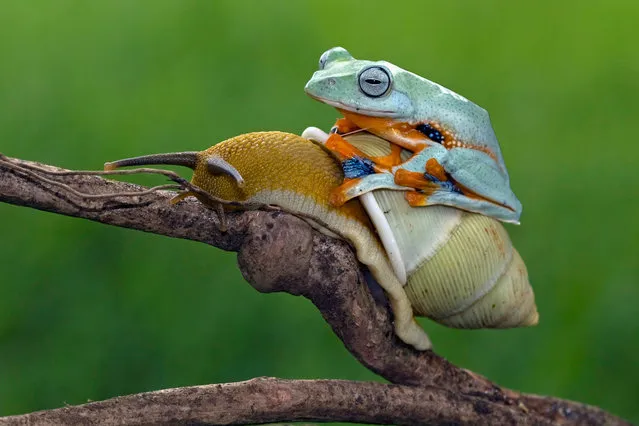
Going nowhere in a hurry, this friendly Javan Tree frog can be seen casually hopping aboard the slow-paced snail who like a lonely highway trucker is only too happy to have the company.  These cute critters chew the fat until froggy reaches his destination and alights at the top of the branch. (Photo by Kurit Afsheen/Media Drum World)

Going nowhere in a hurry, this friendly Javan Tree frog can be seen casually hopping aboard the slow-paced snail who like a lonely highway trucker is only too happy to have the company. These cute critters chew the fat until froggy reaches his destination and alights at the top of the branch. Creative Designer and amateur photographer Kurit Afsheen (34) was able to capture this special sequence while out in his back garden in Ciledug, Indonesia. (Photo by Kurit Afsheen/Media Drum World)
Details
19 Jul 2015 09:17:00


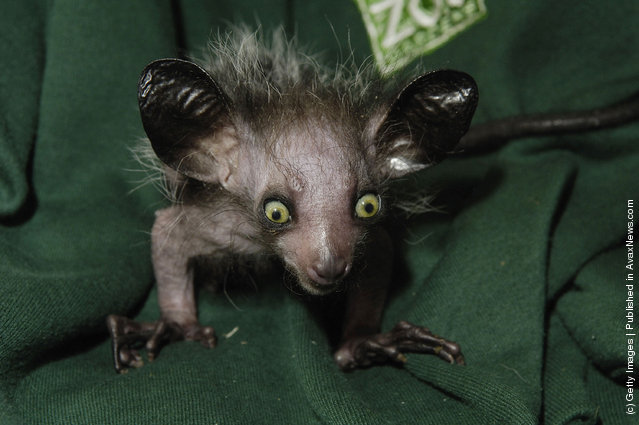
“The aye-aye (Daubentonia madagascariensis) is a lemur, a strepsirrhine primate native to Madagascar that combines rodent-like teeth and a special thin middle finger to fill the same ecological niche as a woodpecker. It is the world's largest nocturnal primate, and is characterized by its unusual method of finding food; it taps on trees to find grubs, then gnaws holes in the wood and inserts its narrow middle finger to pull the grubs out. The only other animal species known to find food in this way is the striped possum. From an ecological point of view the aye-aye fills the niche of a woodpecker as it is capable of penetrating wood to extract the invertebrates within”. – Wikipedia

Photo: In this handout image from Bristol Zoo is seen the first captive bred aye-aye in the UK named “Kintana” (meaning star in Malagasy) April 15, 2005 at Bristol Zoo Gardens, England. The zoo announced today only the second baby aye-aye to be hand-reared in the world (the first was in Jersey Zoo) and has now made his first public appearance since his birth on 11 February 2005. (Photo by Rob Cousins/Bristol Zoo via Getty Images)
Details
13 Apr 2011 13:33:00
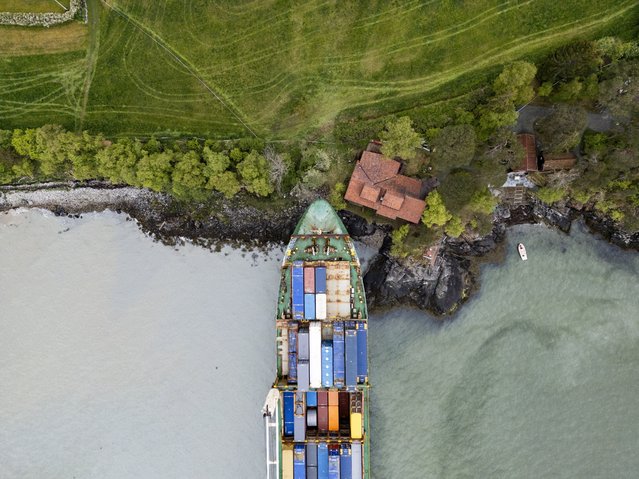
The container ship NCL Salten ran aground at Byneset, outside Trondheim, Norway. A man in Norway woke up to find a massive container ship in his front garden. The 135-metre (443-foot) vessel missed Johan Helberg's house by a few metres at around 5am local time on Thursday, May 22, 2025 in Byneset, near Trondheim. Mr. Helberg was only made aware of the incident after his panicked neighbour, who had seen the ship heading straight for shore, repeatedly rang his doorbell and eventually called him on the phone. (Photo by South West News Service)

The container ship NCL Salten ran aground at Byneset, outside Trondheim, Norway. A man in Norway woke up to find a massive container ship in his front garden. The 135-metre (443-foot) vessel missed Johan Helberg's house by a few metres at around 5am local time on Thursday, May 22, 2025 in Byneset, near Trondheim. Mr. Helberg was only made aware of the incident after his panicked neighbour, who had seen the ship heading straight for shore, repeatedly rang his doorbell and eventually called him on the phone. (Photo by South West News Service)
Details
07 Jul 2025 03:32:00
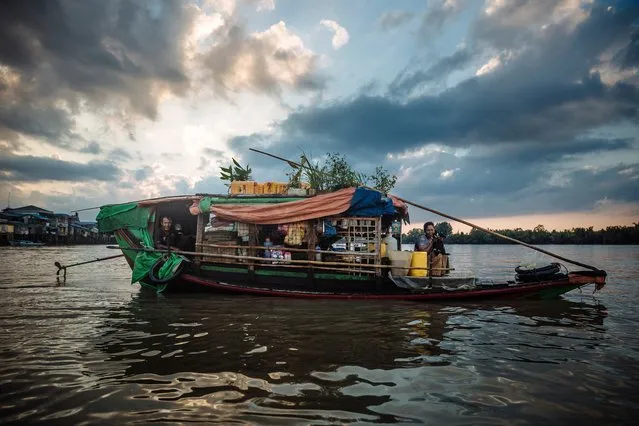
Tin and Naing win live on a small boat which they sail throughout the Delta region in Myanmar. The former gardeners once had a home on land but it was destroyed when a powerful cyclone ravaged the area in 2008. Since then, the couple have not been able to afford to rebuild their home, so they live on the boat from which they sell fish paste to make a living. (Photo by Muse Mohammed/IOM)

The ferocity of crises worldwide is forcing a record number of people to flee their homes, seeking some form of safety within their own country or across international borders. There are 65.3 million displaced people worldwide, including 21.3 million refugees. Most have lost their homes to armed conflict or natural disasters but other factors, such as extreme poverty and climate change, also drive displacement. The International Organisation for Migration commissioned photojournalist Muse Mohammed to document the plight of the displaced. (Photo by Muse Mohammed/IOM)
Details
02 Jan 2017 12:04:00
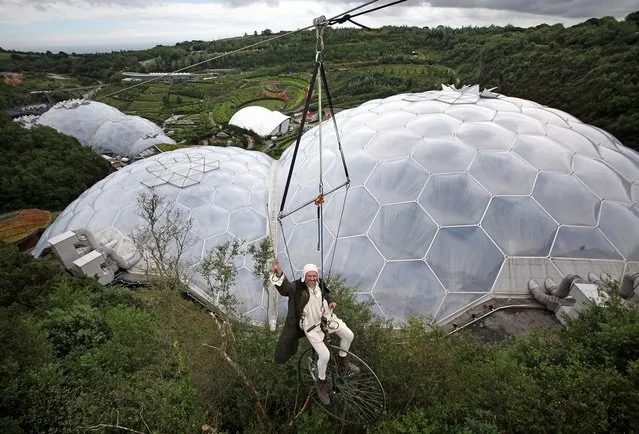
England's Longest Zip Wire Opens At The Eden Project

Marco Fiera from NoFit State Circus tries out the SkyWire, the new zip wire attraction which opens to the public this week at The Eden Project on July 17, 2012 in St Austell, England. The new 740m zip wire, currently the longest in England, allows the public a bird's eye view of the iconic Rainforest and Mediterranean Biome structures as well as the Cornish attractions outdoor gardens. The Eden Project – which opened in 2001 and has attracted over one million visitors – showcases 100,000 plants from around the world in two giant transparent domes, one of which is the world's largest greenhouse, each recreating different climate conditions. (Photo by Matt Cardy)
Details
19 Jul 2012 10:00:00


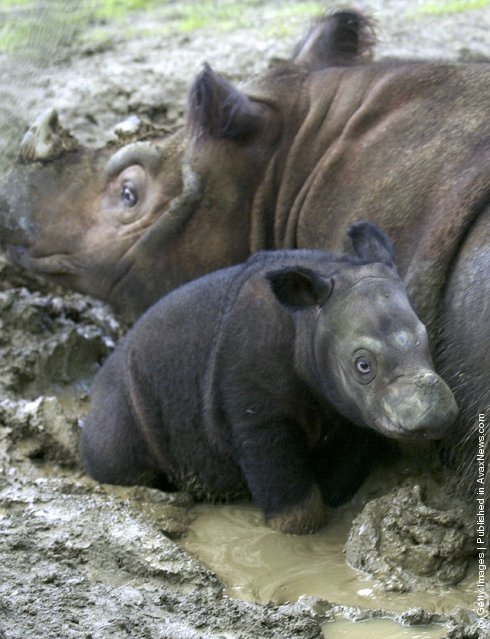
“The Sumatran Rhinoceros (Dicerorhinus sumatrensis) is a member of the family Rhinocerotidae and one of five extant rhinoceroses. It is the only extant species of the genus Dicerorhinus. It is the smallest rhinoceros, standing about 120–145 centimetres (3.9–4.76 ft) high at the shoulder, with a body length of 250 centimetres (8.2 ft) and weight of 500–800 kilograms (1,100–1,800 lb). Like the African species, it has two horns; the larger is the nasal horn, typically 15–25 centimetres (5.9–9.8 in), while the other horn is typically a stub. A coat of reddish-brown hair covers most of the Sumatran Rhino's body”. – Wikipedia

Photo: Emi, a Sumatran rhinoceros lies in the mud with her three-week-old female calf at the Cincinnati Zoo and Botanical Garden August 19, 2004 in Cincinnati, Ohio. Emi made history by becoming the first Sumatran rhino to produce two calves in captivity. (Photo by Mike Simons/Getty Images)
Details
22 Jun 2011 12:37:00
Russians Go To The Polls In Presidential Election And The Kremlin Prepares For Protests

(Excuse me for the clumsy electronic translator) Today in Moscow presidential elections are spent. Abundantly clear that without dependence from their results the winner will be declared Vladimir Putin. It can lead to the mass protest. Therefore the authorities have deduced on streets of thousand soldiers and policemen. For example, personally I (Avax) see from the window: four buses and two trucks with RIOT police. In photos more low – Moscow on March 04, 2012. A Garden Ring, The Tverskaya street, The Mayoralty, The State Duma, and The Bolshoi theater. (Photos by: Vladimir Maltsev; Source: LiveJournal; Rustem Adagamov; Source: LiveJournal).
Details
04 Mar 2012 13:22:00