A reveler wearing sheepfur costume is seen in front of a bonfire on which they burn a coffin symbolizing winter during the closing ceremony of the traditional carnival parade in Mohacs, 189 kms south of Budapest, Hungary, 07 February 2016. The carnival parade of people, the so-called busos, dressed in such costumes and frightening wooden masks, using various noisy wooden rattlers is traditionally held on the seventh weekend before Easter to drive away winter, and is a revival of a legend, which says that ethnic Croats ambushed the Osmanli Turkish troops, who escaped in panic seeing the terrifying figures during the Turkish occupation of Hungary. (Photo by Tamas Soki/EPA)
The sun bear (Ursus malayanus), also known as the honey bear, is a bear found primarily in the tropical rainforest (the dense lowland forests) in Southeast Asia; North-East India, Bangladesh, Myanmar, Thailand, Laos, Cambodia, Vietnam, Southern China, Peninsular Malaysia, and the islands of Sumatra and Borneo.
Photographer Brian Finke spent nearly two years traversing the friendly skies, following the life of flight attendants in the air and on the ground, from Delta and Hawaiian Air, to Hooters Air, Southwest, Air France, British Airways, Air Asia, and dozens more. His images of flight attendants waving, applying makeup and deboarding plans while smiling appear as if they were ripped from an advertisement in a glossy magazine. Here: Tiger Airways, Singapore, 2006. (Photo by Brian Finke/The Washington Post)
The Historic Photographer of the Year awards celebrate historic places and cultural sites across the globe, from national treasures to hidden gems. Entries were judged on originality, composition and technical proficiency as well as the story that inspired the submission and its historical impact. Here: Overall winner. Mont Saint-Michel by Daniel Burton. (Photo by Daniel Burton/The Guardian)
A double rainbow is seen above a woman holding an umbrella and selling snacks along the road in Siaya county, Kenya on May 3, 2020. (Photo by Thomas Mukoya/Reuters)
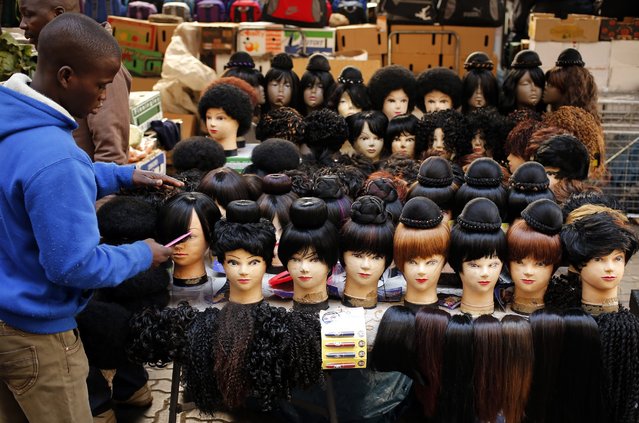
Man prepares wigs as he waits for customers in downtown Johannesburg, on August 5, 2014. Some estimates put Africa's dry hair industry at as much as $6 billion a year; Nigerian singer Muma Gee recently boasted that she spends 500,000 naira ($3,100) on a single hair piece made of 11 sets of human hair. (Photo by Siphiwe Sibeko/Reuters)