Loading...
Done
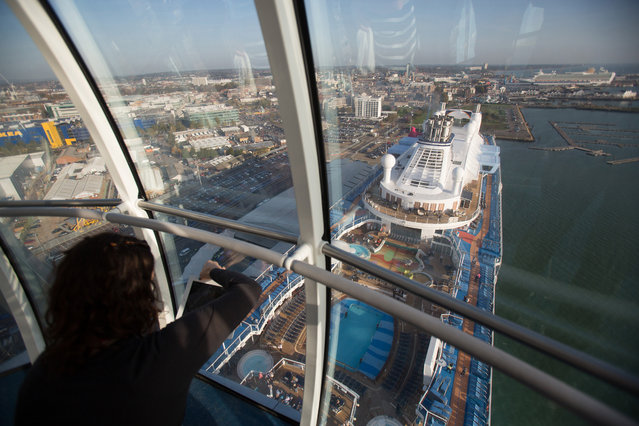
A visitor takes a photograph from the North Star observation capsule onboard the cruise ship Quantum of the Seas which is currently docked at Southampton on October 31, 2014 in Southampton, England. (Photo by Matt Cardy/Getty Images)

A visitor takes a photograph from the North Star observation capsule onboard the cruise ship Quantum of the Seas which is currently docked at Southampton on October 31, 2014 in Southampton, England. Billed as the world's first smartship, Royal Caribbean's Quantum of the Seas is claimed to be the most high-tech cruise ship in the world, with high tech modifications such as virtual balconies in windowless rooms and features such as the first dodgem ride on water, and a skydiving simulator. The ship will shortly begin its voyage from Southampton, where it docked earlier this week, to New York before relocating to the Caribbean for the 2014-15 season. (Photo by Matt Cardy/Getty Images)
Details
11 Nov 2014 11:44:00
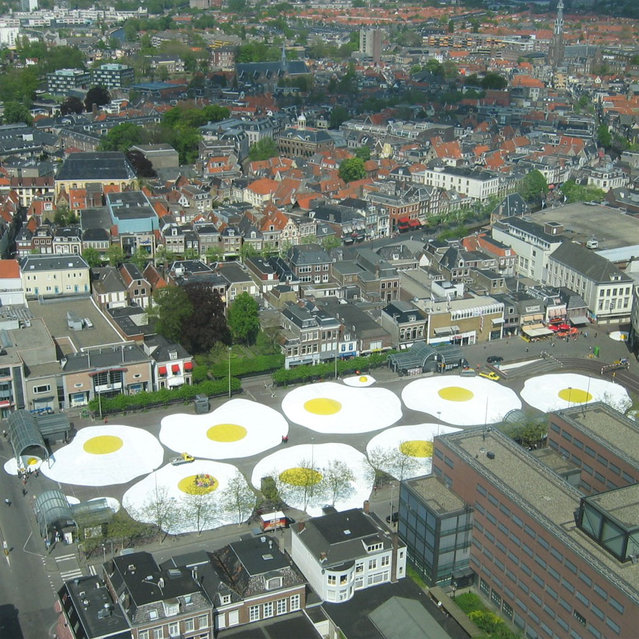
Art Eggcident By Henk Hofstra

With "Art Eggcident," Dutch artist Henk Hofstra demonstrates what it would look like if God threw giant eggs down at us. The eight large, sunny side up eggs measure almost 100 feet wide in diameter. The installation took place in Leeuwarden, a city in the north of the Netherlands.
"I hope it becomes a meeting place with room for art," says Henk. "Art that is different than a framed picture on the wall or a boring bronze sculpture. Art that shows us a different look, surprises us, or makes us angry or happy. Art that allows photographers to grab their cameras and arouses journalists. Art that evokes emotion, or provokes wild laughter."
Details
07 May 2014 10:54:00
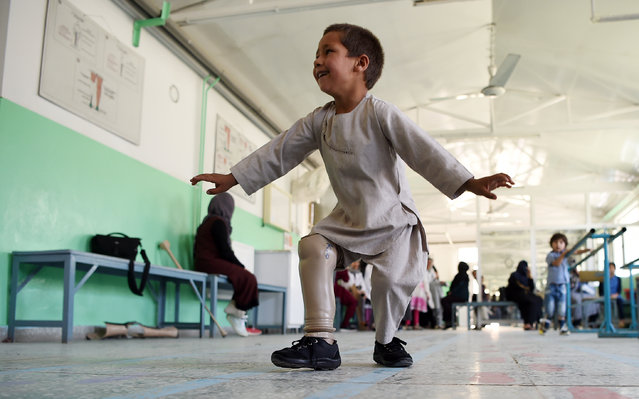
Ahmad Sayed Rahman, a five-year-old Afghan boy who lost his right leg when he was hit by a bullet in the crossfire of a battle, dances with his prosthetic leg at the International Committee of the Red Cross (ICRC) hospital for war victims and the disabled, in Kabul on May 7, 2019. With his hands in the air and an infectious grin spreading from ear to ear, a young Afghan boy whirls around a Kabul hospital room on his new prosthetic leg. The boy, five-year-old Ahmad Sayed Rahman, has become a social media star in Afghanistan and beyond after a short video of him effortlessly dancing on his new limb was published this week on Twitter. (Photo by Wakil Kohsar/AFP Photo)

Ahmad Sayed Rahman, a five-year-old Afghan boy who lost his right leg when he was hit by a bullet in the crossfire of a battle, dances with his prosthetic leg at the International Committee of the Red Cross (ICRC) hospital for war victims and the disabled, in Kabul on May 7, 2019. (Photo by Wakil Kohsar/AFP Photo)
Details
10 Jun 2019 00:03:00
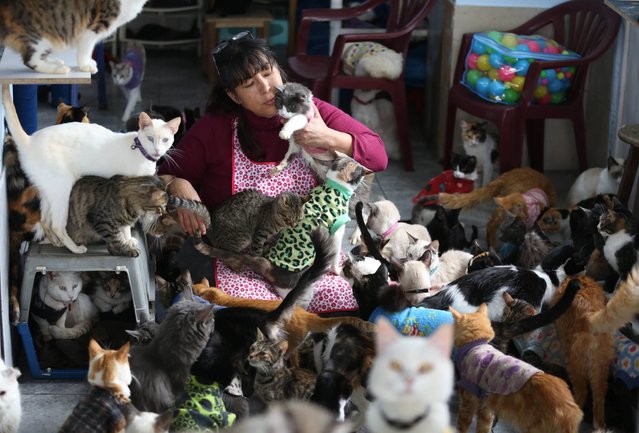
In this August 2, 2014 photo, Maria Torero, plays with a group of 175 cats with leukemia in her home in Lima, Peru. Torero says caring for cats with feline leukemia is her responsibility. Anybody else can care for healthy animals. (Photo by Martin Mejia/AP Photo)

“At her job, Maria Torero cares for sick human beings. At home, she lavishes love on slowly dying cats – 175 of them at last count. The 45-year-old nurse has turned her two-story, eight-room apartment into a hospice for cats with feline leukemia, scattering it with scores of feeding dishes and at least two dozen boxes litter boxes. Some have suggested she shelter healthy cats instead. “That's not my role”, she told The Associated Press. “I'm a nurse. My duty is to the cats that nobody cares about”. She said that “people don't adopt adult cats, especially if they are terminally ill”. – Franklin Briceno via Associated Press. (Photo by Martin Mejia/AP Photo)
Details
24 Aug 2014 09:28:00
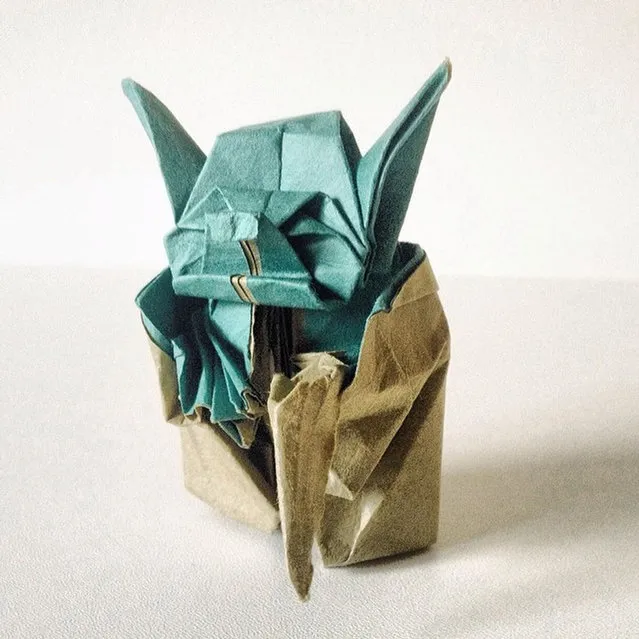
Origami By Ross Symons

As kids we have the natural desire to explore and to create. Whenever our parents would make for us a paper plane, we would become overjoyed seeing it fly across the room. However, planes are not the only thing that can be made from paper, and not only kids are fascinated by it. Some people master the art of origami and are able to create pretty much anything. You never know what’s going to come out when the artist twists and turns a piece of paper in meticulous ways. Finally, the figurine is complete, and you immediately see the striking resemblance of this piece of paper with an animal or some other creature. Ross Symons is one of those artists. He creates his figurines simply for the joy it brings him. Maybe, he uses this as a medium to enter his childhood, or maybe he has other motifs – we will never know. (Photo by Ross Symons)
Details
31 Oct 2014 12:12:00
Rangoli Folk Art From India

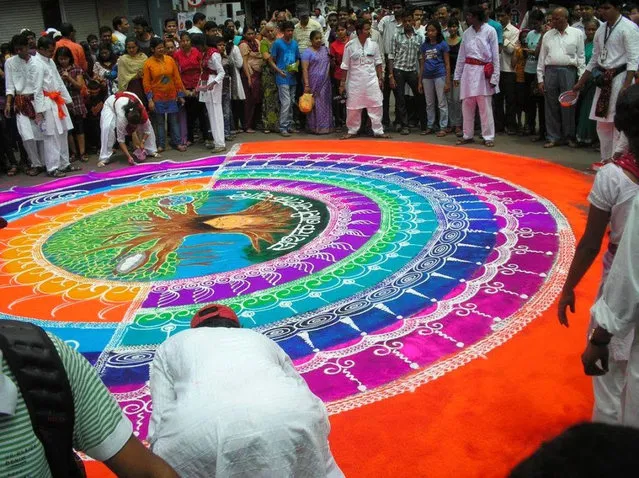
Rangoli, also known as kolam or Muggu, is a folk art from India in which patterns are created on the floor in living rooms or courtyards using materials such as colored rice, dry flour, colored sand or flower petals. It is usually made during Diwali, Onam, Pongal and other Indian festivals. They are meant to be sacred welcoming areas for the Hindu deities. The ancient symbols have been passed down through the ages, from each generation to the next, keeping both the art form and the tradition alive. Similar practices are followed in different Indian states: in Tamil Nadu, there is Kolam in Tamil Nadu; Mandana in Rajasthan; Chaookpurna in Chhattisgarh; Alpana in West Bengal; Aripana in Bihar; Chowk pujan in Uttar Pradesh; Muggu in Andhra Pradesh and others.
Details
16 Jun 2014 10:37:00
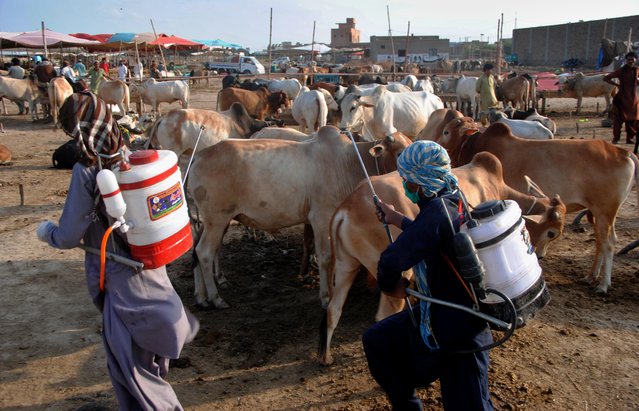
Health workers wearing face masks spray disinfectant liquid on sacrificial animals amid concerns over the spread of the SARS-CoV-2 coronavirus that causes the pandemic COVID-19 disease ahead of the Muslim festival of Eid al-Adha at an animal market in Hyderabad, southern Pakistan, 21 July 2020. Eid al-Adha, also known as the Festival of the Sacrifice, is the second and holiest of the two main Islamic holidays celebrated each year (the other one being Eid al-Fitr). Every year, on the 10th day of the Islamic lunar month of Dhu al-Hijjah, Muslims around the world ritually slaughter a sacrificial animal and split the meat into three parts: one is reserved for the family, another for friends and relatives, and the third is given to the poor and needy. The Saudi Supreme Court has declared that the first day of Eid al-Adha this year falls on 31 July. (Photo by Nadeem Khawar/EPA/EFE)

Health workers wearing face masks spray disinfectant liquid on sacrificial animals amid concerns over the spread of the SARS-CoV-2 coronavirus that causes the pandemic COVID-19 disease ahead of the Muslim festival of Eid al-Adha at an animal market in Hyderabad, southern Pakistan, 21 July 2020. (Photo by Nadeem Khawar/EPA/EFE)
Details
23 Jul 2020 00:07:00
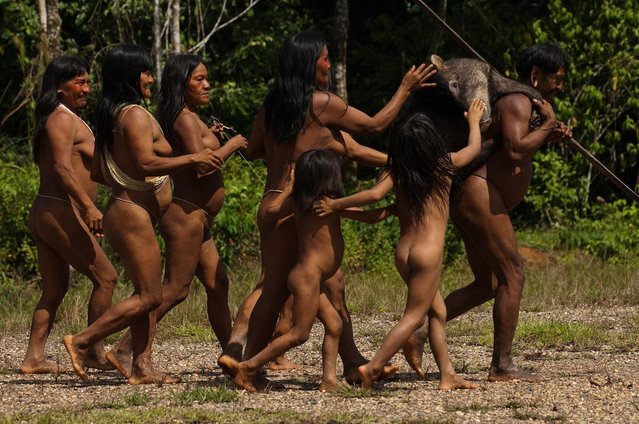
Spectacular images offering insight into the lives of the Huaorani people in the Ecuadorian Amazon have been revealed showing how they use traditional methods to hunt monkeys for food. The stunning pictures were taken by conservation photographer Pete Oxford from Torquay, Devon in the Ecuadorian Amazon. “The Huaorani Indians are a forest people highly in tune with their environment. Many are now totally acculturated since the 1950s by missionaries”, said Pete. “Today they face radical change to their culture to the proximity of oil exploration within their territory and the Yasuni National Park and Biosphere Reserve, they are vastly changed. Some still live very traditionally and for this shoot, through my Huaorani friend, a direct relative of those photographed he wanted to depict them as close to their original culture as possible. They still largely hunt with blow pipes and spears eating a lot of monkeys and peccaries”. The Huaorani are also known as the Waorani, Waodani or the Waos and are native Amerindians. Their lands are located between the Curaray and Napo rivers and speak the Huaorani language. Pete says that during his visit he was welcomed into the group and hopes that ancient cultures can be saved. Here: The tribe were seen celebrating after a hunter returned to camp with a wild pig. (Photo by Pete Oxford/Mediadrumworld.com)

Spectacular images offering insight into the lives of the Huaorani people in the Ecuadorian Amazon have been revealed showing how they use traditional methods to hunt monkeys for food. The stunning pictures were taken by conservation photographer Pete Oxford from Torquay, Devon in the Ecuadorian Amazon. Here: The tribe were seen celebrating after a hunter returned to camp with a wild pig. (Photo by Pete Oxford/Mediadrumworld.com)
Details
20 Jan 2017 07:58:00