Loading...
Done
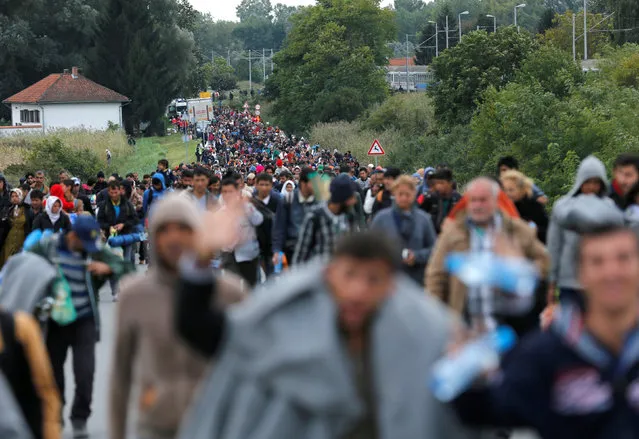
A year after hundreds of thousands of migrants and refugees snaked their way across southeastern Europe and onto television screens worldwide, the roads through the Balkans are now clear, depriving an arguably worsening tragedy of its poignant visibility. Europe's migrant crisis is at the very least numerically worse than it was last year. More people are arriving and more are dying. (Photo by Antonio Bronic/Reuters)

A year after hundreds of thousands of migrants and refugees snaked their way across southeastern Europe and onto television screens worldwide, the roads through the Balkans are now clear, depriving an arguably worsening tragedy of its poignant visibility. Reuters photographer, Antonio Bronic revisiting the people-packed locations where he and his colleagues captured last year's diaspora, found empty roads, unencumbered railway tracks and bucolic countryside. (Photo by Antonio Bronic/Reuters)


Details
12 Aug 2016 12:10:00
Camp director and “duck walk” inventor Rodin Gilbert Flores, 2nd R) teaches aspiring beauty queens how to “duck walk” at a beauty boot camp in Manila in this picture taken on March 8, 2015. From wading in muddy Philippine rice paddies, former housemaid Janicel Lubina now struts down runways for the country's top designers, and is poised to be crowned among the world's most beautiful. (Photo by Noel Celis/AFP Photo)

Camp director and “duck walk” inventor (Rodin Gilbert Flores, 2nd R) teaches aspiring beauty queens how to “duck walk” at a beauty boot camp in Manila in this picture taken on March 8, 2015. From wading in muddy Philippine rice paddies, former housemaid Janicel Lubina now struts down runways for the country's top designers, and is poised to be crowned among the world's most beautiful. Lubina is a star recruit in one of Manila's beauty pageant boot camps, where shy, lanky teenage girls from remote farming provinces are transformed into poised Barbie dolls who can preach about world peace in six-inch heels. (Photo by Noel Celis/AFP Photo)
Details
15 Mar 2015 06:51:00
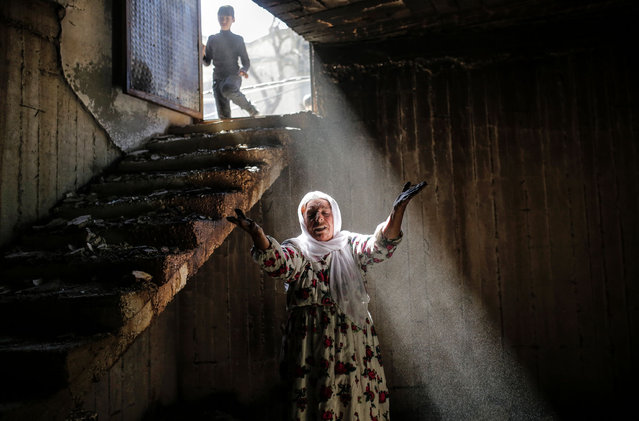
A woman reacts while walking among the ruins of damaged buildings following heavy fighting between government troops and Kurdish fighters, on March 2, 2016 in the southeastern Turkey Kurdish town of Cizre, near the border with Syria and Iraq. Thousands in Turkey's Kurdish-majority town of Cizre started returning to their homes today after authorities partially lifted a curfew in place since December for a controversial military operation to root out separatist rebels. (Photo by Yasin Akgül/AFP Photo)

A woman reacts while walking among the ruins of damaged buildings following heavy fighting between government troops and Kurdish fighters, on March 2, 2016 in the southeastern Turkey Kurdish town of Cizre, near the border with Syria and Iraq. Thousands in Turkey's Kurdish-majority town of Cizre started returning to their homes today after authorities partially lifted a curfew in place since December for a controversial military operation to root out separatist rebels. (Photo by Yasin Akgül/AFP Photo)
Details
03 Mar 2016 11:29:00
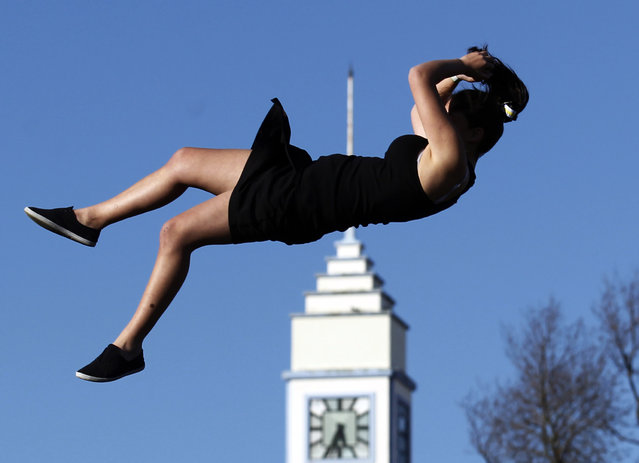
8. NEW ZEALAND: A woman dives from a platform into a giant air bed at a park in Palmerston North September 29, 2011. (Photo by Marcos Brindicci/Reuters)

The report, prepared by the Sustainable Development Solutions Network (SDSN) and the Earth Institute at Columbia University, showed Syria, Afghanistan and eight sub-Saharan countries as the 10 least happy places on earth to live. The top 10 this year were Denmark, Switzerland, Iceland, Norway, Finland, Canada, Netherlands, New Zealand, Australia, and Sweden. Denmark was in third place last year, behind Switzerland and Iceland. The bottom 10 were Madagascar, Tanzania, Liberia, Guinea, Rwanda, Benin, Afghanistan, Togo, Syria and Burundi. The United States came in at 13, the United Kingdom at 23, France at 32, and Italy at 50. Here: #8. NEW ZEALAND: A woman dives from a platform into a giant air bed at a park in Palmerston North September 29, 2011. (Photo by Marcos Brindicci/Reuters)
Details
26 Mar 2016 13:19:00
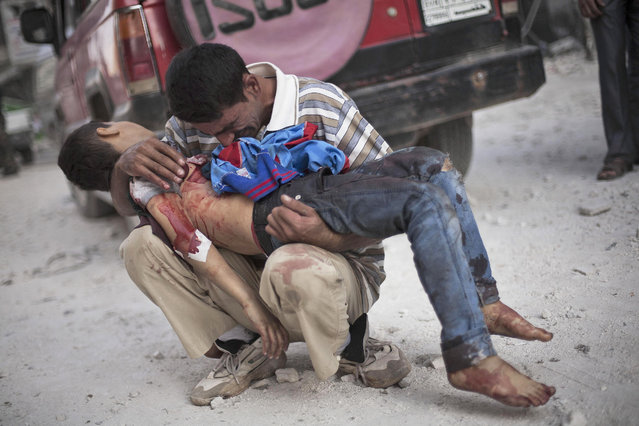
A Syrian man cries while holding the body of his son, killed by the Syrian Army, near Dar El Shifa hospital in Aleppo, Syria, Wednesday, October 3, 2012. (Photo by Manu Brabo/AP Photo)

Manu Brabo was born in Spain in 1981. After studying Photography in The School of Arts and Crafts in Oviedo, he moved to Madrid where he started Journalism in Carlos III University while he was working as a photographer for several humble newspapers and agencies. In 2011, Manu was held captive and then released by by Libyan forces. Brabo, along with fellow AP photographers were awarded the 2013 Pulitzer Prize for Breaking News Photography. Here: a Syrian man cries while holding the body of his son, killed by the Syrian Army, near Dar El Shifa hospital in Aleppo, Syria, Wednesday, October 3, 2012. (Photo by Manu Brabo/AP Photo)
Details
27 Oct 2015 08:04:00
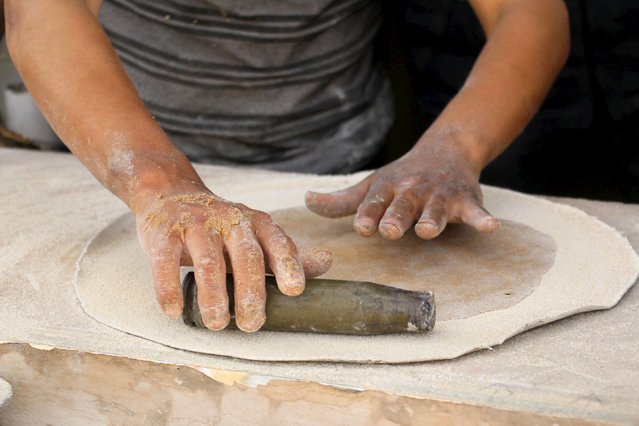
A boy uses remnants of ordnance as he prepares dough inside Abu Khaled's shop in the Douma neighborhood of Damascus April 28, 2015. Abu Khaled opened a shop for making “barley bread” using remnants of weapons including rockets, tank shells and other ordnance fired by forces loyal to Syria's President Bashar al-Assad. (Photo by Amer Almohibany/Reuters)

A boy uses remnants of ordnance as he prepares dough inside Abu Khaled's shop in the Douma neighborhood of Damascus April 28, 2015. Abu Khaled opened a shop for making “barley bread” using remnants of weapons including rockets, tank shells and other ordnance fired by forces loyal to Syria's President Bashar al-Assad. (Photo by Amer Almohibany/Reuters)
Details
09 Aug 2015 11:13:00
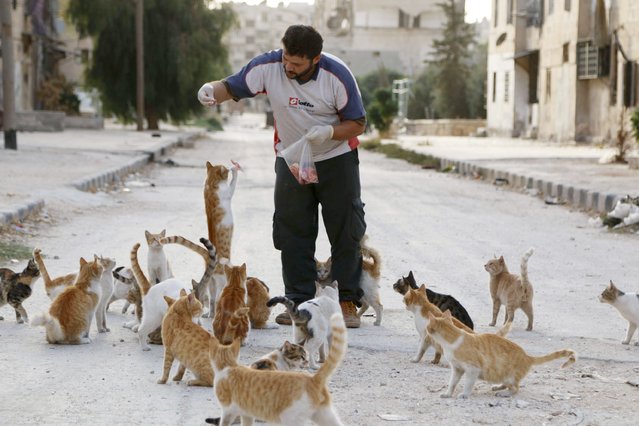
Alaa, an ambulance driver, feeds cats in Masaken Hanano in Aleppo, September 24, 2014. Alaa buys about $4 of meat everyday to feed about 150 abandoned cats in Masaken Hanano, a neigbourhood in Aleppo that has been abandoned because of shelling from forces loyal to Syria's president Bashar Al-Assad on it. Alaa said that he has been feeding and taking care of the cats for over 2 months. (Photo by Hosam Katan/Reuters)

Alaa, an ambulance driver, feeds cats in Masaken Hanano in Aleppo, September 24, 2014. Alaa buys about $4 of meat everyday to feed about 150 abandoned cats in Masaken Hanano, a neigbourhood in Aleppo that has been abandoned because of shelling from forces loyal to Syria's president Bashar Al-Assad on it. Alaa said that he has been feeding and taking care of the cats for over 2 months. (Photo by Hosam Katan/Reuters)
Details
25 Sep 2014 13:29:00
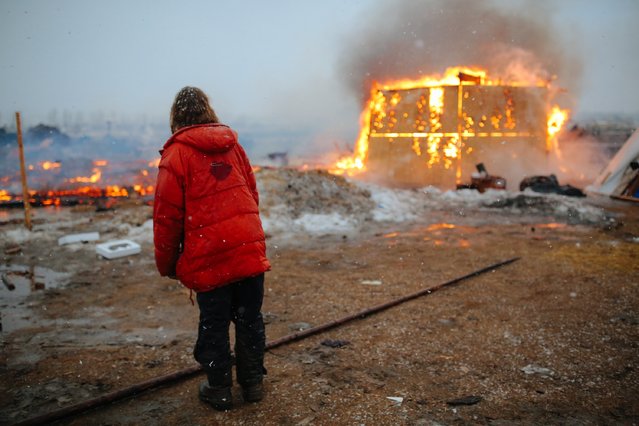
Campers set structures on fire in preparation of the Army Corp's 2pm deadline to leave the Oceti Sakowin protest camp on February 22, 2017 in Cannon Ball, North Dakota. (Photo by Stephen Yang/Getty Images)

Campers set structures on fire in preparation of the Army Corp's 2pm deadline to leave the Oceti Sakowin protest camp on February 22, 2017 in Cannon Ball, North Dakota. Activists and protesters have occupied the Standing Rock Sioux reservation for months in opposotion to the completion of the Dakota Access Pipeline. (Photo by Stephen Yang/Getty Images)
Details
26 Feb 2017 00:01:00