Loading...
Done
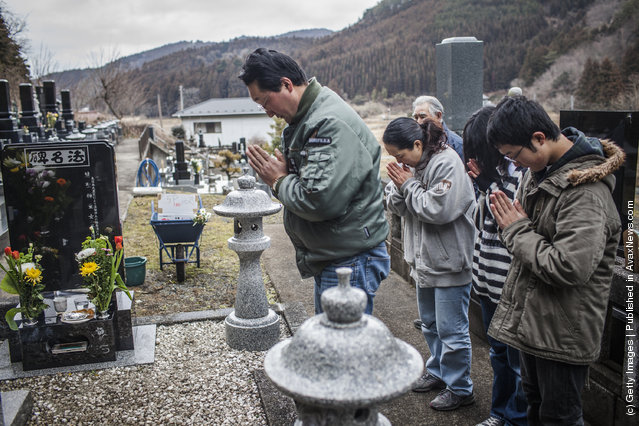
Takahiro Shito, 47, and his wife Sayomi Shito, 46, pray with their children Tomoka, 14, and Kenya 16, and their great uncle Akinori Takahashi, 76, as they pay respects to their daughter Chisato,12, buried in a nearby cemetery, victim of the Okowa Elementary School tragedy, who was killed during last year's tsunami on March 11, 2012 near Ishinomaki, Japan

Takahiro Shito, 47, and his wife Sayomi Shito, 46, pray with their children Tomoka, 14, and Kenya 16, and their great uncle Akinori Takahashi, 76, as they pay respects to their daughter Chisato,12, buried in a nearby cemetery, victim of the Okowa Elementary School tragedy, who was killed during last year's tsunami on March 11, 2012 near Ishinomaki, Japan. Teachers at the school weren't trained for tsunami evacuation and didn't to lead the children up the snow covered mountain behind the school after the tsunami warning was sounded. Out of 108 students at the school, 74 died and four remain missing; 10 of the school's 13 teachers were also killed. (Photo by Daniel Berehulak /Getty Images)
Details
11 Mar 2012 09:47:00
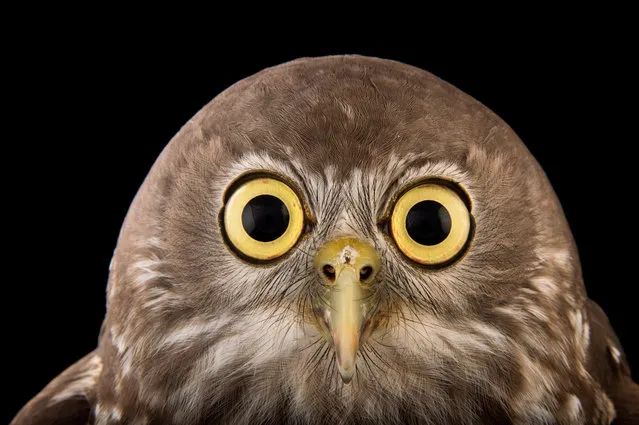
The National Geographic Photo Ark is a travelling exhibition of photographer Joel Sartore’s quest to create a photo archive of biodiversity around the world. So far, Sartore has captured studio portraits of more than 6,000 species – a number that he hopes to double. On 1 July, the ark will open at Melbourne zoo – the first time it has been exhibited in the southern hemisphere. More than 50 portraits will be on display, including many of Australian endangered animals being protected by programs at the zoo itself. These captions have been edited from text supplied by Melbourne zoo. Here: Barking owl. So-named because its call sounds like a barking dog, these birds are native to Australia, Indonesia and Papua New Guinea. In Victoria they are listed as an endangered species, and in 2003 there were estimated to be fewer than 50 breeding pairs. The main threat to the species in Victoria is loss of habitat, especially large trees with hollows in which they can nest and on which many of their prey depend. Apart from a bark, they may utter a chilling scream when they feel threatened. (Photo by Joel Sartore/National Geographic Photo Ark/The Guardian)

The National Geographic Photo Ark is a travelling exhibition of photographer Joel Sartore’s quest to create a photo archive of biodiversity around the world. So far, Sartore has captured studio portraits of more than 6,000 species – a number that he hopes to double. On 1 July, the ark will open at Melbourne zoo – the first time it has been exhibited in the southern hemisphere. More than 50 portraits will be on display, including many of Australian endangered animals being protected by programs at the zoo itself. These captions have been edited from text supplied by Melbourne zoo. Here: Barking owl. (Photo by Joel Sartore/National Geographic Photo Ark/The Guardian)
Details
01 Jul 2017 07:45:00
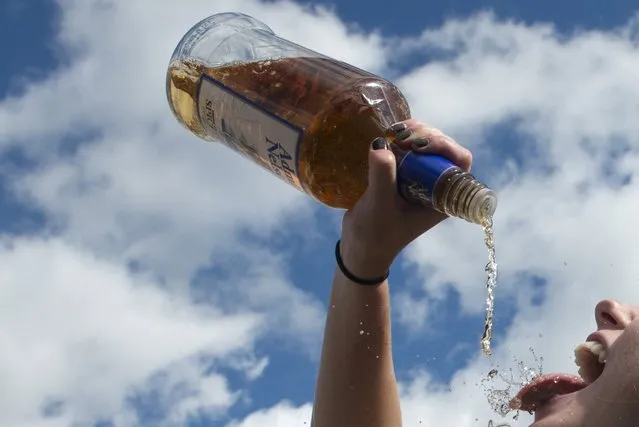
A woman pours alcohol from the bottle into her mouth at the Far Hills Race Day at Moorland Farms in Far Hills, New Jersey, October 17, 2015. (Photo by Stephanie Keith/Reuters)

A woman pours alcohol from the bottle into her mouth at the Far Hills Race Day at Moorland Farms in Far Hills, New Jersey, October 17, 2015. Young locals in New Jersey catch up with friends from school and college days at the Far Hills Race Day, which started as a fox-hunting event in the early 1900s. Many racegoers first went to the Hunt, as it's known locally, as children, but nowadays it's an alcohol-fuelled party for them. Makeshift bars are set up in cars, with the horses' efforts on the turf sometimes a backdrop to the main event. (Photo by Stephanie Keith/Reuters)
Details
26 Oct 2015 08:00:00
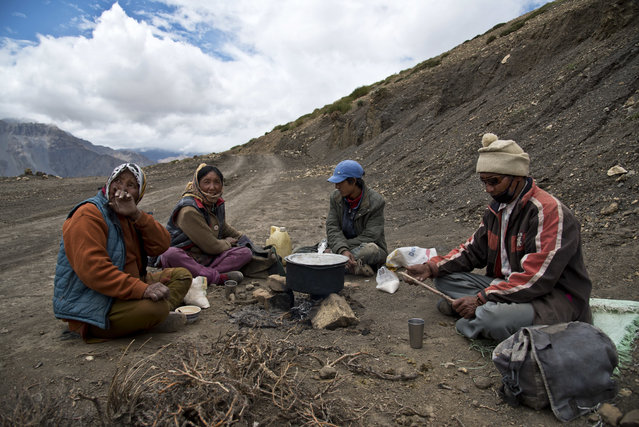
In this August 17, 2016, photo, from left to right, Chhering Chodom, 60, Tashi Yangzom, 50, Lobsang Chhering, 27, and Dorje Tandup, 58, drink milk tea on the side of the road. For centuries, the sleepy valley nestled in the Indian Himalayas remained a hidden Buddhist enclave forbidden to outsiders. Enduring the harsh year-round conditions of the high mountain desert, the people of Spiti Valley lived by a simple communal code – share the Earth's bounty, be hospitable to neighbors, and eschew greed and temptation at all turns. That's all starting to change, for better or worse. Since India began allowing its own citizens as well as outsiders to visit the valley in the early 1990s, tourism and trade have boomed. And the marks of modernization, such as solar panels, asphalt roads and concrete buildings, have begun to appear around some of the villages that dot the remote landscape at altitudes above 4,000 meters (13,000 feet). (Photo by Thomas Cytrynowicz/AP Photo)

In this August 17, 2016, photo, from left to right, Chhering Chodom, 60, Tashi Yangzom, 50, Lobsang Chhering, 27, and Dorje Tandup, 58, drink milk tea on the side of the road. For centuries, the sleepy valley nestled in the Indian Himalayas remained a hidden Buddhist enclave forbidden to outsiders. Enduring the harsh year-round conditions of the high mountain desert, the people of Spiti Valley lived by a simple communal code – share the Earth's bounty, be hospitable to neighbors, and eschew greed and temptation at all turns. That's all starting to change, for better or worse. (Photo by Thomas Cytrynowicz/AP Photo)
Details
15 Sep 2016 09:22:00
Camp director and “duck walk” inventor Rodin Gilbert Flores, 2nd R) teaches aspiring beauty queens how to “duck walk” at a beauty boot camp in Manila in this picture taken on March 8, 2015. From wading in muddy Philippine rice paddies, former housemaid Janicel Lubina now struts down runways for the country's top designers, and is poised to be crowned among the world's most beautiful. (Photo by Noel Celis/AFP Photo)

Camp director and “duck walk” inventor (Rodin Gilbert Flores, 2nd R) teaches aspiring beauty queens how to “duck walk” at a beauty boot camp in Manila in this picture taken on March 8, 2015. From wading in muddy Philippine rice paddies, former housemaid Janicel Lubina now struts down runways for the country's top designers, and is poised to be crowned among the world's most beautiful. Lubina is a star recruit in one of Manila's beauty pageant boot camps, where shy, lanky teenage girls from remote farming provinces are transformed into poised Barbie dolls who can preach about world peace in six-inch heels. (Photo by Noel Celis/AFP Photo)
Details
15 Mar 2015 06:51:00
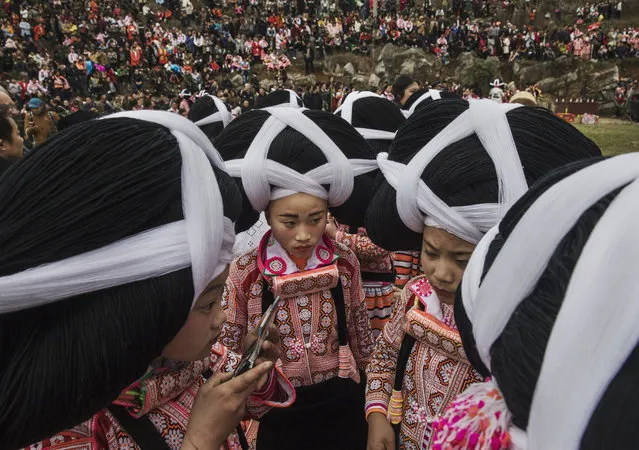
Girls of the Long Horn Miao ethnic minority group wear headdresses as they prepare gather for Tiaohua or Flower Festival as part of the Lunar New Year on February 6, 2017 in Longga village, Guizhou province, southern China. The Long Horn Miao are recognized for their declining practice of wrapping a blend of linen, wool, and the hair of their ancestors around animal horns or a wooden clip to make headdresses. Many young women say they now wear the headdresses only for special occasions and festivals, as the ornaments, which are attached by the horns to their real hair, have proved impractical for modern daily life in a fast changing world. China officially recognizes 56 different ethnic minorities, and statistics show over 7 million Chinese identifying themselves as Miao. But the small Long Horn Miao community counts only around 5000 people living in 12 villages, whose age-old traditions, language, and culture are fading. It is increasingly difficult in a modernizing China, as young people are drawn from remote rural villages to opportunities in bigger cities amongst wide-scale urbanization. Farming and labour remain the mainstays of life for the Long Horn Miao, leaving the area relatively poor in comparison with many parts of China. The government has invested significant amounts into local infrastructure and the tourism industry to try to bolster the local economy. (Photo by Kevin Frayer/Getty Images)

Girls of the Long Horn Miao ethnic minority group wear headdresses as they prepare gather for Tiaohua or Flower Festival as part of the Lunar New Year on February 6, 2017 in Longga village, Guizhou province, southern China. (Photo by Kevin Frayer/Getty Images)
Details
13 Feb 2017 00:01:00
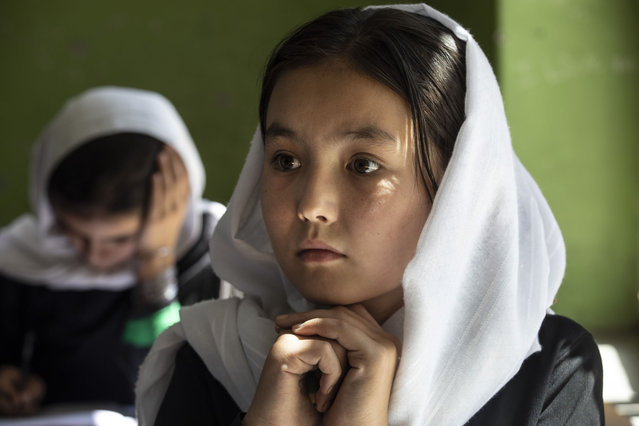
Behishta,11, listens during 4th grade class at the Zarghoona high school on July 25 2021 in Kabul, Afghanistan. The Zarghoona girls high school is the largest in Kabul with 8,500 female students attending classes. The school opened after a nearly two-month break due to the coronavirus (COVID-19) pandemic. Currently there is widespread fear that the Taliban who already control around half the country will reintroduce its notorious system barring girls and women from almost all work, and access to education. The Ministry of Education has announced the opening of schools, but there are  mixed reports in many areas where the Taliban have taken control or where fighting is ongoing. (Photo by Paula Bronstein/Getty Images)

Behishta,11, listens during 4th grade class at the Zarghoona high school on July 25 2021 in Kabul, Afghanistan. The Zarghoona girls high school is the largest in Kabul with 8,500 female students attending classes. The school opened after a nearly two-month break due to the coronavirus (COVID-19) pandemic. (Photo by Paula Bronstein/Getty Images)
Details
12 Aug 2021 08:41:00
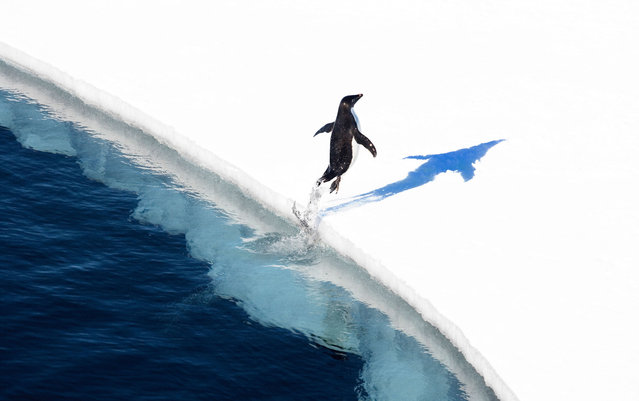
This undated handout photo received from the Antarctic Ocean Alliance on October 28, 2016 shows a adelie penguin jumping onto the ice in the Ross Sea in Antarctica. The world's largest marine reserve aimed at protecting the pristine wilderness of Antarctica will be created after a “momentous” agreement was finally reached on October 28, 2016 with Russia dropping its long-held opposition. A remote and largely pristine stretch of ocean off Antarctica received international protection on Friday, becoming the world's largest marine reserve as a broad coalition of countries came together to protect 598,000 square miles of water. The new marine protected area in the Ross Sea was created by a unanimous decision of the international body that oversees the waters around Antarctica – the Commission for the Conservation of Antarctic Marine Living Resources – and was announced at the commission's annual meeting in Tasmania. The commission comprises 24 countries, including the United States, and the European Union. (Photo by John Weller/AFP Photo/Antarctic Ocean Alliance)

This undated handout photo received from the Antarctic Ocean Alliance on October 28, 2016 shows a adelie penguin jumping onto the ice in the Ross Sea in Antarctica. The world's largest marine reserve aimed at protecting the pristine wilderness of Antarctica will be created after a “momentous” agreement was finally reached on October 28, 2016 with Russia dropping its long-held opposition. (Photo by John Weller/AFP Photo/Antarctic Ocean Alliance)
Details
29 Oct 2016 11:43:00