Loading...
Done
People look at a newly installed 'Renew' media point in the City of London

Girls look at a newly installed “Renew” media point in the City of London on January 26, 2012 in London, England. The “pods” will transmit each market day and will include breaking news, weather and travel information, and information about sport, fashion, the arts and entertainment. The stations which will also double as recycling points are run by media company Renew. (Photo by Dan Kitwood/Getty Images)
Details
27 Jan 2012 11:32:00


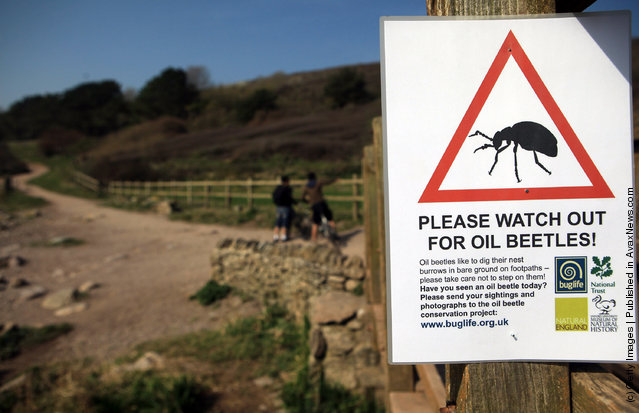
People enjoy the fine weather on the coast at Wembury during the first ever nationwide survey to map the location of the threatened and creatures on March 24, 2011 in near Plymouth, England. Often found on the coast, and particularly in the south west of England, the number of oil beetle species found in the UK has halved in the last 100 years and the survey will help establish the whereabouts of the remaining four species and boost efforts to secure their future. The survey is being launched today by Buglife: The Invertebrate Trust and the National Trust in partnership with Natural England and Oxford University Museum of Natural History. (Photo by Matt Cardy/Getty Images)
Details
25 Mar 2011 15:20:00
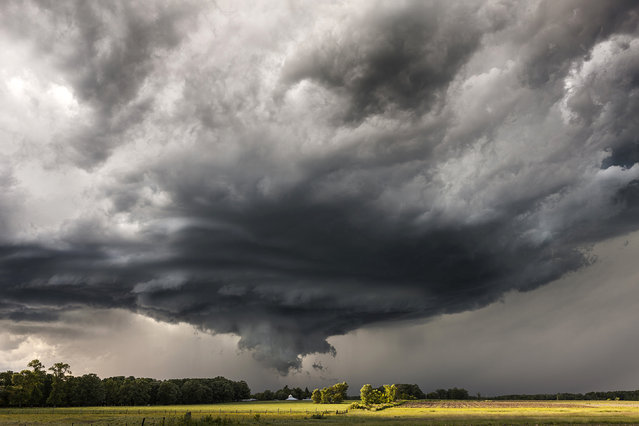
Supercell in Minnesota, near Browerville, Minnesota in 2014. (Photo by Camille Seaman/Caters News)

These stunning images show the phwoar-some power of some of Americas most extreme weather. Camille Seaman’s wondrous work features huge super cells, crashing lightning and gale-force winds. The roaming photographer has chased storms across the US from Iowa to Wyoming and from Minnesota to Texas. Her favorite places to chase are Kansas, Nebraska and South Dakota – notorious hotspots for spectacular storms. Here: Supercell in Minnesota, near Browerville, Minnesota in 2014. (Photo by Camille Seaman/Caters News)
Details
26 Jan 2015 12:10:00
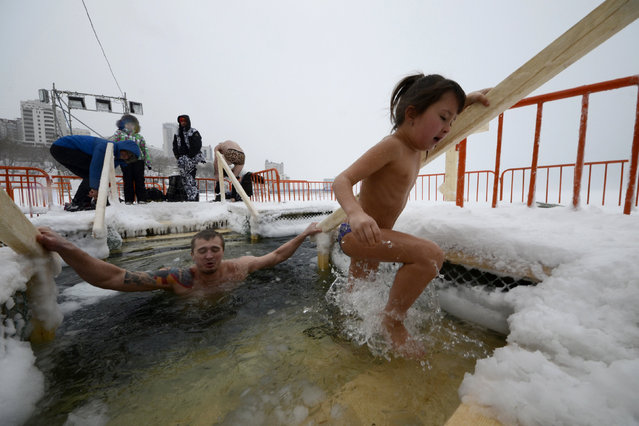
A man and a girl take a dip in icy waters during celebrations for the Orthodox Epiphany in the Sea of Japan in the far eastern city of Vladivostok, Russia, January 19, 2016. (Photo by Yuri Maltsev/Reuters)

A man and a girl take a dip in icy waters during celebrations for the Orthodox Epiphany in the Sea of Japan in the far eastern city of Vladivostok, Russia, January 19, 2016. Orthodox believers mark Epiphany on January 19 by immersing themselves in icy waters regardless of the weather. (Photo by Yuri Maltsev/Reuters)
Details
21 Jan 2016 08:04:00
A surfer rides a wave at the snowy beach of Unstad, in Lofoten Island, Arctic Circle, on March 9, 2016. (Photo by Olivier Morin/AFP Photo)

A surfer rides a wave at the snowy beach of Unstad, in Lofoten Island, Arctic Circle, on March 9, 2016. Surfers from all over the world comes to Lofoten island to surf in extrem conditions. Ocean temperature is 6-7 °C, air temperature around 0°C in spite of a weather very unstable. (Photo by Olivier Morin/AFP Photo)
Details
15 Mar 2016 13:54:00
A belly dancer performs in a talent show in early morning ceremonies for Groundhog Day on February 2, 2018 in Punxsutawney, Pa. (Photo by Brett Carlsen/Getty Images)

A belly dancer performs in a talent show in early morning ceremonies for Groundhog Day on February 2, 2018 in Punxsutawney, Pennsylvania. Punxsutawney Phil, the weather-forecasting groundhog, emerged from his burrow in Pennsylvania on Friday, saw his shadow and predicted six more weeks of winter, despite his rival Staten Island Chuck in New York predicting an early spring. (Photo by Brett Carlsen/Getty Images)
Details
03 Feb 2018 07:24:00


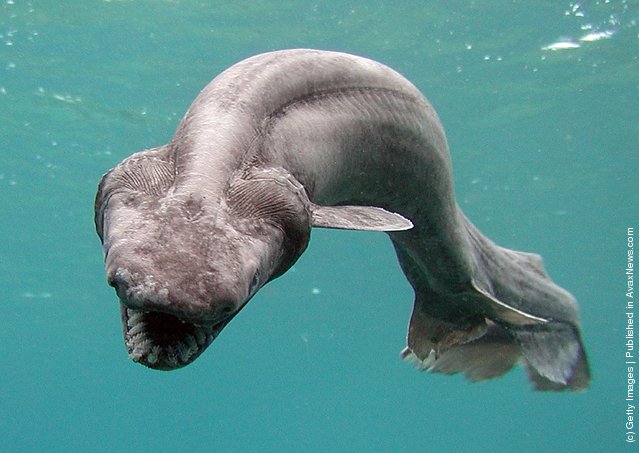
“The frilled shark (Chlamydoselachus anguineus) is one of two extant species of shark in the family Chlamydoselachidae, with a wide but patchy distribution in the Atlantic and Pacific Oceans. This uncommon species is found over the outer continental shelf and upper continental slope, generally near the bottom though there is evidence of substantial upward movements. It has been caught as deep as 1,570 m (5,150 ft), whereas in Suruga Bay, Japan it is most common at depths of 50–200 m (160–660 ft). Exhibiting several “primitive” features, the frilled shark has often been termed a «living fossil»”. – Wikipedia

Photo: A 1.6 meter long Frill shark swims in a tank after being found by a fisherman at a bay in Numazu, on January 21, 2007 in Numazu, Japan. The frill shark, also known as a Frilled shark usually lives in waters of a depth of 600 meters and so it is very rare that this shark is found alive at sea-level. It's body shape and the number of gill are similar to fossils of sharks which lived 350,000,000 years ago. (Photo by Awashima Marine Park/Getty Images)

Details
05 May 2011 10:01:00


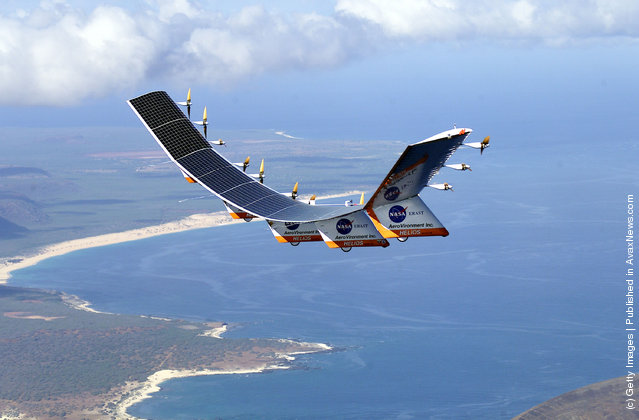
“NASA's Pathfinder, Pathfinder Plus, Centurion and Helios Prototype were an evolutionary series of solar- and fuel-cell-system-powered unmanned aerial vehicles. AeroVironment, Inc. developed the vehicles under NASA's Environmental Research Aircraft and Sensor Technology (ERAST) program. They were built to develop the technologies that would allow long-term, high-altitude aircraft to serve as “atmospheric satellites”, to perform atmospheric research tasks as well as serve as communications platforms”. – Wikipedia

Photo: The solar-electric Helios Prototype flying wing is flies over the Hawaiian islands of Niihau and Lehua during the first solar-powered test flight July 14, 2001 from the U.S. Navy's Pacific Missile Range Facility on Kauai, HI. The 18-hour flight was a functional checkout of the aircraft's systems and performance in preparation for an attempt to reach sustained flight at 100,000 feet altitude later in the summer. (Photo Courtesy of NASA/Getty Images)
Details
14 Jul 2011 09:24:00