Kacey Musgraves performs at the 49th annual CMA Awards at the Bridgestone Arena on Wednesday, November 4, 2015, in Nashville, Tenn. (Photo by Chris Pizzello/Invision/AP Photo)
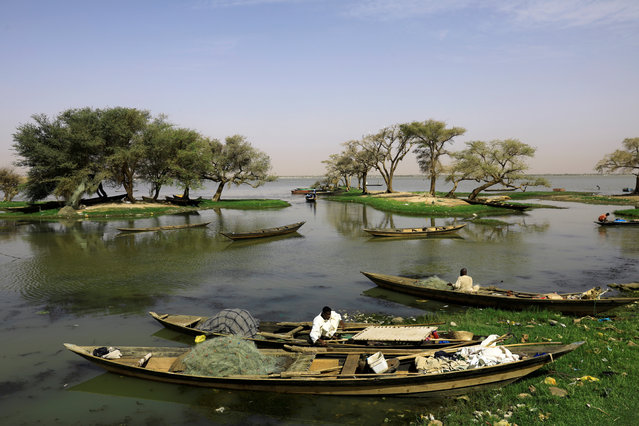
Sudanese fishermen check their boats and nets before they row through the waters of Nile River near Jebel Aulia, Sudan, May 3, 2019. (Photo by Umit Bektas/Reuters)
A model wears a creation as part of the Prada women's Spring Summer 2023 collection presented in Milan, Italy, Thursday, September 22, 2022. (Photo by Antonio Calanni/AP Photo)
An Iraqi woman and foreigners use pair of compact discs as a filter to watch the partial solar eclipse in war-torn Baghdad, 29 March 2006. Without access to proper equipment to protect their eyes from the sun's rays, eclipse watchers in Iraq used makeshift filters. The moon blotted out the sun over northwest Africa early Wednesday, turning day into night in a total solar eclipse as it swept a shadowy path from the outer tip of Brazil to the steppes of Mongolia. (Photo by Hassan Ammar/AFP Photo)
Long row of shiny new Flying Fortresses, part of huge reserves being built up in Britain for D-Day, stands by to be flown to combat units as replacements, May 25, 1944. (Photo by AP Photo)
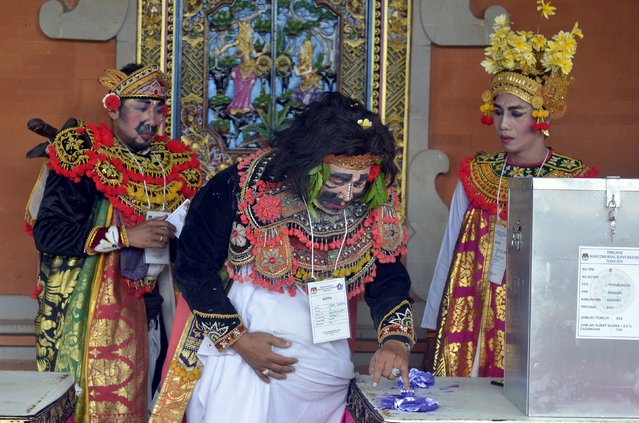
Polling station officials dressed as traditional Balinese performers vote in Badung regency on the Indonesian island of Bali December 9, 2015 in this photo taken by Antara Foto. Around 100 million Indonesians were expected to go to the polls on Wednesday in many parts of the country to elect heads of local government. (Photo by Wira Suryantala/Reuters/Antara Foto)
Members of the “Exit Point” amateur rope-jumping group jump from a 44-metre high (144-ft) waterpipe bridge in the Siberian Taiga area outside Krasnoyarsk, September 13, 2015. Rope-jumping, an extreme sport, involves jumping from a high point using an advanced leverage system combining mountaineering and rope safety equipment. (Photo by Ilya Naymushin/Reuters)
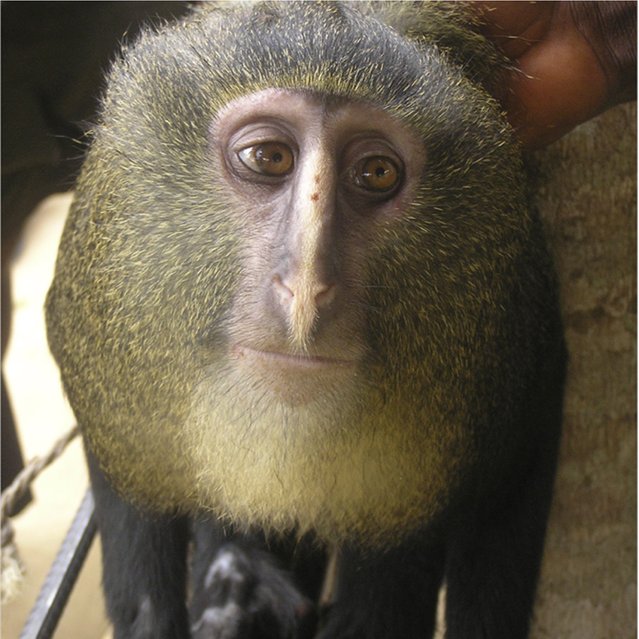
A new species of monkey found in the Democratic Republic of the Congo and identified as Lesula (Cercopithecus lomamiensis) is seen in this undated photograph from an article published September 12, 2012 in the science journal PLOS One. The monkey was first seen in 2007 by researchers John and Terese Hart of the Peabody Museum of Natural History at Yale Research Project. The finding of C. lomamiensis represents only the second new species of African monkey to be discovered in the past 28 years, according to the research article. (Photo by Hart J. A., Detwiler K. M., Gilbert C. C./Reuters)