Loading...
Done
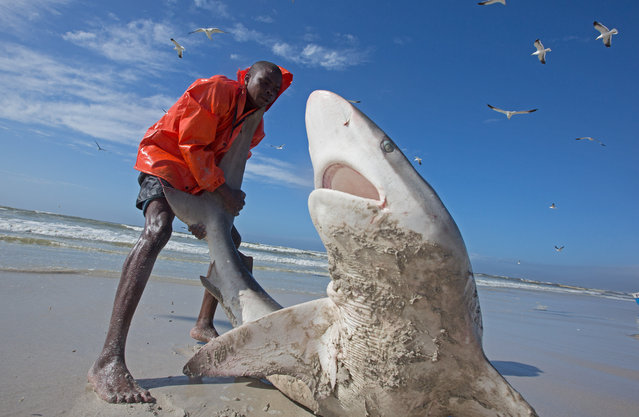
Bronze whaler shark (Carcharhinus brachyurus), caught in traditional seine net and released by fisherman, Muizenberg beach, Cape Town, South Africa on October 11, 2016. Action shots have captured fishermen trying to free a potentially deadly Bronze Whaler shark who was caught in their nets. The incredible images show the eight-foot-long 500-pound predator lunging its mouth towards the fishermen who are desperately trying to pull it back into the safety of the sea by its tail. Eventually they succeeded. (Photo by Chris and Monique Fallows/NPL)

Bronze whaler shark (Carcharhinus brachyurus), caught in traditional seine net and released by fisherman, Muizenberg beach, Cape Town, South Africa on October 11, 2016. Action shots have captured fishermen trying to free a potentially deadly Bronze Whaler shark who was caught in their nets. The incredible images show the eight-foot-long 500-pound predator lunging its mouth towards the fishermen who are desperately trying to pull it back into the safety of the sea by its tail. Eventually they succeeded. (Photo by Chris and Monique Fallows/NPL)
Details
13 Oct 2016 11:51:00
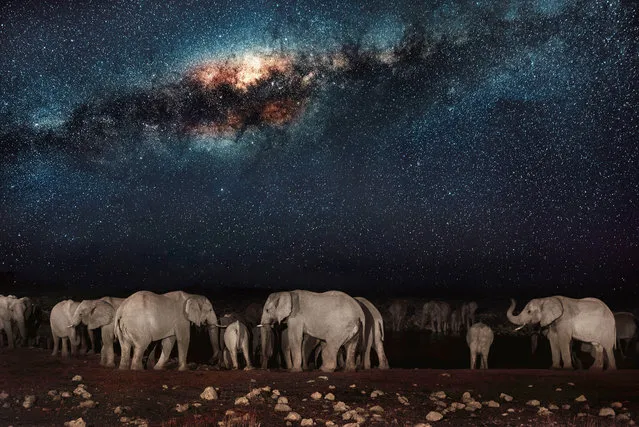
This watering hole is the social hub of the veldt; the scrubby grasslands that stretch across Namibia. The scorched earth supports sometimes fragile populations of magnificent wildlife – from endangered predators to plentiful herds of game. But these gentle giraffes and elephants need to be careful: lions don’t sleep at night, they hunt! The spectacular starscape above southern Africa is unchanged since explorers first mapped the continent. The photographer, Pietro Olivetta from Italy, said he had to be patient to capture these shots – but it was worth the wait. (Photo by Pietro Olivetta/Caters News)

This watering hole is the social hub of the veldt; the scrubby grasslands that stretch across Namibia. The scorched earth supports sometimes fragile populations of magnificent wildlife – from endangered predators to plentiful herds of game. But these gentle giraffes and elephants need to be careful: lions don’t sleep at night, they hunt! The spectacular starscape above southern Africa is unchanged since explorers first mapped the continent. The photographer, Pietro Olivetta from Italy, said he had to be patient to capture these shots – but it was worth the wait. (Photo by Pietro Olivetta/Caters News)
Details
20 Feb 2017 00:05:00
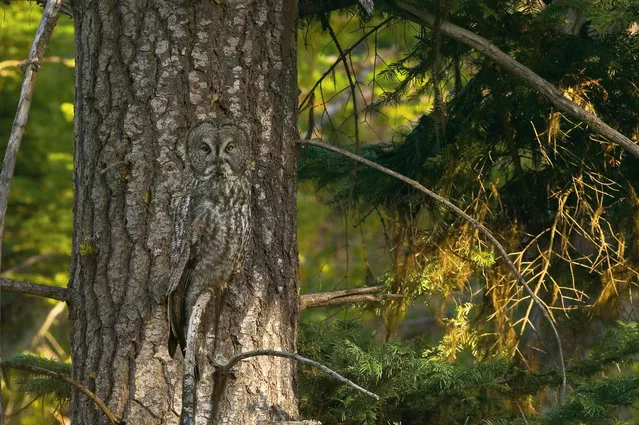
Vanishing Act By Art Wolfe

An amazing series by Art Wolfe that were taken as part of his “Vanishing Act” in which the Seattle-based photographer shows the talent of animals in disguising themselves from predators. “This collection has been a long time in the making. Finding and filming animals on location is an exhilarating and painstaking process. I’m still adding to the project even now”. Have fun spotting the hidden animals.
Details
22 Oct 2013 09:44:00
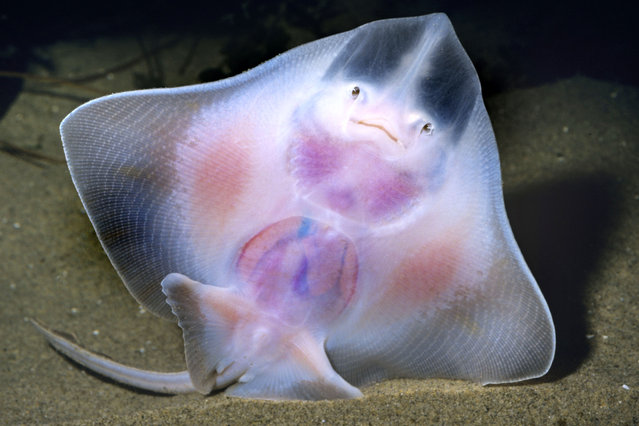
Thornback Skate. (Photo by Ken Lucas/Caters News)

“They're some of the most intriguing and complex creatures on the planet but they really do have nothing to hide – because theyre totally see-through. Transparent animals – creatures with clear glass-like skin – can be found all over the world but their very existence is still shrouded in mystery. The fascinating organisms verge on the invisible and their translucent skin often helps them elude predators”. – Caters News. Photo: Thornback Skate. (Photo by Ken Lucas/Caters News)
Details
04 Sep 2014 08:37:00
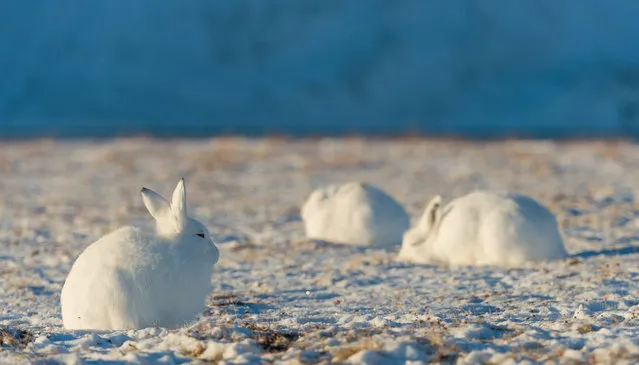
Arctic Hare

The arctic hare, or polar rabbit, is a species of hare which is adapted largely to polar and mountainous habitats. The arctic hare survives with a thick coat of fur and usually digs holes in the ground or under snow to keep warm and sleep. Arctic hares look like rabbits but have shorter ears, are taller when standing, and, unlike rabbits, can thrive in cold climates. They can travel together with many other hares, sometimes huddling with dozens or more, but are usually found alone, taking, in some cases, more than one partner. The arctic hare can run up to 60 kilometres per hour (40 mph). Its predators include the arctic wolf, arctic fox, and ermine.
Details
17 Mar 2014 13:56:00
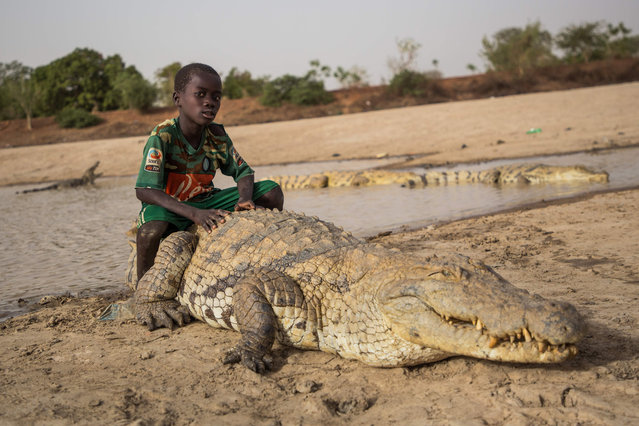
A boy sits on the back of a crocodile on May 19, 2018 at a pond in Bazoule in Burkina Faso, a village which happily shares its local pond with “sacred” crocodiles. Crocodiles may be one of the deadliest hunters in the animal kingdom, but in a small village in Burkina Faso it is not unusual to see someone sitting atop one of the fearsome reptiles. According to local legend, the startling relationship with the predators dates back to at least the 15 th century. The village was in the grip of an agonising drought until the crocodiles led women to a hidden pond where the population could slake their thirst. (Photo by Olympia de Maismont/AFP Photo)

A boy sits on the back of a crocodile on May 19, 2018 at a pond in Bazoule in Burkina Faso, a village which happily shares its local pond with “sacred” crocodiles. Crocodiles may be one of the deadliest hunters in the animal kingdom, but in a small village in Burkina Faso it is not unusual to see someone sitting atop one of the fearsome reptiles. According to local legend, the startling relationship with the predators dates back to at least the 15 th century. The village was in the grip of an agonising drought until the crocodiles led women to a hidden pond where the population could slake their thirst. (Photo by Olympia de Maismont/AFP Photo)
Details
17 Jul 2018 00:01:00
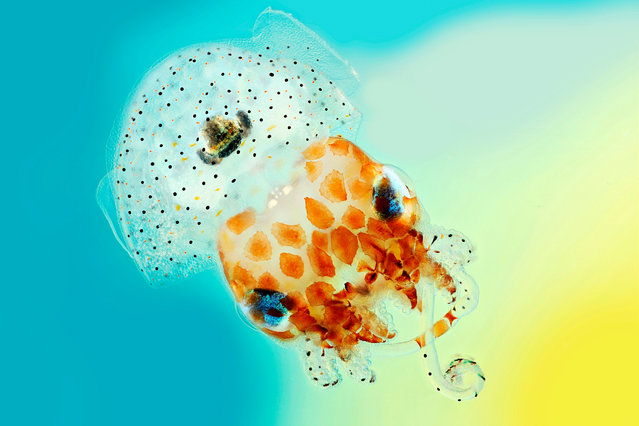
With its huge eyes, comical name and diminutive size, Mark R. Smith’s image of a baby Hawaiian bobtail squid can’t help but raise a smile. A curiously endearing creature, the cephalopod is just 1.5cm across, its mantle cavity bearing more than a passing resemblance to a rather natty shower cap. But it is also a beautiful example of symbiosis – nature’s version of “I’ll scratch your back if you scratch mine” – for on the underside of the squid is a light organ which houses bioluminescent bacteria. The squid offers the bacteria protection and food, while the bacteria emit a glow – a handy trait that the squid uses to offset its silhouette, helping it to evade predators in the depths below. Mark R. Smith’s entry combines several images of a Hawaiian bobtail squid with different focus lengths to create a final picture with greater depth of field than normal. (Photo by Mark R. Smith/Wellcome Images/Macroscopic Solutions)

With its huge eyes, comical name and diminutive size, Mark R. Smith’s image of a baby Hawaiian bobtail squid can’t help but raise a smile. A curiously endearing creature, the cephalopod is just 1.5cm across, its mantle cavity bearing more than a passing resemblance to a rather natty shower cap. But it is also a beautiful example of symbiosis – nature’s version of “I’ll scratch your back if you scratch mine” – for on the underside of the squid is a light organ which houses bioluminescent bacteria. The squid offers the bacteria protection and food, while the bacteria emit a glow – a handy trait that the squid uses to offset its silhouette, helping it to evade predators in the depths below. Mark R. Smith’s entry combines several images of a Hawaiian bobtail squid with different focus lengths to create a final picture with greater depth of field than normal. (Photo by Mark R. Smith/Wellcome Images/Macroscopic Solutions)
Details
08 Mar 2017 00:05:00
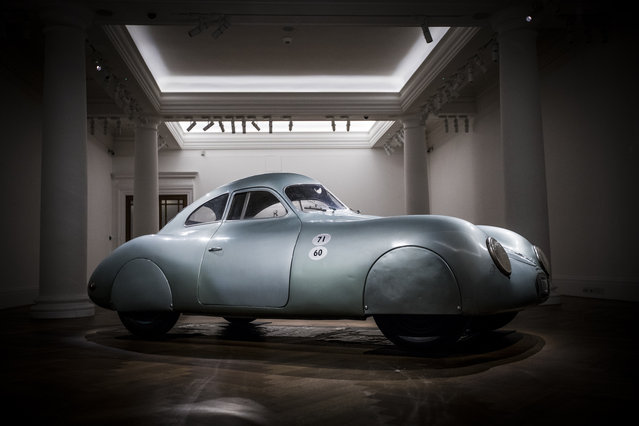
The oldest car to wear the Porsche badge goes on view at Sotheby's on May 21, 2019 in London, England. The only surviving 1939 Porsche Type 64 Berlin-Rome, No. 3, this rare piece of motoring history was the personal car of Ferdinand and Ferry Porsche, predating the first production Porsche, the 356. The car is on view at Sotheby's in London from 21st -24th May prior to being offered for sale by RM Sotheby's in Monterey, California, 15-17th August 2019, with an estimate in excess of $20 million. (Photo by Tristan Fewings/Getty Images for Sotheby's)

The oldest car to wear the Porsche badge goes on view at Sotheby's on May 21, 2019 in London, England. The only surviving 1939 Porsche Type 64 Berlin-Rome, No. 3, this rare piece of motoring history was the personal car of Ferdinand and Ferry Porsche, predating the first production Porsche, the 356. The car is on view at Sotheby's in London from 21st -24th May prior to being offered for sale by RM Sotheby's in Monterey, California, 15-17th August 2019, with an estimate in excess of $20 million. (Photo by Tristan Fewings/Getty Images for Sotheby's)
Details
23 May 2019 00:07:00