Loading...
Done
A crowd of people gathered at the seaside of Udaipur, Digha, India before a cloud burst of rain on May 21, 2022. India Meteorological Department (IMD) has predicted that the Monsoon rain will likely arrive a week early this year due to twin cyclones, Asani and Karim. (Photo by Avishek Das/SOPA Images/LightRocket via Getty Images)

A crowd of people gathered at the seaside of Udaipur, Digha, India before a cloud burst of rain on May 21, 2022. India Meteorological Department (IMD) has predicted that the Monsoon rain will likely arrive a week early this year due to twin cyclones, Asani and Karim. (Photo by Avishek Das/SOPA Images/LightRocket via Getty Images)
Details
23 Aug 2022 04:43:00
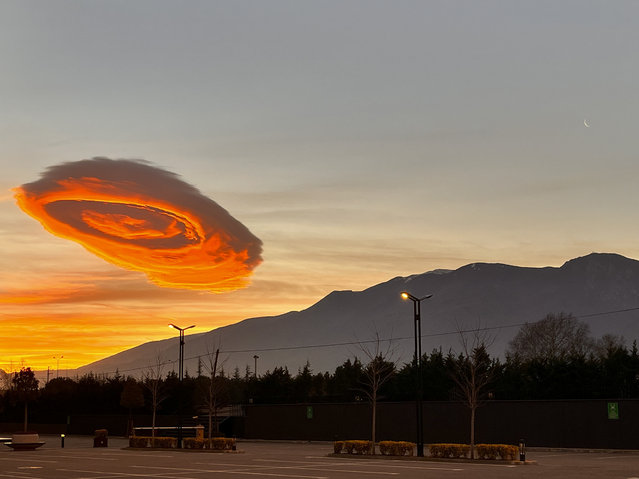
A lenticular cloud is seen during sunrise from Gokmen Aerospace Training Center (GUHEM) in Bursa, Turkiye on January 19, 2023. (Photo by Halit Mirahmetoglu/Anadolu Agency via Getty Images)

A lenticular cloud is seen during sunrise from Gokmen Aerospace Training Center (GUHEM) in Bursa, Turkiye on January 19, 2023. (Photo by Halit Mirahmetoglu/Anadolu Agency via Getty Images)
Details
12 Sep 2023 03:27:00
Before sunrise there is a “Turneresque” sky over the abbey at the picturesque Wiltshire, England market town of Malmesbury on June 11, 2023. (Photo by Terry Mathews/Alamy Live News)

Before sunrise there is a “Turneresque” sky over the abbey at the picturesque Wiltshire, England market town of Malmesbury on June 11, 2023. (Photo by Terry Mathews/Alamy Live News)
Details
17 Jan 2024 17:56:00
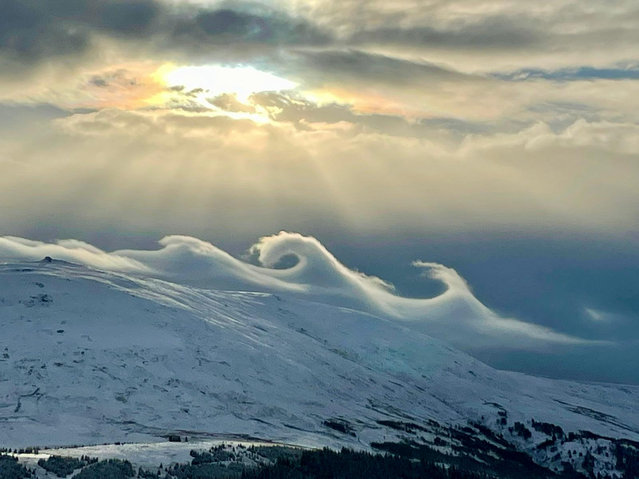
The extremely rare Kelvin-Helmholtz cloud formation lurking in the skies over Northumberland in North East England on December 5, 2023. The distinctive formation gets its name from scientists Lord Kelvin and Hermann von Helmholtz who studied the physics behind the rare cloud. (Photo by Ian Davison/South West News Service)

The extremely rare Kelvin-Helmholtz cloud formation lurking in the skies over Northumberland in North East England on December 5, 2023. The distinctive formation gets its name from scientists Lord Kelvin and Hermann von Helmholtz who studied the physics behind the rare cloud. (Photo by Ian Davison/South West News Service)
Details
20 Aug 2024 03:49:00
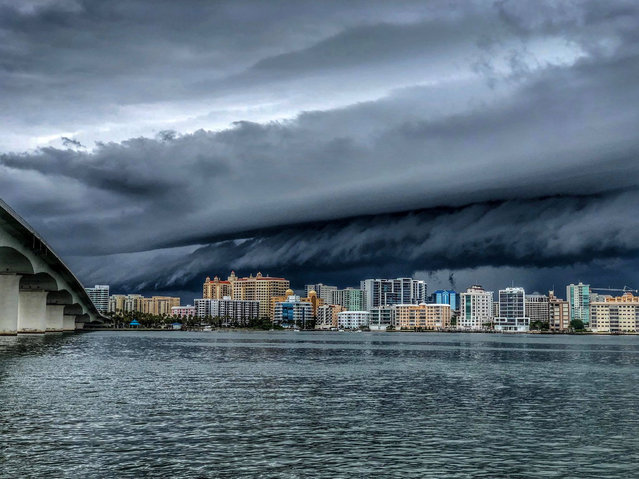
A storm is seen in Sarasota, Florida, June 24, 2018. (Courtesy of Val Vasilescu/Facebook.com/Kingofsunsets via Reuters)

A storm is seen in Sarasota, Florida, June 24, 2018. (Courtesy of Val Vasilescu/Facebook.com/Kingofsunsets via Reuters)
Details
01 Aug 2018 00:05:00
Two paddle boarders stop to watch the sunrise on a stormy morning in Sanibel, Fla., Thursday, August 15, 2019. (Photo by J. David Ake/AP Photo)

Two paddle boarders stop to watch the sunrise on a stormy morning in Sanibel, Fla., Thursday, August 15, 2019. (Photo by J. David Ake/AP Photo)
Details
07 Oct 2019 00:03:00
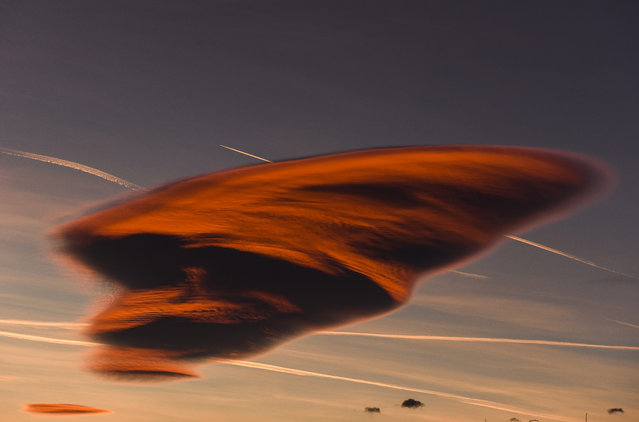
This photo taken on December 2, 2015 shows a lenticular cloud forming as white streaks from airplanes mark the blue sky, in a rare atmospheric phenomena above the town of Gevgelija on December 2, 2015. Lenticular clouds have been regularly confused for UFOs throughout history due to the their smooth, round or oval lens-shaped structure. (Photo by Armend Nimani/AFP Photo)

This photo taken on December 2, 2015 shows a lenticular cloud forming as white streaks from airplanes mark the blue sky, in a rare atmospheric phenomena above the town of Gevgelija on December 2, 2015. Lenticular clouds have been regularly confused for UFOs throughout history due to the their smooth, round or oval lens-shaped structure. (Photo by Armend Nimani/AFP Photo)
Details
31 Dec 2019 00:03:00
Stairway To Heaven In Hawaii

The Haʻikū Stairs, also known as the Stairway to Heaven or Haʻikū Ladder, is a steep hiking trail on the island of Oʻahu. The trail began as a wooden ladder spiked to the cliff on the south side of the Haʻikū Valley. It was installed in 1942 to enable antenna cables to be strung from one side of the cliffs above Haʻikū Valley to the other. A building to provide a continuous communication link between Wahiawā and Haʻikū Valley Naval Radio Station was constructed at the peak of Puʻukeahiakahoe, elevation about 2,800 feet (850 m). The antennae transmitted very low frequency radio signals from a 200,000-watt Alexanderson alternator in the center of Haʻikū valley. The signals could reach US Navy submarines as far away as Tokyo Bay while the submarines were submerged.

Details
30 Nov 2013 12:47:00