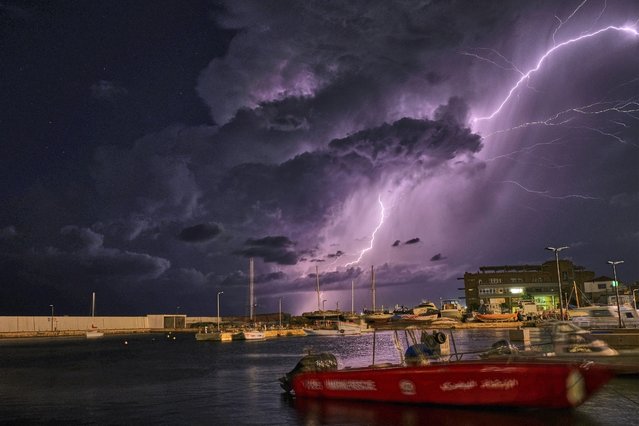
Lightning streaks across the skies over the coastal port city of Batroun, some 43km north of the Lebanese capital Beirut on December 6, 2023. (Photo by Ibrahim Chalhoub/AFP Photo)
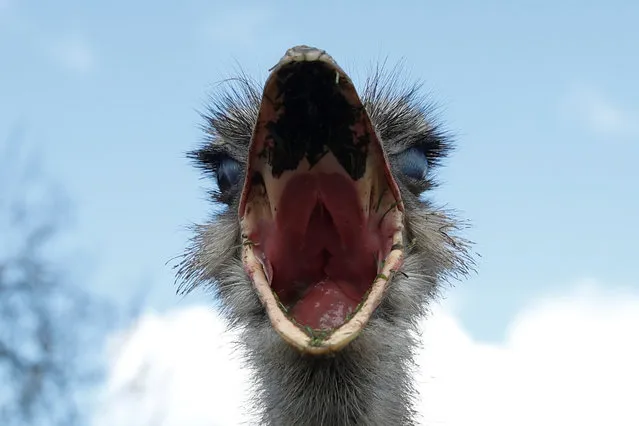
An ostrich is seen at Woburn Safari park before its opening as coronavirus disease (COVID-19) restrictions begin to ease, in Woburn, Britain on April 11, 2021. (Photo by Andrew Boyers/Reuters)
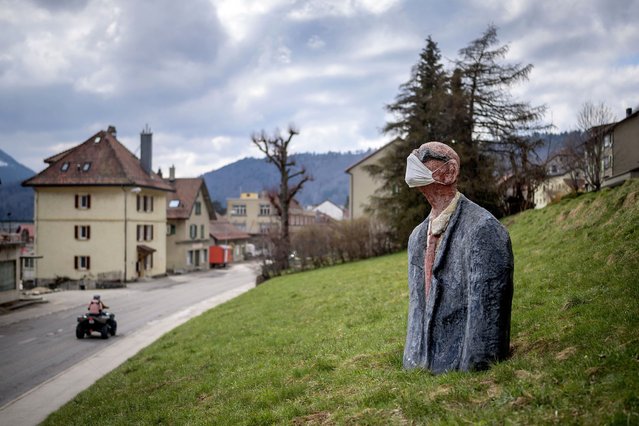
A picture taken on April 18, 2020 in Sainte-Croix shows a scultpure representing a man wearing a facemask as a preventive measure against the Covid-19 coronavirus in a field. (Photo by Fabrice Coffrini/AFP Photo)
A priest sprinkles holy water on a believer during the Orthodox Easter service in the Holy Transfiguration Cathedral in the rebel-controlled city of Donetsk, Ukraine on May 2, 2021. (Photo by Alexander Ermochenko/Reuters)
Fire blows from a fogging machine as a worker sprays fumigation vapour to stem the spread of dengue virus along a street in Peshawar, Pakistan, October 18, 2021. (Photo by Fayaz Aziz/Reuters)
Salvadoran indigenous participate in the International Day of the Indigenous Peoples at Divino Slavador square in San Salvador, El Salvador, 09 August 2016. (Photo by Oscar Rivera/EPA)
The cast of “Transparent” pose in various positions as they arrive at The HBO Golden Globe After Party in Beverly Hills, California January 10, 2016. (Photo by Mario Anzuoni/Reuters)
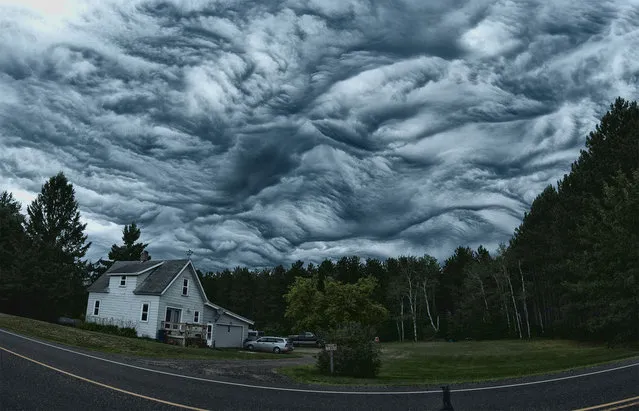
Undulatus asperatus (or alternately, asperatus) is a cloud formation, proposed in 2009 as a separate cloud classification by the founder of the Cloud Appreciation Society. If successful it will be the first cloud formation added since cirrus intortus in 1951 to the International Cloud Atlas of the World Meteorological Organization. The name translates approximately as “roughened or agitated waves”.