Loading...
Done
Floating Vases By ooDesign

This vase is simple as a piece of cake but it’s so special at the same time – it’s Floating Ripple vase by ooDesign. It’s a piece manufactured in glass that allows any transparent vase to look like ripples in water.
Long-stemmed flowers float vertically in the water and according to the movement of the air, they change their position within the container – so, what can I say? Japanese designers continue to create genially simple and natural-looking philosophic pieces that inspire everybody.
Details
14 Jun 2015 08:58:00
“A very delicate person, beneath the flamboyance”. Jasper, Ladbroke Grove, 1977. “In the 1970s, Australia was rather cut off. I’d always wanted to live abroad, so I moved to Rome and then London. I was an art historian, but started studying photography part-time. I was interested in the demi-monde culture and began mixing in all sorts of circles. Jasper was a rather wonderful character. He was from Sydney, but he was living downstairs from me in Ladbroke Grove, in a flat rented to some gay friends. It was fairly eclectic. Jasper was always playing around with clothes and makeup. If he was looking particularly wonderful, I might get out my lights and take a shot. Or he might put makeup on me. He wasn’t always in drag, but he was permanently in diva mode, dependably louche, funny and naughty. I think all that comes across in the image. He was actually a very delicate person, though, beneath the wit and flamboyance. Jasper floated through London all too briefly. His real name was Peter MacMahon, but to us he was only ever Jasper Havoc, an alter ego he’d created while part of a transvestite troupe called Sylvia and the Synthetics. They were legendary in Sydney gay culture. On this day, we’d been taking some pictures inside and had gone out into the streets to fool around some more. Jasper was wearing a corset and fishnets ensemble, with other bits and pieces, and we joked about him being trashy as he lay in the skip. We just took the shot for ourselves. It wasn’t done with any publication in mind, or anything else. This was way before the internet and people didn’t share images. If you dressed up, it was just for that moment”. (Photo by Jane England)

“A very delicate person, beneath the flamboyance”. Jasper, Ladbroke Grove, 1977. “In the 1970s, Australia was rather cut off. I’d always wanted to live abroad, so I moved to Rome and then London. I was an art historian, but started studying photography part-time. I was interested in the demi-monde culture and began mixing in all sorts of circles. Jasper was a rather wonderful character...”. (Photo by Jane England)
Details
26 Jun 2017 09:04:00
A performer wearing a lion mask performs the Ise Daikagura lion dance at the remote village of Yamanawa on February 08, 2021 in Ryuo, Japan. Ise Daikagura is a group of traditional Lion Dance performers who pray in front of farmers houses and businesses for good grain harvests and disease-free lives. Performers play sacred music using drums and flutes with two lion mask dancers. A lion mask is considered a symbol of God, who enters the house and performs in front of the Shinto God, a statue placed inside the house, mostly in the kitchen. These prayers are called “Kamodo Barai”. After the prayers, they are gifted with money, rice, sake and Japanese sweets from the householders. A group can travel for more than one hundred days to thousands of households and businesses throughout rural-villages in western Japan, and pray to those who are unable to visit the country’s most sacred shrine, the Grand Ise Shrine in Mie Prefecture. The group started its performance in the Edo era between 1603 to 1868 according to Japanese history. The Japanese government designated it as an important folk cultural national property in 1981. (Photo by Buddhika Weerasinghe/Getty Images)

A performer wearing a lion mask performs the Ise Daikagura lion dance at the remote village of Yamanawa on February 08, 2021 in Ryuo, Japan. Ise Daikagura is a group of traditional Lion Dance performers who pray in front of farmers houses and businesses for good grain harvests and disease-free lives. (Photo by Buddhika Weerasinghe/Getty Images)
Details
18 Feb 2021 09:27:00
A sushi restaurant staff member holds the cut tail of the auctioned 212-kilogram Bluefin tuna after the New Year's first auction of the Toyosu Market, at the Kaiten Sushi Ginza Onodera in Tokyo, Japan, 05 January 2023. Yukitaka Yamaguchi, president of wholesaler Yamayuki, and the company operating the Sushi Ginza Onodera restaurants, secured the first tuna auction of the New Year with a bid of almost 257,000 euros (36.04 million Japanese Yen). (Photo by Franck Robichon/EPA/EFE)

A sushi restaurant staff member holds the cut tail of the auctioned 212-kilogram Bluefin tuna after the New Year's first auction of the Toyosu Market, at the Kaiten Sushi Ginza Onodera in Tokyo, Japan, 05 January 2023. Yukitaka Yamaguchi, president of wholesaler Yamayuki, and the company operating the Sushi Ginza Onodera restaurants, secured the first tuna auction of the New Year with a bid of almost 257,000 euros (36.04 million Japanese Yen). (Photo by Franck Robichon/EPA/EFE)
Details
13 Jan 2023 02:02:00
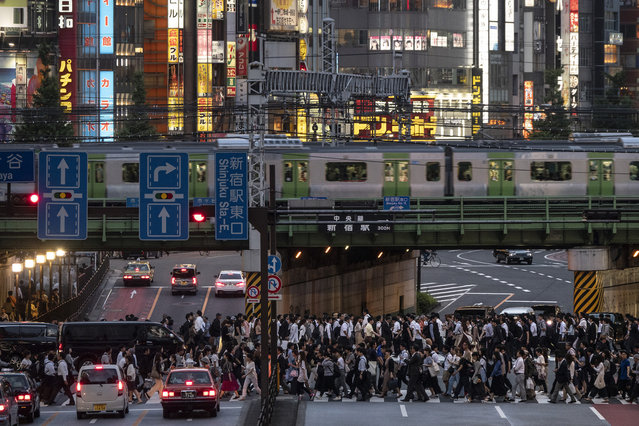
In this Tuesday, June 4, 2019, photo, a Yamanote Line train travels above commuters walking across the crossing during evening rush hours in the Shinjuku district of Tokyo. Operated by the East Japan Railway Co., the Yamanote Line in Tokyo makes a loop around the center of the city, connecting 29 stations that include key stops such as Shinjuku, Shibuya and Ikebukuro. A complete loop of about an hour offers scenes of Japanese daily lives. (Photo by Jae C. Hong/AP Photo)

In this Tuesday, June 4, 2019, photo, a Yamanote Line train travels above commuters walking across the crossing during evening rush hours in the Shinjuku district of Tokyo. Operated by the East Japan Railway Co., the Yamanote Line in Tokyo makes a loop around the center of the city, connecting 29 stations that include key stops such as Shinjuku, Shibuya and Ikebukuro. A complete loop of about an hour offers scenes of Japanese daily lives. (Photo by Jae C. Hong/AP Photo)
Details
27 Jun 2019 00:03:00


“Itasha (痛車), literally “painmobile”, is a Japanese term for an otaku fad of individuals decorating the bodies of their cars with fictional characters of anime, manga, or video games (especially bishōjo game or eroge). These characters are predominately “cute” female. The decorations usually involve paint schemes and stickers. Automobiles are called Itasha, while similar motorcycles and bicycles are called itansha (痛単車) and itachari (痛チャリ), respectively”. – Wikipedia


Photo: A visitor takes pictures of an anime-decorated «Itasha» car displayed during the “Moe Fes in Washimiya” at Washimiya Town Hall on July 18, 2009 in Washimiya, Saitama, Japan. Itasha, a word derived from “itai” (painful) and “sha” (car), are vehicles decorated with mostly female characters from Japanese manga, anime and video games. (Photo by Kiyoshi Ota/Getty Images)
Details
02 May 2011 08:38:00
Seized plastic handguns which were created using 3D printing technology are displayed at Kanagawa police station in Yokohama, south of Tokyo, in this photo taken by Kyodo May 8, 2014. (Photo by Reuters/Kyodo)

Seized plastic handguns which were created using 3D printing technology are displayed at Kanagawa police station in Yokohama, south of Tokyo, in this photo taken by Kyodo May 8, 2014. Yoshimoto Imura became the first man to be arrested in Japan for illegal possession of two guns he created himself using 3D printing technology, Japanese media said on Thursday. The 27-year-old, a college employee in the city of Kawasaki, was arrested after police found video online posted by Imura claiming to have produced his own guns. Gun possession is strictly regulated in Japan. Police raided Imura's home and found five guns, two of which could fire real bullets, Japanese media said. (Photo by Reuters/Kyodo)
Details
12 May 2014 10:46:00
A humanoid robot named Kansei, meaning “sensibility” in Japanese, makes a facial expression depicting “happiness”, next to the word “Love” during a demonstration at a laboratory of Meiji University's Robot and Science Institute in Kawasaki, south of Tokyo in this June 4, 2007 file photo. (Photo by Yuriko Nakao/Reuters)

A humanoid robot named Kansei, meaning “sensibility” in Japanese, makes a facial expression depicting “happiness”, next to the word “Love” during a demonstration at a laboratory of Meiji University's Robot and Science Institute in Kawasaki, south of Tokyo in this June 4, 2007 file photo. Three-fourths of robot installations over the next decade are expected to be concentrated in four areas: transportation equipment, including the automotive sector; computer and electronic products; electrical equipment and machinery. Labor costs have climbed in countries such as China that have been popular for outsourcing production, while technological advances for robots allow them to be more flexible and perform more tasks. (Photo by Yuriko Nakao/Reuters)
Details
17 Apr 2015 09:39:00