Loading...
Done
German artist Ha Schult stands with his trash people below the pyramids May 15, 2002 in Giza, Egypt

“HA Schult, born Hans-Jürgen Schult on June 24, 1939 in Parchim, Mecklenburg is a German installation, happening and conceptual artist known primarily for his object and performance art and more specifically his work with garbage”. – Wikipedia

Photo: German artist Ha Schult stands with his “trash people” below the pyramids May 15, 2002 in Giza, Egypt. Inspired by the statues of the terracotta army of Chinese Emperor Quin Shi Huangdi (247–206 B.C.), the thousand piece sulpture has stood in Red Square in Moscow, La Defense in Paris and the Great Wall in China. Schult, born in 1939 wants to bring the “trash war” to the world's attention beause trash is the greatest battle facing mankind. (Photo by Norbert Schiller/Getty Images)
Details
31 Jul 2011 13:37:00
Fresh produce and baskets of fish surround a woman at the Siti Khadijah market in Kota Bharu, Malaysia. (Photo by Duratul Ain D.)

Fresh produce and baskets of fish surround a woman at the Siti Khadijah market in Kota Bharu, Malaysia. (Photo by Duratul Ain D.)
Details
25 Dec 2015 08:06:00
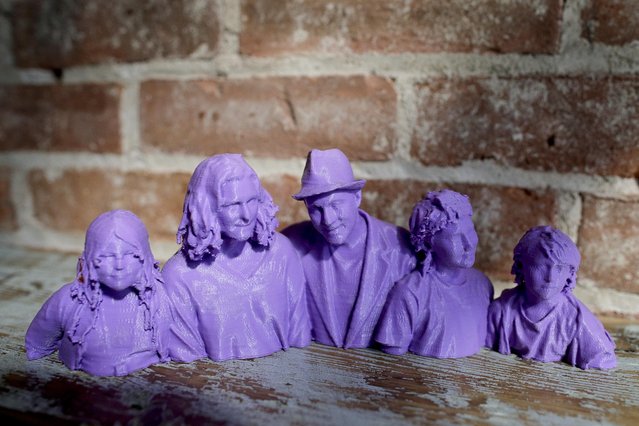
In this August 14, 2014 photo, a plastic bust statue of Kevin Micelli, center, and his family, made by a 3-D scanner and printer, sits on a shelf inside Micelli's coffee shop in New York. Micelli purchased the 3-D scanning and printing services at the Cubo toy store next door to his shop. With the old studio portrait supplanted by the selfie, 3-D scanning services provide a new reason for people to go to a store and stand stock-still in front of a camera. (Photo by Julie Jacobson/AP Photo)

“The advent of digital cameras and smartphones killed the traditional mall portrait studio, but 3-D printing has sparked a new trend. Overloaded with digital photos, statues may be moving in to fulfill our desire for portraits that stand out”. – Peter Svensson via The Associated Press. (Photo by Julie Jacobson/AP Photo)
Details
12 Oct 2014 12:28:00
Restive woman driving. (Photo by Cultura Creative (RF)/Alamy Stock Photo )

Restive woman driving. (Photo by Cultura Creative (RF)/Alamy Stock Photo)
Details
31 May 2017 07:01:00
A woman selling souvenirs walks through Kuta beach in Bali June 5, 2008. Indonesia is expected to report tourist arrivals in December this week. (Photo by Murdani Usman/Reuters)

A woman selling souvenirs walks through Kuta beach in Bali June 5, 2008. Indonesia is expected to report tourist arrivals in December this week. (Photo by Murdani Usman/Reuters)
Details
02 Feb 2016 13:40:00
A boy reaches for a ball on a creek clogged with plastic waste on April 15, 2023 in Caloocan, Metro Manila, Philippines. (Photo by Ezra Acayan/Getty Images)

A boy reaches for a ball on a creek clogged with plastic waste on April 15, 2023 in Caloocan, Metro Manila, Philippines. (Photo by Ezra Acayan/Getty Images)
Details
06 May 2023 03:12:00
People gather to view a new art installaiton at Waterfront Park entitled,  Interstellar Influencer (Make an Impact) by Jason Klimoski and Lesley Chang of  STUDIOKCA on Saturday March 30, 2024 in Alexandria, VA. The artwork depicts an asteroid that struck the region millions of years ago. (Photo by Matt McClain/The Washington Post)

People gather to view a new art installaiton at Waterfront Park entitled, Interstellar Influencer (Make an Impact) by Jason Klimoski and Lesley Chang of STUDIOKCA on Saturday March 30, 2024 in Alexandria, VA. The artwork depicts an asteroid that struck the region millions of years ago. (Photo by Matt McClain/The Washington Post)
Details
27 Apr 2024 05:39:00
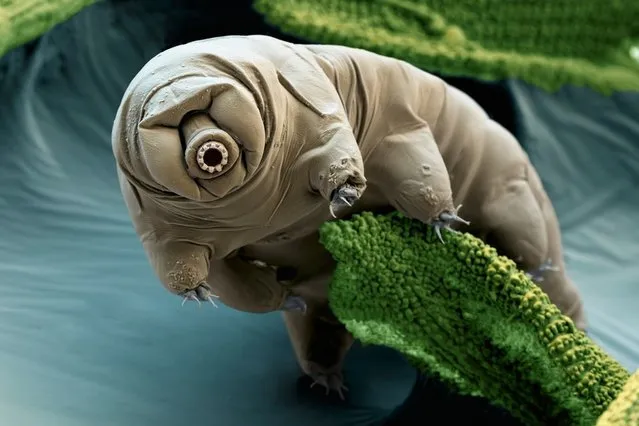
Tardigrades (commonly known as waterbears or moss piglets). (Photo by SPL/East News)

“Tardigrades (commonly known as waterbears or moss piglets) are small, water-dwelling, segmented animals with eight legs. Tardigrades were first discovered in 1773 by Johann August Ephraim Goeze, who called them kleiner Wasserbär, meaning “little water bear” in German. The name Tardigrada means “slow walker” and was given by Lazzaro Spallanzani in 1777. The name water bear comes from the way they walk, reminiscent of a bear's gait. The biggest adults may reach a body length of 1.5 millimetres (0.059 in), the smallest below 0.1 mm. Freshly hatched tardigrades may be smaller than 0.05 mm”. – Wikipedia. Photo: Tardigrades. (Photo by SPL/East News)
Details
26 Sep 2012 09:55:00