Loading...
Done
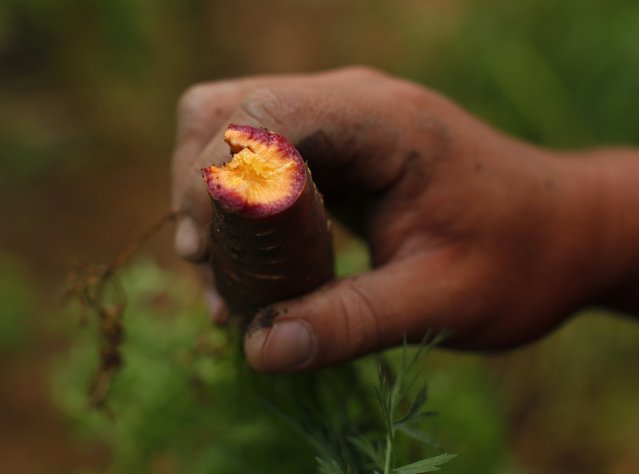
Makoto Chino eats a purple haze carrot as he works harvesting the morning's vegetables and fruit from his family's farm in Rancho Santa Fe, California August 12, 2014. (Photo by Mike Blake/Reuters)

Makoto Chino eats a purple haze carrot as he works harvesting the morning's vegetables and fruit from his family's farm in Rancho Santa Fe, California August 12, 2014. The gravitational pull of Chino Farm is legendary. Since they don't ship, everyone – whether a top chef or a traveling foodie or a local resident – comes to the farm stand, simply called “Vegetable Shop”, on a dusty corner of this affluent San Diego County town, hemmed in by sprawling housing estates. (Photo by Mike Blake/Reuters)
Details
26 Nov 2014 14:41:00
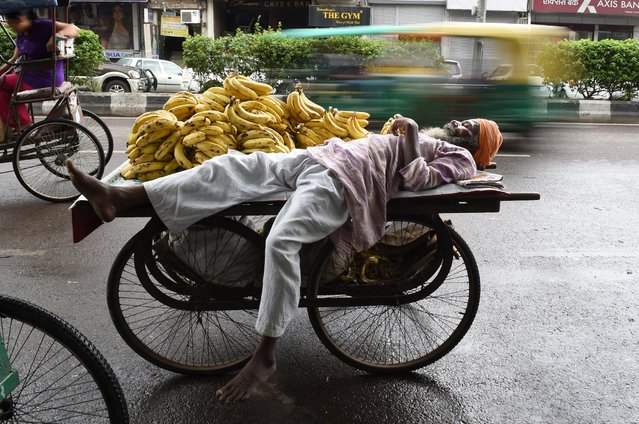
An Indian street vendor selling bananas naps on his fruit cart at the roadside in New Delhi on June 3, 2015. (Photo by Money Sharma/AFP Photo)

An Indian street vendor selling bananas naps on his fruit cart at the roadside in New Delhi on June 3, 2015. (Photo by Money Sharma/AFP Photo)
Details
02 Mar 2016 13:33:00
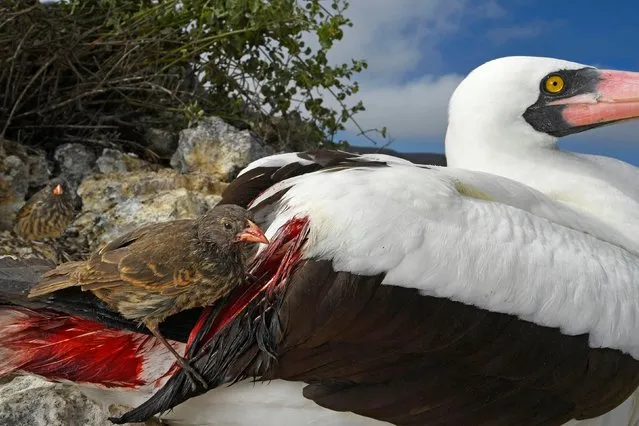
Bloodthirsty by Thomas P Peschak, Germany/South Africa — winner, Behaviour: birds. When rations run short on Wolf Island, in the remote northern Galápagos, the sharp-beaked ground finches become vampires. Their sitting targets are Nazca boobies and other large birds. The finches rely on a scant diet of seeds and insects, which regularly dries up, so they drink blood to survive. ‘I’ve seen more than half a dozen finches drinking from a single Nazca booby,’ says Tom. Rather than leave their nests the boobies tolerate the vampires, and the blood loss doesn’t seem to cause permanent harm. (Photo by Thomas P Peschak/2018 Wildlife Photographer of the Year)

Bloodthirsty by Thomas P. Peschak, Germany/South Africa — winner, Behaviour: birds. When rations run short on Wolf Island, in the remote northern Galápagos, the sharp-beaked ground finches become vampires. Their sitting targets are Nazca boobies and other large birds. The finches rely on a scant diet of seeds and insects, which regularly dries up, so they drink blood to survive. ‘I’ve seen more than half a dozen finches drinking from a single Nazca booby,’ says Tom. Rather than leave their nests the boobies tolerate the vampires, and the blood loss doesn’t seem to cause permanent harm. (Photo by Thomas P. Peschak/2018 Wildlife Photographer of the Year)
Details
19 Oct 2018 00:05:00
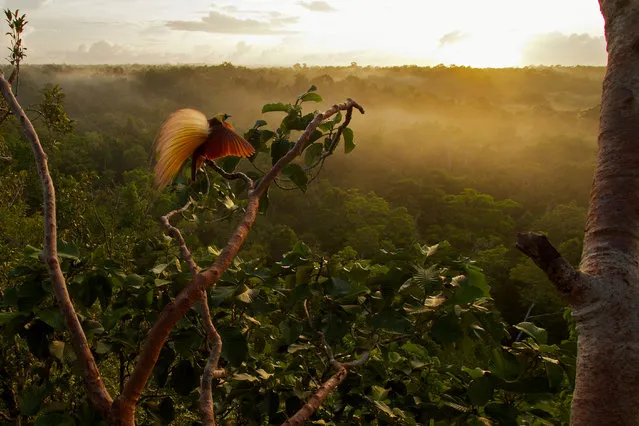
A greater bird of paradise (Paradisaea apoda) displaying in Badigaki Forest, Wokam Island (Aru Islands, Indonesia). Found here in Aru and on adjacent New Guinea, the greater bird of paradise represents about 40 different species of birds of paradise that depend on intact rainforest across the New Guinea region spanning eastern Indonesia and Papua New Guinea. With more than 80% of forest cover still intact, this region represents the largest remaining block of rainforest in the entire Asia-Pacific. (Photo by Tim Laman/naturepl.com/LDY Agency)

A greater bird of paradise (Paradisaea apoda) displaying in Badigaki Forest, Wokam Island (Aru Islands, Indonesia). Found here in Aru and on adjacent New Guinea, the greater bird of paradise represents about 40 different species of birds of paradise that depend on intact rainforest across the New Guinea region spanning eastern Indonesia and Papua New Guinea. With more than 80% of forest cover still intact, this region represents the largest remaining block of rainforest in the entire Asia-Pacific. (Photo by Tim Laman/naturepl.com/LDY Agency)
Details
14 Nov 2021 05:57:00
Women pose for a selfie in a lavender field at Hitchin Lavender farm in Ickleford, Britain, August 4, 2020. (Photo by Peter Cziborra/Reuters)

Women pose for a selfie in a lavender field at Hitchin Lavender farm in Ickleford, Britain, August 4, 2020. (Photo by Peter Cziborra/Reuters)
Details
26 Jun 2021 09:31:00
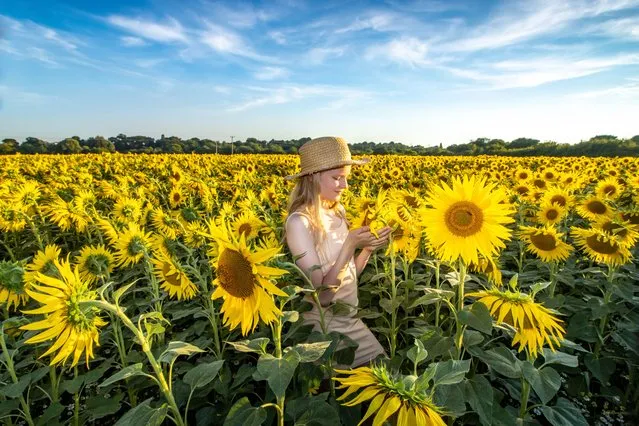
Georgia Baker, 12, enjoys the bright yellow Sunflower field on a farm near Christchurch in Dorset on August 7, 2022. (Photo by Rachel Baker/Bournemouth News)

Georgia Baker, 12, enjoys the bright yellow Sunflower field on a farm near Christchurch in Dorset on August 7, 2022. (Photo by Rachel Baker/Bournemouth News)

Details
11 Nov 2022 06:00:00
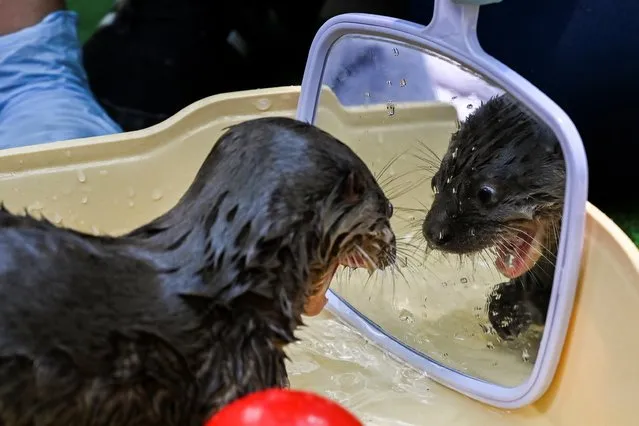
A river otter (lontra longicaudis) of 6-weeks-old looks in the mirror during a bath in the Animal Welfare Unit of the Zoo in Cali, Colombia, on October 22, 2019. The baby otter was found abandoned brought to the Cali Zoo for breeding, for its extensive experience in raising these species. According to the International Union for Conservation of Nature the river otter (lontra longicaudis) are in danger of extinction, because of mining, agriculture, pollution of rivers and housing construction in their habitat. (Photo by Luis Robayo/AFP Photo)

A river otter (lontra longicaudis) of 6-weeks-old looks in the mirror during a bath in the Animal Welfare Unit of the Zoo in Cali, Colombia, on October 22, 2019. The baby otter was found abandoned brought to the Cali Zoo for breeding, for its extensive experience in raising these species. According to the International Union for Conservation of Nature the river otter (lontra longicaudis) are in danger of extinction, because of mining, agriculture, pollution of rivers and housing construction in their habitat. (Photo by Luis Robayo/AFP Photo)
Details
27 Oct 2019 00:03:00


“The Antonov An-124 Ruslan (NATO reporting name: Condor) is a strategic airlift jet aircraft. It was designed by the Soviet Union's Antonov design bureau. It is the world's largest ever serially-manufactured cargo airplane and world's second largest operating cargo aircraft. During development it was known as Izdeliye 400 in house, and An-40 in the West. First flown in 1982, civil certification was issued on 30 December 1992”. – Wikipedia

Photo: The new metro called “Bombardier MOVIA” with 22,50 meters long and 3,2 meters wide is load on a Antonow An-124 plane for transport to India on February 25, 2009 in Parchim, Germany. (Photo Handout Bombardier Transportation via Getty Images)
Details
21 Jul 2011 13:19:00