Loading...
Done
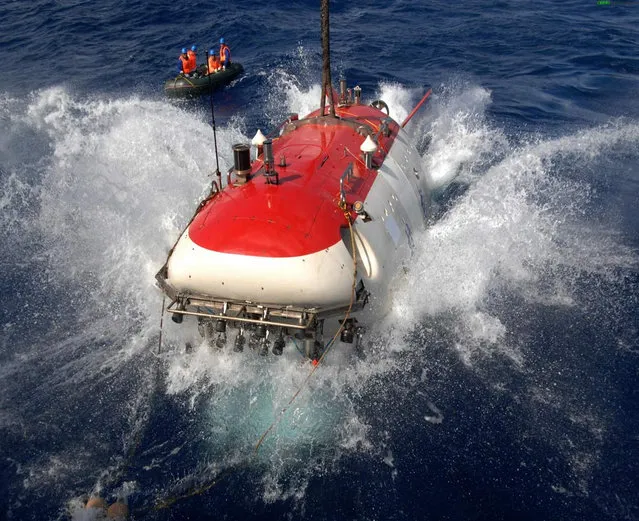
China-made Manned Jiaolong Submersible Reaches 6,965 Meters In The Mariana Trench

Submersible “Jiaolong” is put into the sea for the second dive during a series of six scheduled ones to attempt the country's deepest-ever 7,000-meter manned dive on June 19, 2012 in At Sea, Unspecified. The submersible “Jiaolong”, carrying three people, reportedly reached a depth of 6,965 meters in the Mariana Trench, the deepest part of the world's oceans which is located in the western Pacific Ocean, on June 19, local time. (Photo by China Foto Press)
Details
21 Jun 2012 09:54:00
Nova, a Walpi, in 1906. (Photo by Edward S. Curtis)

At the beginning of the 20th century, Edward S. Curtis set out to document what he saw as a disappearing race: the Native American. From 1907 to 1930, Curtis took more than 2,000 photos of 80 tribes stretching from the Great Plains to the Pacific Northwest and Alaska. He then published and sold these photos, along with narrative text, in 20 volumes of work known as “The North American Indian”. It is one of the most significant collections of its kind, “probably the most important photographic document of its age and its topic,” said Jeffrey Garrett, associate university librarian for Special Libraries at Northwestern University. (Photo by Edward S. Curtis)
Details
07 Sep 2014 12:57:00
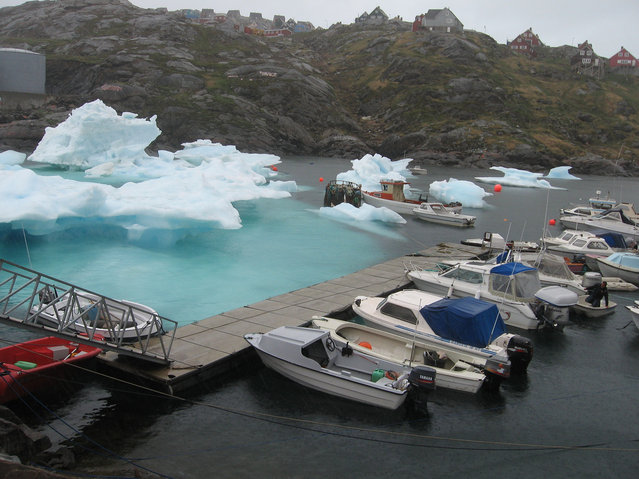
Tasiilaq Greenland

Tasiilaq, formerly Ammassalik and Angmagssalik, is a town in the Sermersooq municipality in southeastern Greenland. With 1,930 inhabitants as of 2010, it is the most populous community on the eastern coast, and the seventh-largest town in Greenland. The Sermilik Station, dedicated to the research of the nearby Mittivakkat Glacier, is located near the town.
Details
09 Mar 2015 11:33:00


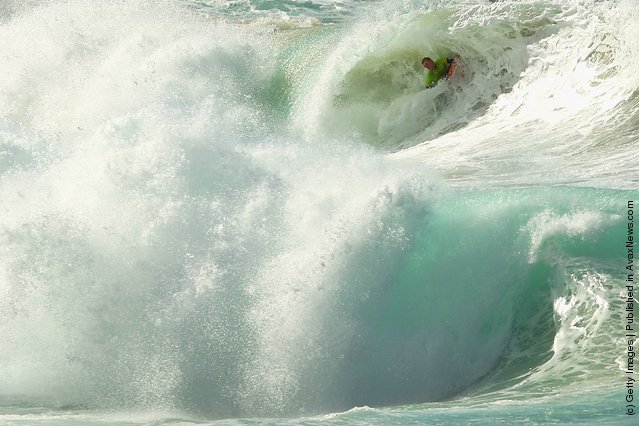
A bodyboarder rides a wave at Mackenzies Bay on May 1, 2011 in Sydney, Australia. A strong east-south-east swell has developed along the NSW coastline with waves between 6ft and 8ft expected to hit the coast for much of the weekend and into next week. (Photo by Cameron Spencer/Getty Images)
Details
01 May 2011 08:02:00
Girls sleep in the back of their father's moto-taxi as he watches them from the front seat, days after an earthquake in Pedernales, Ecuador, Wednesday, April 20, 2016. A fresh tremor rattled Ecuador before dawn Wednesday, a magnitude-6.1 jolt that set babies crying and shaken residents pouring once again into the streets, fearful of yet more damage following a monster earthquake over the weekend. (Photo by Dolores Ochoa/AP Photo)

Girls sleep in the back of their father's moto-taxi as he watches them from the front seat, days after an earthquake in Pedernales, Ecuador, Wednesday, April 20, 2016. A fresh tremor rattled Ecuador before dawn Wednesday, a magnitude-6.1 jolt that set babies crying and shaken residents pouring once again into the streets, fearful of yet more damage following a monster earthquake over the weekend. (Photo by Dolores Ochoa/AP Photo)
Details
21 Apr 2016 12:02:00


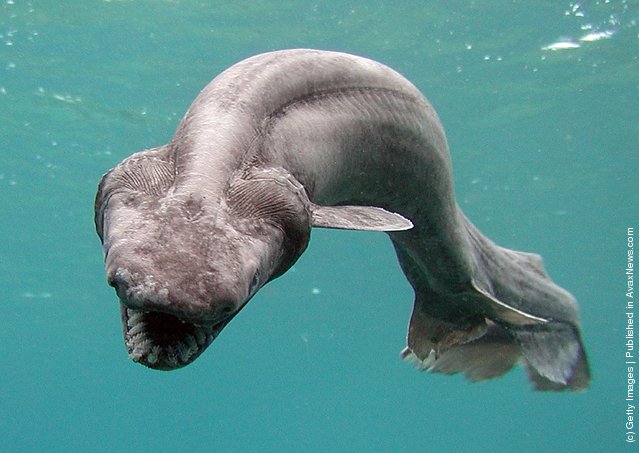
“The frilled shark (Chlamydoselachus anguineus) is one of two extant species of shark in the family Chlamydoselachidae, with a wide but patchy distribution in the Atlantic and Pacific Oceans. This uncommon species is found over the outer continental shelf and upper continental slope, generally near the bottom though there is evidence of substantial upward movements. It has been caught as deep as 1,570 m (5,150 ft), whereas in Suruga Bay, Japan it is most common at depths of 50–200 m (160–660 ft). Exhibiting several “primitive” features, the frilled shark has often been termed a «living fossil»”. – Wikipedia

Photo: A 1.6 meter long Frill shark swims in a tank after being found by a fisherman at a bay in Numazu, on January 21, 2007 in Numazu, Japan. The frill shark, also known as a Frilled shark usually lives in waters of a depth of 600 meters and so it is very rare that this shark is found alive at sea-level. It's body shape and the number of gill are similar to fossils of sharks which lived 350,000,000 years ago. (Photo by Awashima Marine Park/Getty Images)

Details
05 May 2011 10:01:00


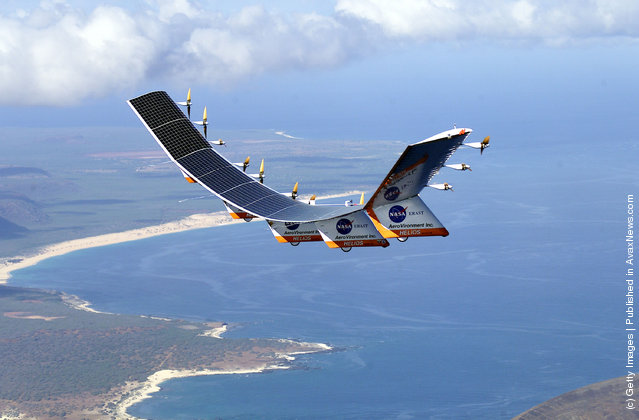
“NASA's Pathfinder, Pathfinder Plus, Centurion and Helios Prototype were an evolutionary series of solar- and fuel-cell-system-powered unmanned aerial vehicles. AeroVironment, Inc. developed the vehicles under NASA's Environmental Research Aircraft and Sensor Technology (ERAST) program. They were built to develop the technologies that would allow long-term, high-altitude aircraft to serve as “atmospheric satellites”, to perform atmospheric research tasks as well as serve as communications platforms”. – Wikipedia

Photo: The solar-electric Helios Prototype flying wing is flies over the Hawaiian islands of Niihau and Lehua during the first solar-powered test flight July 14, 2001 from the U.S. Navy's Pacific Missile Range Facility on Kauai, HI. The 18-hour flight was a functional checkout of the aircraft's systems and performance in preparation for an attempt to reach sustained flight at 100,000 feet altitude later in the summer. (Photo Courtesy of NASA/Getty Images)
Details
14 Jul 2011 09:24:00
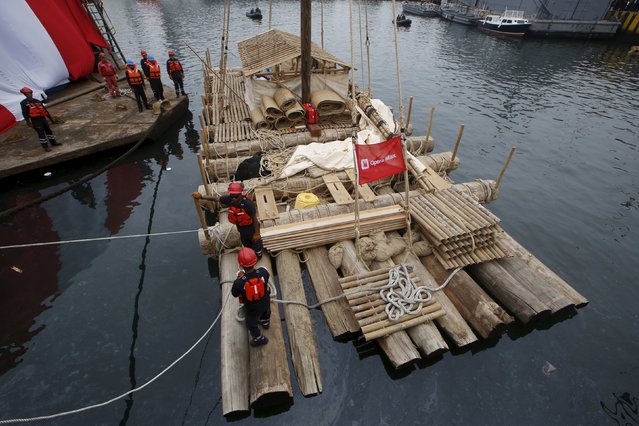
One of the two wooden rafts of the Kon-Tiki II expedition is prepared  at the port of Callao prior to the departure to Pascua island in Chile, in Callao, Peru, October 30, 2015. Fourteen men from various parts of the world set out on rafts to commemorate the  Norwegian navigator Thor Heyerdahl expedition 68 years ago. (Photo by Mariana Bazo/Reuters)

One of the two wooden rafts of the Kon-Tiki II expedition is prepared at the port of Callao prior to the departure to Pascua island in Chile, in Callao, Peru, October 30, 2015. Fourteen men from various parts of the world set out on rafts to commemorate the Norwegian navigator Thor Heyerdahl expedition 68 years ago. The original raft crossed the Pacific Ocean from South America to the Polynesian Islands. This rafts are a replica of ships used 6,000 years ago, but will be equipped with solar panel. (Photo by Mariana Bazo/Reuters)
Details
02 Nov 2015 08:00:00