Loading...
Done
NASA's rover Opportunity visits Victoria Crater, viewed from orbit by the High Resolution Imaging Science Experiment on NASA's Mars Reconnaissance Orbiter in october of 2006. Opportunity is a small dot on the crater's lip, at top right. Opportunity first reached the crater's rim on September 27, 2006. (Photo by NASA/JPL-Caltech/University of Arizona/The Atlantic)

“NASA's Mars rover Opportunity just celebrated its ninth anniversary on Mars – a mission that was originally meant to last just 90 days...” – The Atlantic. Photo: NASA's rover Opportunity visits Victoria Crater, viewed from orbit by the High Resolution Imaging Science Experiment on NASA's Mars Reconnaissance Orbiter in october of 2006. Opportunity is a small dot on the crater's lip, at top right. Opportunity first reached the crater's rim on September 27, 2006. (Photo by NASA/JPL-Caltech/University of Arizona via The Atlantic)


Details
14 Feb 2013 10:58:00
An infrared portrait from NASA's Spitzer Space Telescope which shows generations of stars is seen in this undated NASA handout image released February 14, 2013. In this wispy star-forming region, called W5, the oldest stars can be seen as blue dots in the centers of the two hollow cavities (other blue dots are background and foreground stars not associated with the region). Red shows heated dust that pervades the region's cavities, while green highlights dense clouds. (Photo by NASA/Reuters/JPL-Caltech/Harvard-Smithsonian/Handout)

An infrared portrait from NASA's Spitzer Space Telescope which shows generations of stars is seen in this undated NASA handout image released February 14, 2013. In this wispy star-forming region, called W5, the oldest stars can be seen as blue dots in the centers of the two hollow cavities (other blue dots are background and foreground stars not associated with the region). Red shows heated dust that pervades the region's cavities, while green highlights dense clouds. (Photo by NASA/Reuters/JPL-Caltech/Harvard-Smithsonian/Handout)
Details
03 Mar 2013 08:44:00
Military Woman Part 3

'Military woman' is a constantly updated gallery of images of women wearing uniform: military, police and so on. We truly hope that our beloved visitors won't remain passive and will take part in this project making it even more interesting! Note that all the images featured in the gallery are taken from publically available sources: their copyright belongs to their respective creators and the trade mark to the owners. ...

See also:Part 1 _ Part 2
Details
11 Mar 2015 10:29:00


“Henri Marie Raymond de Toulouse-Lautrec-Monfa or simply Henri de Toulouse-Lautrec (24 November 1864 – 9 September 1901) was a French painter, printmaker, draughtsman, and illustrator, whose immersion in the colourful and theatrical life of fin de siècle Paris yielded an œuvre of exciting, elegant and provocative images of the modern and sometimes decadent life of those times. Toulouse-Lautrec is known along with Cézanne, Van Gogh, and Gauguin as one of the greatest painters of the Post-Impressionist period. In a 2005 auction at Christie's auction house a new record was set when “La blanchisseuse”, an early painting of a young laundress, sold for $22.4 million U.S” – Wikipedia.

Photo: Full-length portrait of French artist Henri Toulouse-Lautrec wearing an overcoat, a bowler hat, and pince-nez eyeglasses while holding a cane. (Photo by Hulton Archive/Getty Images). Circa 1895
Details
20 Mar 2011 09:28:00


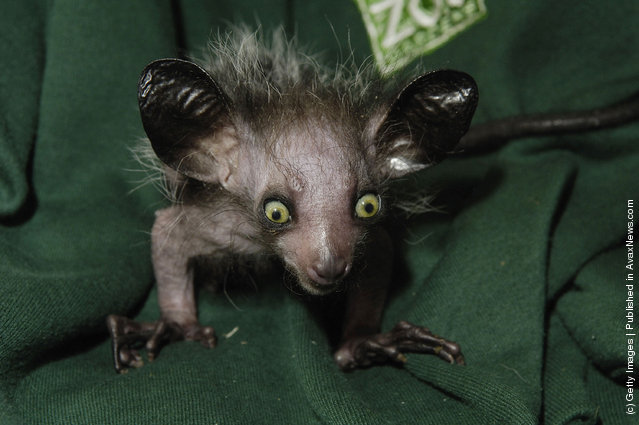
“The aye-aye (Daubentonia madagascariensis) is a lemur, a strepsirrhine primate native to Madagascar that combines rodent-like teeth and a special thin middle finger to fill the same ecological niche as a woodpecker. It is the world's largest nocturnal primate, and is characterized by its unusual method of finding food; it taps on trees to find grubs, then gnaws holes in the wood and inserts its narrow middle finger to pull the grubs out. The only other animal species known to find food in this way is the striped possum. From an ecological point of view the aye-aye fills the niche of a woodpecker as it is capable of penetrating wood to extract the invertebrates within”. – Wikipedia

Photo: In this handout image from Bristol Zoo is seen the first captive bred aye-aye in the UK named “Kintana” (meaning star in Malagasy) April 15, 2005 at Bristol Zoo Gardens, England. The zoo announced today only the second baby aye-aye to be hand-reared in the world (the first was in Jersey Zoo) and has now made his first public appearance since his birth on 11 February 2005. (Photo by Rob Cousins/Bristol Zoo via Getty Images)
Details
13 Apr 2011 13:33:00
A Ballet Paraisópolis student wearing a face mask rehearses amidst the coronavirus (COVID-19) pandemic on August 13, 2020 in Sao Paulo, Brazil. The Ballet Paraisópolis is a project that teaches dance to children and young people in the Paraisópolis community in order to encourage them to seek better life opportunities. Founded in 2012 by ballerina, teacher and choreographer, Monica Tarragó, Ballet Paraisópolis has a total of 200 students and another 2,000 on the waiting list. (Photo by Alexandre Schneider/Getty Images)

A Ballet Paraisópolis student wearing a face mask rehearses amidst the coronavirus (COVID-19) pandemic on August 13, 2020 in Sao Paulo, Brazil. The Ballet Paraisópolis is a project that teaches dance to children and young people in the Paraisópolis community in order to encourage them to seek better life opportunities. Founded in 2012 by ballerina, teacher and choreographer, Monica Tarragó, Ballet Paraisópolis has a total of 200 students and another 2,000 on the waiting list. (Photo by Alexandre Schneider/Getty Images)
Details
02 Sep 2020 00:01:00
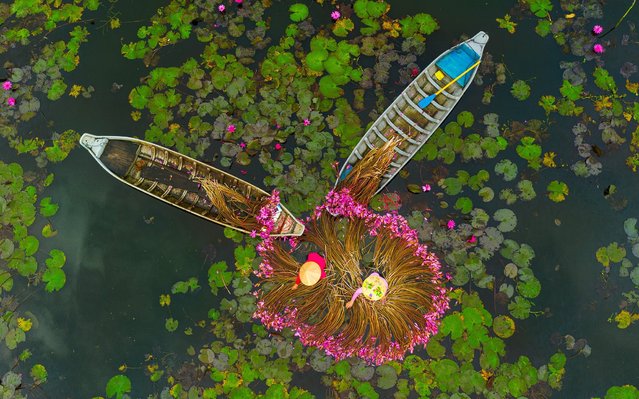
Incredible drone image capture colourful water lilies being harvested in An Giang Province, Vietnam, Southeast Asia on September 2020. Water lilies are an iconic symbol in the Mekong Delta and the flowers are immediately sent to market before landing on meal tables. Their stalks are edible and can be eaten raw with either fermented paste or braised sauce, or dunked into sour soup or hotpot. (Photo by Nguyen Sanh Quoc Huy/Triangle News)

Incredible drone image capture colourful water lilies being harvested in An Giang Province, Vietnam, Southeast Asia on September 2020. Water lilies are an iconic symbol in the Mekong Delta and the flowers are immediately sent to market before landing on meal tables. Their stalks are edible and can be eaten raw with either fermented paste or braised sauce, or dunked into sour soup or hotpot. (Photo by Nguyen Sanh Quoc Huy/Triangle News)
Details
25 Sep 2020 00:05:00
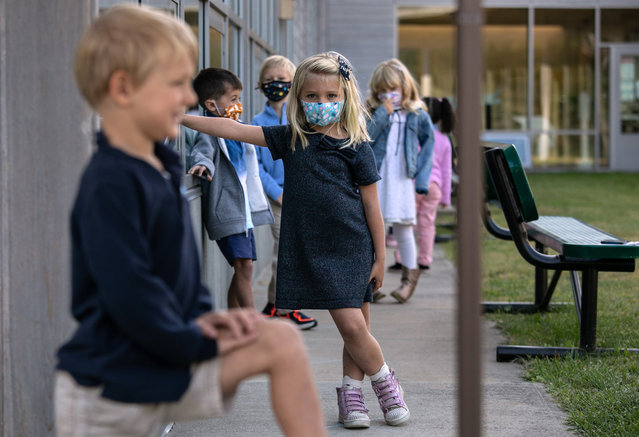
Kindergartner Cameron McManus, 5, watches as a fellow student has his portrait made during “picture day” at Rogers International School on September 23, 2020 in Stamford, Connecticut. Students lined up outside to be photographed while socially distanced due to COVID-19 precautions. Most students at Stamford Public Schools are taking part in a hybrid education model, attending in-school classes every other day and distance learning the rest. (Photo by John Moore/Getty Images)

Kindergartner Cameron McManus, 5, watches as a fellow student has his portrait made during “picture day” at Rogers International School on September 23, 2020 in Stamford, Connecticut. Students lined up outside to be photographed while socially distanced due to COVID-19 precautions. Most students at Stamford Public Schools are taking part in a hybrid education model, attending in-school classes every other day and distance learning the rest. (Photo by John Moore/Getty Images)
Details
03 Oct 2020 00:03:00