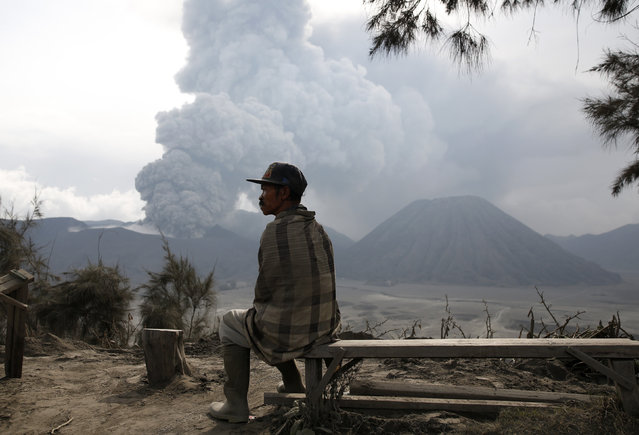
A local resident rests on a bench as Mount Bromo volcano erupts in the background in Ngadisari, Probolinggo, East Java, Indonesia January 5, 2016. (Photo by Darren Whiteside/Reuters)
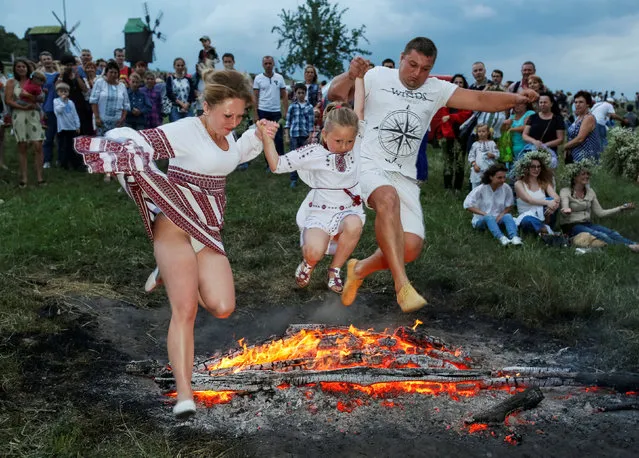
People jump over a campfire during a celebration on the traditional Ivana Kupala (Ivan the Bather) holiday, the ancient tradition, originating from pagan times, is usually marked with grand overnight festivities during which people sing and dance around campfires, believing it will purge them of their sins and make them healthier, in Kiev, Ukraine, July 6, 2016. (Photo by Gleb Garanich/Reuters)
Participants hold red scarves as they celebrate the “Chupinazo” marking the start at noon sharp of the San Fermin Festival at Castle square in Pamplona, northern Spain on July 6, 2013. Ten of thousands of people packed Pamplona's streets for a drunken kick-off to Spain's best-known fiesta: the nine-day San Fermin bull-running festival. (Photo by Pedro Armestre/AFP Photo)
JAPAN: A businessman stands at a pond in the Kyu-Shiba-rikyu Garden on a warm and sunny day in Tokyo, Japan, March 18, 2016. (Photo by Thomas Peter/Reuters)
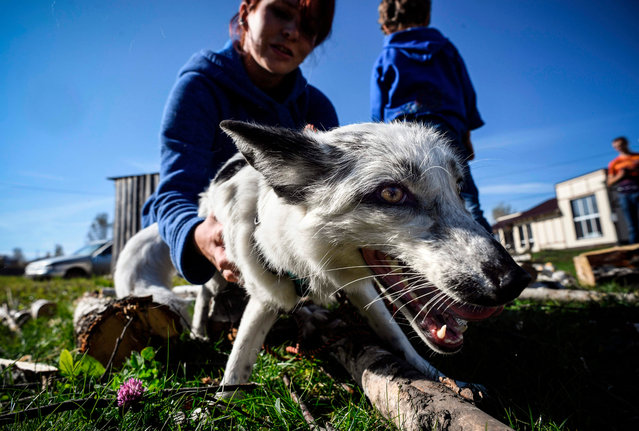
Tatyana Abramova, 33, plays with her home fox Plombir at her countryside house outside Siberian city of Novosibirsk on September 12, 2020. The official start of the Soviet experiment to better understand the domestication of animals by humans began in 1959, and was initiated by geneticists Dmitri Beliaiev and Lioudmila Trout on a farm in Akademgorodok, the scientific center of excellence in Siberia. Their primary objective was to domesticate foxes, to understand how the ancestor of wolves, another canine, evolved into a loyal and loving dog. And understand what this domestication tells us about the genetic evolution of species. (Photo by Alexander Nemenov/AFP Photo)