People wearing face masks to help curb the spread of the coronavirus wait to walk across a traffic intersection in Osaka, western Japan, Thursday, November 26, 2020. (Photo by Hiro Komae/AP Photo)
A model prepares backstage of the House of Holland catwalk show during London Fashion Week Women's A/W19 in London, Britain on February 16, 2019. (Photo by Henry Nicholls/Reuters)
Sea of clouds is seen after a rainfall at the Huangshan Mountain scenic spot on April 10, 2019 in Huangshan, Anhui Province of China. (Photo by Fang Lihua/Qianlong.com/VCG via Getty Images)
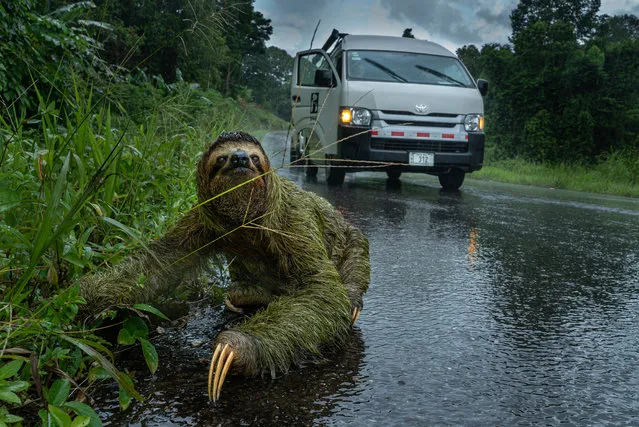
People and Nature category winner: Why did the sloth cross the road? by Andrew Whitworth (Osa Conservation and University of Glasgow), taken in Osa Peninsula, Costa Rica. “I was driving out from the Osa Peninsula, located on the southern Pacific coast of Costa Rica on a dark, stormy day. This female three-toed sloth (Bradypus variegatus) had luckily just about made it across the road, and the drivers of the Toyota on this occasion had spotted her in good time”. (Photo by Andrew Whitworth/2019 British Ecological Society Photography Competition)
Young Haitian migrants hang out in the Batey La Lima community, an impoverished community surrounded by a massive sugarcane plantation in the coastal city of La Romana, Dominican Republic, Wednesday, November 17, 2021. As the rest of the world closes its doors to Haitian migrants, the country that shares an island with Haiti also is cracking down in a way that human rights activists say hasn’t been seen in decades. (Photo by Matias Delacroix/AP Photo)
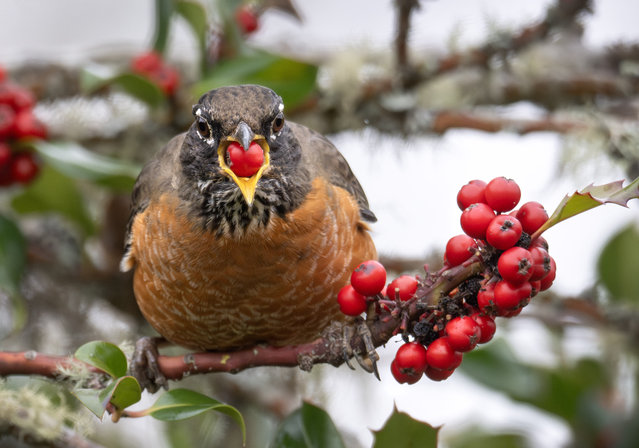
An American robin feeds on holly berries in a thicket near Elkton in southwestern Oregon on November 16, 2024. Many birds can safely consume holly berries, including blackbirds, redwings, and thrushes. There is an old wives tale that if you see a bird eating a berry, it is safe for humans to eat, but this is not true. Birds consume many plants that are poisonous to humans, holly berries included. (Photo by Robin Loznak/ZUMA Press Wire/Rex Features/Shutterstock)