Loading...
Done
People move through a waterlogged street in Gauhati, India, Tuesday, July 16, 2013.  Heavy showers flooded some areas in the city on Tuesday. (Photo by Anupam Nath/AP Photo)

People move through a waterlogged street in Gauhati, India, Tuesday, July 16, 2013. Heavy showers flooded some areas in the city on Tuesday. (Photo by Anupam Nath/AP Photo)
Details
17 Jul 2013 10:16:00
A man wearing personal protective equipment (PPE) cremates a body of a coronavirus disease (COVID-19) victim at the crematory as the country recorded the highest daily increase in deaths since the pandemic began, in Kathmandu, Nepal on May 3, 2021. (Photo by Navesh Chitrakar/Reuters)

A man wearing personal protective equipment (PPE) cremates a body of a coronavirus disease (COVID-19) victim at the crematory as the country recorded the highest daily increase in deaths since the pandemic began, in Kathmandu, Nepal on May 3, 2021. (Photo by Navesh Chitrakar/Reuters)
Details
15 May 2021 08:31:00
Surfers walk out of the water at sunset after surfing along the coast of Kiritimati Island, part of the Pacific Island nation of Kiribati, April 5, 2016. (Photo by Lincoln Feast/Reuters)


Kiritimati is a far-flung outpost of the Republic of Kiribati. The world's largest coral atoll, Kiritimati has just one flight a week to either Fiji or Hawaii, four-and-a-half hours in either direction. Tarawa, the capital of Kiribati lies nearly 3,300 km (2,000 miles) to the west – about three weeks by boat. No lawyers are based on Kiritimati and the High Court only comes once or twice a year to clear a backlog of the most serious cases, bringing a public lawyer for defendants who can't afford their own. (Photo by Lincoln Feast/Reuters)
Details
28 Apr 2016 12:01:00
A terminally ill patient raises his arm in a hospice for those dying of AIDS at the Buddhist temple Wat Prabat Nampu in Lopburi province, north of Bangkok November 30, 2014. From 1992, the temple has provided housing for HIV positive patients and palliative care for those in the final stages of the AIDS disease. (Photo by Damir Sagolj/Reuters)

A terminally ill patient raises his arm in a hospice for those dying of AIDS at the Buddhist temple Wat Prabat Nampu in Lopburi province, north of Bangkok November 30, 2014. From 1992, the temple has provided housing for HIV positive patients and palliative care for those in the final stages of the AIDS disease. Data from 2013 estimates Thailand has 450,000 people living with HIV/AIDS, but only 353,000 have access to life-saving antiretroviral drugs. (Photo by Damir Sagolj/Reuters)
Details
08 Dec 2014 11:52:00
He was provided with black and white film, and would photograph as many as 60 people a day, against a portable white backdrop. But he also carried a wide-angle camera with expensive C-41 colour film, and took his own photo portraits. (Photo by Alexander Chekmenev/The Guardian)

In 1994, after the fall of the Soviet Union, all Ukrainians had to get a new passport – and photographer Alexander Chekmenev was on hand to take their photos. The snatched extra shots he took are remarkable in their honesty and tenderness. (Photo by Alexander Chekmenev/The Guardian)
Details
30 Dec 2016 10:22:00
Three female friends dancing in nightclub. (Photo by Cultura Creative (RF)/Alamy Stock Photo )

Three female friends dancing in nightclub. (Photo by Cultura Creative (RF)/Alamy Stock Photo )
Details
12 May 2017 07:00:00
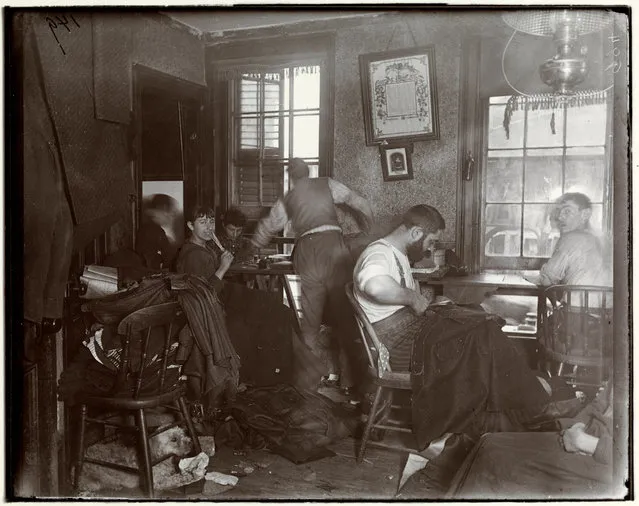
Drastic inequality is by no means new in New York. Jacob A. Riis was called a muckraker after he chose to spotlight the city’s poverty at the turn of the 20th century by photographing it. Here: Sweatshop in Hester Street, 1889-1890. (Photo by Jacob A. Riis/Museum of the City of New York, Gift of Roger William Riis)

Drastic inequality is by no means new in New York. Jacob A. Riis was called a muckraker after he chose to spotlight the city’s poverty at the turn of the 20th century by photographing it. Here: Sweatshop in Hester Street, 1889-1890. (Photo by Jacob A. Riis/Museum of the City of New York, Gift of Roger William Riis)
Details
16 Nov 2015 08:12:00
Reading the Metro, enjoying some Swedish meatballs. (Photo by Svetlana Valyiskaya/Mercury)

It's often said that pets and their owners can start to look alike, but these adorable photographs take the old mantra to a new extreme. They are the work of Svetlana Valyiskaya (27), from St Petersburg, who snaps pets in everyday poses in her spare time from her job as a commercial photographer. The vibrant costumes and scenes, which Svetlana designs herself, have made the photos a hit in her native Russia – and it's not hard to see why. She said: “I really love animals, they are loyal, faithful and true and always interesting to work with – plus they never criticise the photographs afterwards”. (Photo by Svetlana Valyiskaya/Mercury)
Details
03 Sep 2014 10:44:00