Loading...
Done
A female adult jaguar, which has a cub, growls at the Mamiraua Sustainable Development Reserve in Uarini, Amazonas state, Brazil, June 5, 2017. (Photo by Bruno Kelly/Reuters)

Brazilian jaguars, imperilled by hunters, ranchers and destruction of their habitat, have learned to survive at least one menace – flooding in the Amazon. They take to the trees. Although they can be six feet long and 200 pounds, the largest South American cats nimbly navigate treetops where they stay from April to July when the rainforest floor is under meters-deep water. Here: A female adult jaguar, which has a cub, growls at the Mamiraua Sustainable Development Reserve in Uarini, Amazonas state, Brazil, June 5, 2017. (Photo by Bruno Kelly/Reuters)
Details
07 Apr 2018 00:03:00
People carrying torches march during the traditional Bonfire Celebrations in Lewes, Britain, 04 November 2017. (Photo by Neil Hall/EPA/EFE)

People carrying torches march during the traditional Bonfire Celebrations in Lewes, Britain on November 4, 2017. Lewes holds Britain's largest Bonfire night celebrations. The event marks Guy Fawkes Night and the uncovering of the Gunpowder Plot in 1605 and commemorates the memory seventeen Protestant martyrs from the town who were burned at the stake. Thousands gather with flaming torches to march through the street and burn effigies. (Photo by Neil Hall/EPA/EFE)
Details
05 Nov 2017 08:30:00
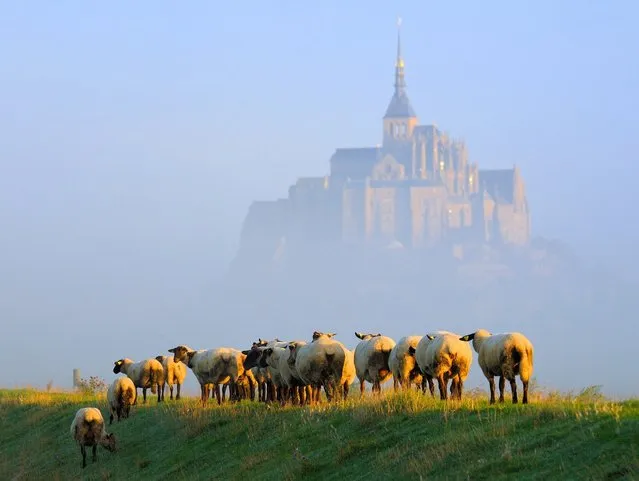
Mont St-Michel In Normandy, France

During the feudal times, the society was very structured where everyone knew their place. Fishermen knew that they would always have to bend their knee for highborn ladies and gentlemen, while the latter considered themselves to be far too superior to even look at the common folk. Mont Saint-Michel is a living memorial of those times. Its structural composition clearly reflects the structure of feudal society: The monastery and abbey were built on the highest point; housing and stores were built some distance below; finally, fishermen’s and farmer’s houses were constructed, not even being within the city walls, making them the most vulnerable to the possible attack.
Details
03 Mar 2015 10:20:00
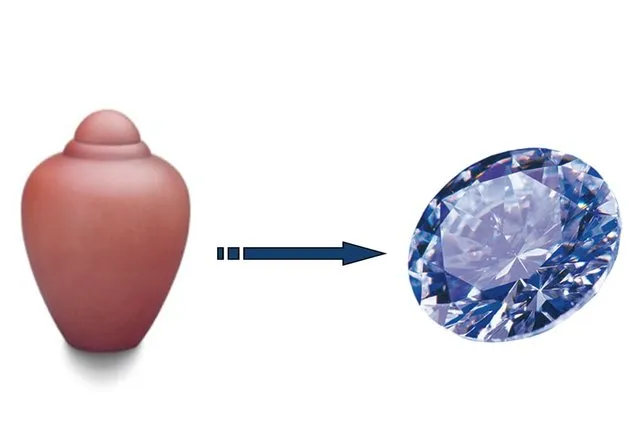
Swiss Company Turns People’s Ashes Into Diamonds

In the past people used to bury their loved ones or turn them into ashes. However, now there is a completely new possibility. Since having an urn with ashes in your house may be a bit weird, you may want to choose the option of turning your deceased relative into a diamond. Yes, diamond! You’ve heard us correctly. By using immense heat and pressure, the ashes you get after cremating a person can be turned into a real diamond. After this, the diamond can be left as it is, and stored in a jewelry box, or it can be used as a piece of jewelry, such as a ring or a pendant, allowing you to always keep your loved one close to your heart. (Photo by djd/Algordanza memorial diamonds)
Details
20 Oct 2014 08:52:00
A devotee takes a holy bath in River Saali in Sankhu on the first day of Swasthani Brata Katha festival in Kathmandu January 5, 2015. During the month long festival, devotees recite one chapter of a Hindu tale daily from the 31-chapter sacred Swasthani Brata Katha book that is dedicated to God Madhavnarayan and Goddess Swasthani, alongside various other gods and goddess and the miraculous feats performed by them. (Photo by Navesh Chitrakar/Reuters)

A devotee takes a holy bath in River Saali in Sankhu on the first day of Swasthani Brata Katha festival in Kathmandu January 5, 2015. During the month long festival, devotees recite one chapter of a Hindu tale daily from the 31-chapter sacred Swasthani Brata Katha book that is dedicated to God Madhavnarayan and Goddess Swasthani, alongside various other gods and goddess and the miraculous feats performed by them. (Photo by Navesh Chitrakar/Reuters)
Details
06 Jan 2015 12:22:00
Devotees take a holy bath during the Swasthani Brata Katha festival in Kathmandu January 20, 2015. During the month-long festival, devotees recite one chapter of a Hindu tale daily from the 31-chapter sacred Swasthani Brata Katha book that is dedicated to God Madhavnarayan and Goddess Swasthani, alongside various other gods and goddesses and the miraculous feats performed by them. (Photo by Navesh Chitrakar/Reuters)

Devotees take a holy bath during the Swasthani Brata Katha festival in Kathmandu January 20, 2015. During the month-long festival, devotees recite one chapter of a Hindu tale daily from the 31-chapter sacred Swasthani Brata Katha book that is dedicated to God Madhavnarayan and Goddess Swasthani, alongside various other gods and goddesses and the miraculous feats performed by them. The devotees also go on pilgrimages to various temples, perform religious rituals, take a holy bath in the rivers and fast for a month, especially among women who believe fasting helps in their family's well-being or in getting them a good husband. (Photo by Navesh Chitrakar/Reuters)
Details
21 Jan 2015 13:50:00
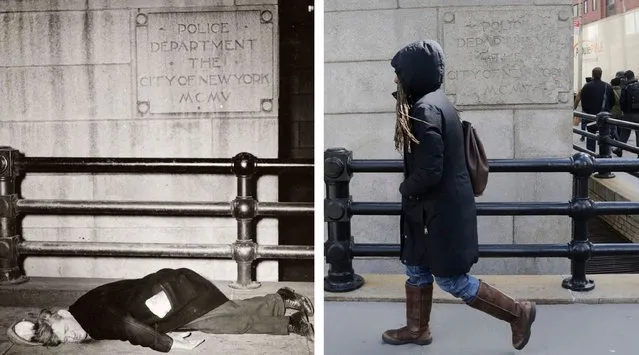
A new book of photos by legendary photographer Weegee shows what industrialized, pre-gentrified New York looked like in the mid-20th century, before the city was crammed with towers and billboards. (Photo by AP Photo/Copyright Weegee/The International Center of Photography, Mark Lennihan)

A new book of photos by legendary photographer Weegee shows what industrialized, pre-gentrified New York looked like in the mid-20th century, before the city was crammed with towers and billboards. Here: this combination shows the 1945 photo “Derelict sleeping on the sidewalk outside police headquarters” by Weegee, provided by the International Center of Photography in New York, and a woman walking on the same spot on Wednesday, March 18, 2015. (Photo by AP Photo/Copyright Weegee/The International Center of Photography, Mark Lennihan)


Details
27 Mar 2015 13:16:00
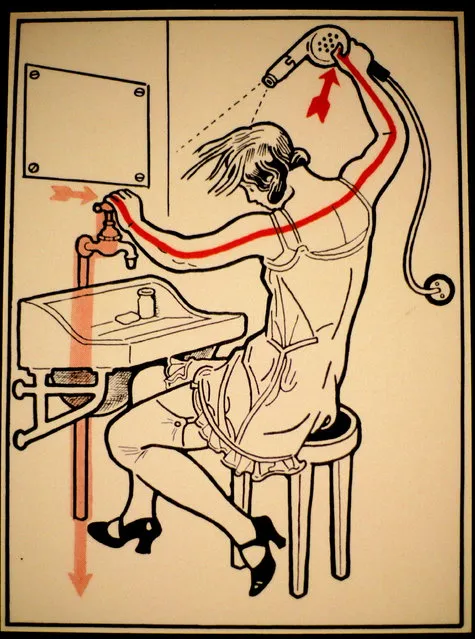
The book “Elektroschutz in 132 Bildern” (Electrical Protection in 132 Pictures) was published in Vienna in the early 1900s by a Viennese physician named Stefan Jellinek (1878-1968, a founder of the Electro-Pathological Museum). The pictures are nice and direct and unambiguous; they teach, graphically, that the surest way to kill yourself with electricity is to form a complete path from source (usually the bright red arrow) to ground (the screened back, pink arrow). Arrowheads provide the path for current flow. (Photo by The Vienna Technical Museum)

The book “Elektroschutz in 132 Bildern” (Electrical Protection in 132 Pictures) was published in Vienna in the early 1900s by a Viennese physician named Stefan Jellinek (1878-1968, a founder of the Electro-Pathological Museum). The pictures are nice and direct and unambiguous; they teach, graphically, that the surest way to kill yourself with electricity is to form a complete path from source (usually the bright red arrow) to ground (the screened back, pink arrow). Arrowheads provide the path for current flow. (Photo by The Vienna Technical Museum)
Details
11 Aug 2014 11:10:00