Loading...
Done
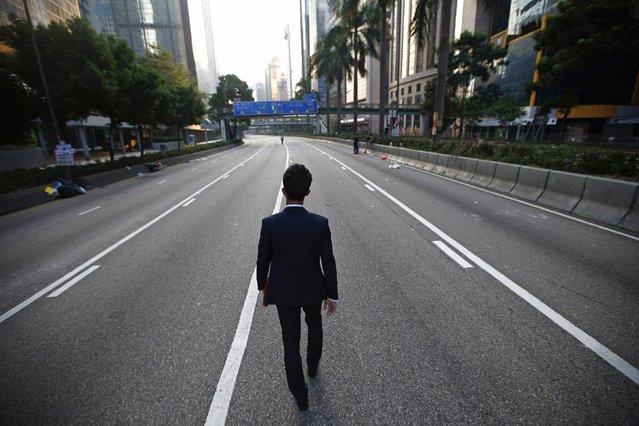
A man walks along an empty street near the central financial district in Hong Kong September 30, 2014. Tens of thousands of pro-democracy protesters extended a blockade of Hong Kong streets on Tuesday, stockpiling supplies and erecting makeshift barricades ahead of what some fear may be a push by police to clear the roads before Chinese National Day. (Photo by Carlos Barria/Reuters)

Reuters photographer Bobby Yip took a series of portraits of people taking part in the “Occupy Central” protests in Hong Kong, and asked them why they had joined the demonstrations. China rules Hong Kong under a “one country, two systems” formula that accords the territory limited democracy. Tens of thousands of mostly student protesters are demanding Beijing give them full democracy, with the freedom to nominate election candidates. The unrest is the worst in Hong Kong since China resumed its rule over the former British colony in 1997. (Photo by Carlos Barria/Reuters)
Details
30 Sep 2014 09:10:00
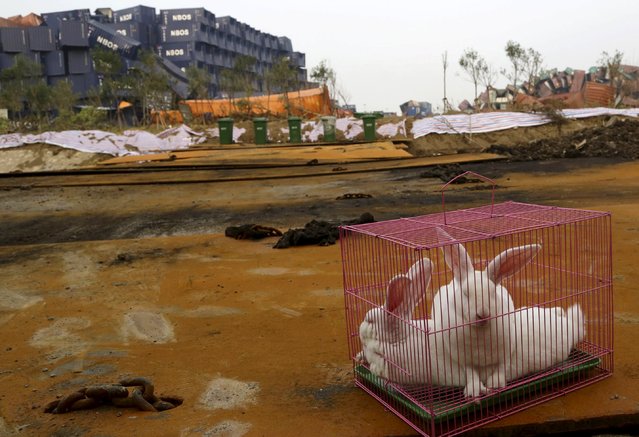
Rabbits are seen in a cage, which is placed by authority as a test of the living conditions near the site of last week's blasts at Binhai new district in Tianjin, China, August 19, 2015. (Photo by Reuters/Stringer)

Rabbits are seen in a cage, which is placed by authority as a test of the living conditions near the site of last week's blasts at Binhai new district in Tianjin, China, August 19, 2015. According to local media, the animals were alive after being placed near the blasts site for two hours. Four new fires have broken out at the site where two huge blasts last week killed 116 people, Chinese state media reported Friday soon after officials said safety hazards were found at almost 70 percent of firms handling dangerous chemicals in Beijing. (Photo by Reuters/Stringer)
Details
22 Aug 2015 12:16:00
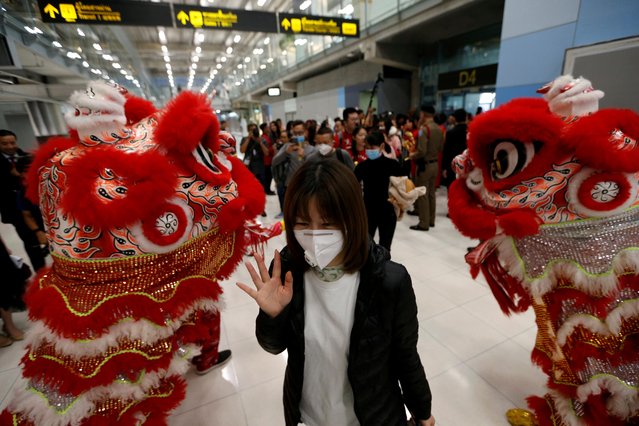
A Chinese tourist wears a mask as she arrives at Suvarnabhumi Airport during a welcome ceremony of Chinese Lunar New Year travellers in Bangkok, Thailand on January 22, 2020. (Photo by Soe Zeya Tun/Reuters)

A Chinese tourist wears a mask as she arrives at Suvarnabhumi Airport during a welcome ceremony of Chinese Lunar New Year travellers in Bangkok, Thailand on January 22, 2020. (Photo by Soe Zeya Tun/Reuters)
Details
24 Jan 2020 00:05:00
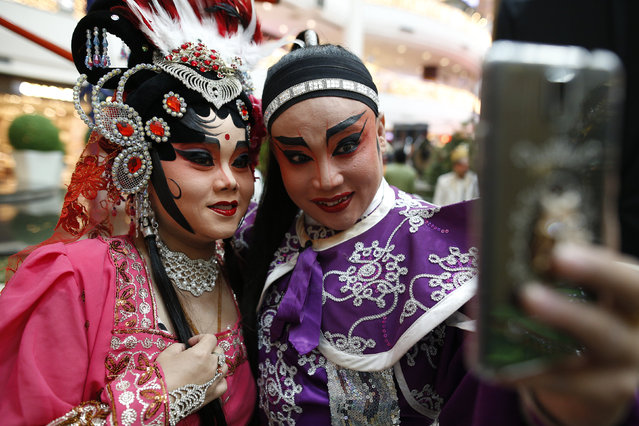
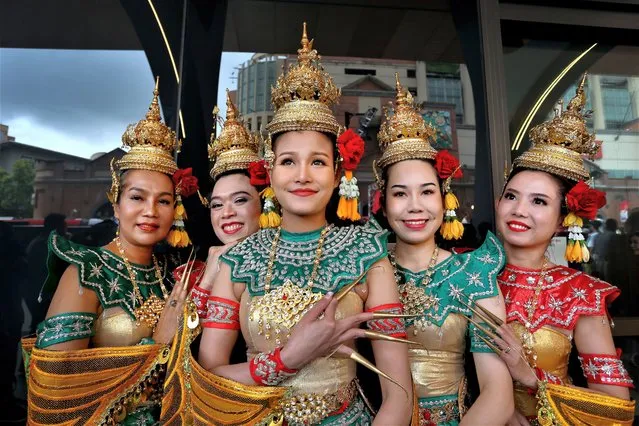
Members of a Chinese opera take a selfie before a performance at a shopping mall ahead of the Chinese Lunar New Year celebrations in Bangkok, Thailand, February 4, 2016. (Photo by Athit Perawongmetha/Reuters)

Members of a Chinese opera take a selfie before a performance at a shopping mall ahead of the Chinese Lunar New Year celebrations in Bangkok, Thailand, February 4, 2016. (Photo by Athit Perawongmetha/Reuters)
Details
05 Feb 2016 11:06:00
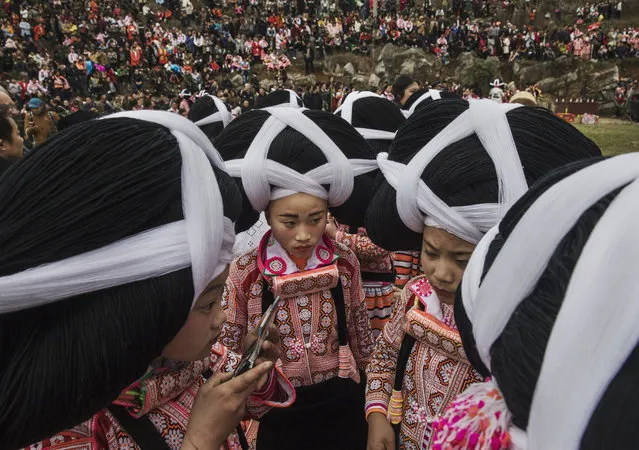
Girls of the Long Horn Miao ethnic minority group wear headdresses as they prepare gather for Tiaohua or Flower Festival as part of the Lunar New Year on February 6, 2017 in Longga village, Guizhou province, southern China. The Long Horn Miao are recognized for their declining practice of wrapping a blend of linen, wool, and the hair of their ancestors around animal horns or a wooden clip to make headdresses. Many young women say they now wear the headdresses only for special occasions and festivals, as the ornaments, which are attached by the horns to their real hair, have proved impractical for modern daily life in a fast changing world. China officially recognizes 56 different ethnic minorities, and statistics show over 7 million Chinese identifying themselves as Miao. But the small Long Horn Miao community counts only around 5000 people living in 12 villages, whose age-old traditions, language, and culture are fading. It is increasingly difficult in a modernizing China, as young people are drawn from remote rural villages to opportunities in bigger cities amongst wide-scale urbanization. Farming and labour remain the mainstays of life for the Long Horn Miao, leaving the area relatively poor in comparison with many parts of China. The government has invested significant amounts into local infrastructure and the tourism industry to try to bolster the local economy. (Photo by Kevin Frayer/Getty Images)

Girls of the Long Horn Miao ethnic minority group wear headdresses as they prepare gather for Tiaohua or Flower Festival as part of the Lunar New Year on February 6, 2017 in Longga village, Guizhou province, southern China. (Photo by Kevin Frayer/Getty Images)
Details
13 Feb 2017 00:01:00
Members of Siam Classic Dance Studio perform for onlookers at Haymarket on January 21, 2023 in Sydney, Australia. The Lunar New Year or Spring Festival marks the transition of the Chinese zodiac sign from one animal to the next. 2023 sees in the Year of the Rabbit, which begins on January 22. In Chinese culture, the Rabbit is a symbol of longevity, peace and prosperity. The festival is celebrated in Australia by the country's significant Chinese-origin minority, who follow much of the same traditions as the Chinese diaspora in the rest of the world. (Photo by Lisa Maree Williams/Getty Images)

Members of Siam Classic Dance Studio perform for onlookers at Haymarket on January 21, 2023 in Sydney, Australia. The Lunar New Year or Spring Festival marks the transition of the Chinese zodiac sign from one animal to the next. 2023 sees in the Year of the Rabbit, which begins on January 22. In Chinese culture, the Rabbit is a symbol of longevity, peace and prosperity. The festival is celebrated in Australia by the country's significant Chinese-origin minority, who follow much of the same traditions as the Chinese diaspora in the rest of the world. (Photo by Lisa Maree Williams/Getty Images)
Details
13 Apr 2024 05:28:00
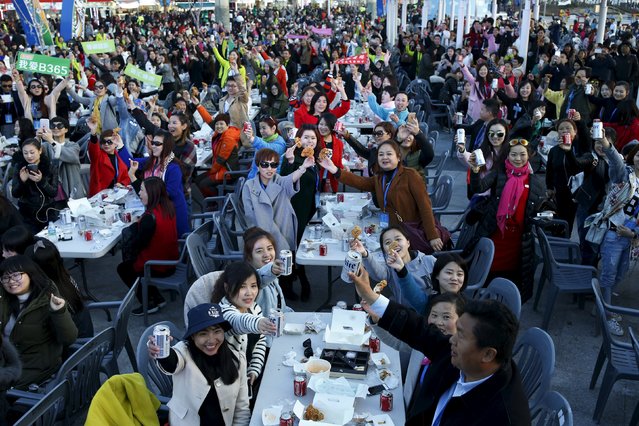
Chinese tourists make a toast with canned drinks and fried chicken pieces during an event organized by a Chinese company at a park in Incheon, South Korea, March 28, 2016. (Photo by Kim Hong-Ji/Reuters)

Chinese tourists make a toast with canned drinks and fried chicken pieces during an event organized by a Chinese company at a park in Incheon, South Korea, March 28, 2016. (Photo by Kim Hong-Ji/Reuters)
Details
29 Mar 2016 11:43:00
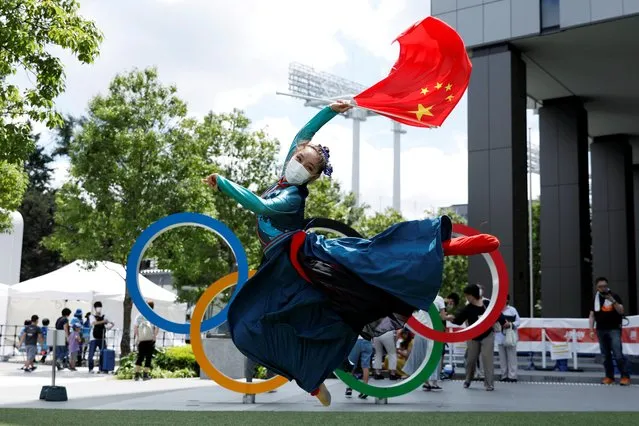
Mongolian Chinese performs a traditional Chinese dance in front of the Olympic Rings located near the National Stadium, the main stadium for the 2020 Tokyo Olympic Games in Tokyo, Japan July 29 2021. (Photo by Androniki Christodoulou/Reuters)

Mongolian Chinese performs a traditional Chinese dance in front of the Olympic Rings located near the National Stadium, the main stadium for the 2020 Tokyo Olympic Games in Tokyo, Japan July 29 2021. (Photo by Androniki Christodoulou/Reuters)
Details
04 Aug 2021 08:44:00