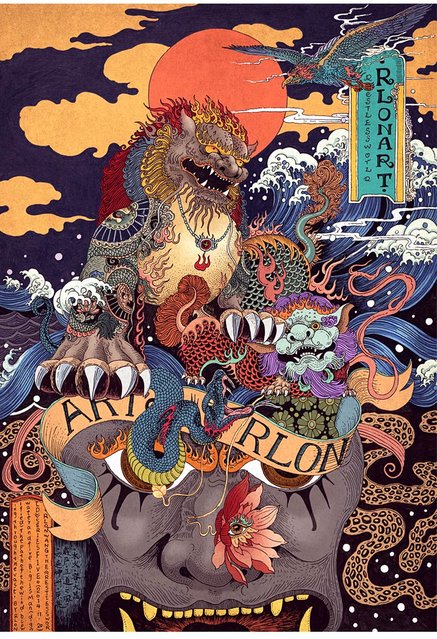
Through his series entitled Impetuous World Life, the Chinese artist and illustrator Rlon Wang, based in Shenzhen, reveals some beautiful and colorful illustrations inspired by nature and wildlife, playing with talent with the aesthetics and strength of ancient Japanese and Chinese prints.
Motoi Yamamoto is an incredibly patient man. His intricate salt labyrinths can take weeks to create and require a slow, steady hand, not to mention a tremendous amount of salt. The result is a beautifully detailed, if impermanent, exhibition.
Born in London of Scottish descent, Adrian Chesterman, British painter and illustrator, was educated at the William Harvey School in Kent. It was here that he first discovered his burning passion for the visual arts.
The “Hoegh Osaka” ro-ro cargo ship, operated by Hoegh Autoliners AS, sits grounded on Bramble Bank in the Solent near Cowes, on the Isle of Wight, U.K., on Monday, January 5, 2015. The car transporter was deliberately grounded after developing a list, shortly after it left the Port of Southampton. (Photo by Simon Dawson/Bloomberg)
Rooftops of solar powered houses are pictured in Ota, 80 km northwest of Tokyo in this October 28, 2008 file photo. One by one, Japan is turning off the lights at the giant oil-fired power plants that propelled it to the ranks of the world's top industrialised nations. With nuclear power in the doldrums after the Fukushima disaster, it's solar energy that is becoming the alternative. Solar power is set to become profitable in Japan as early as this quarter, according to the Japan Renewable Energy Foundation (JREF), freeing it from the need for government subsidies and making it the last of the G7 economies where the technology has become economically viable. (Photo by Yuriko Nakao/Reuters)
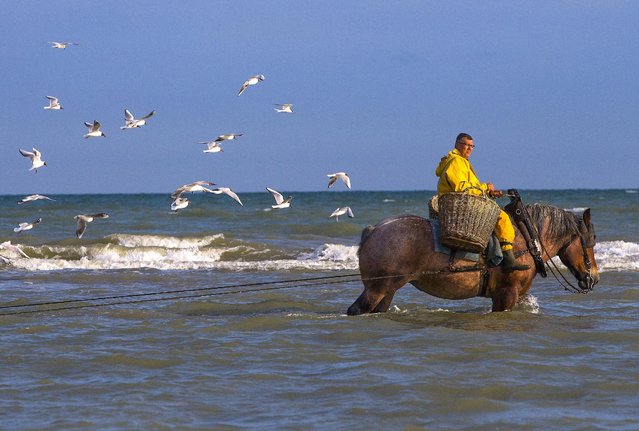
A Belgian shrimp fisherman rides a carthorse to haul a net out in the sea to catch shrimps during low tide at the coastal town of Oostduinkerke, Belgium July 3, 2015. At the end of each fishing session, the fishermen and their mounts leave the water to empty the net's contents into two wicker baskets fixed on each side of the horse. This traditional method of catching shrimps along the North Sea coast, which dates back to some 500 years, attracts tourists every summer. In 2013, Unesco recognized shrimp fishing on horseback as an intangible cultural heritage. (Photo by Yves Herman/Reuters)