Loading...
Done
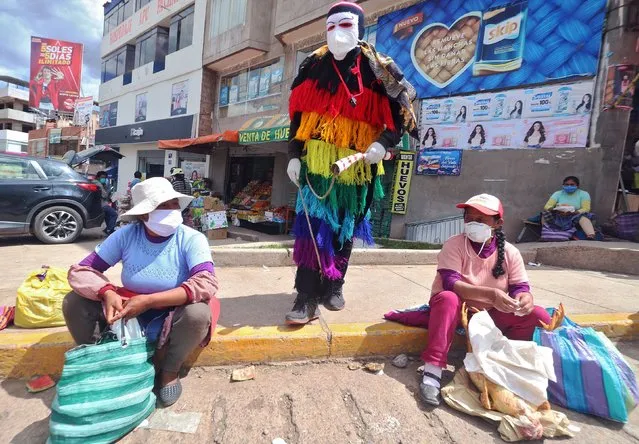
A man dressed in Andean attire as “Ukukus” or “Pabluchas”, a traditional character that acts as a vigilante imposing social order, uses a whip as a threat to force people to maintain their distance and remind them to wear face masks and gloves as a preventive measure against the novel coronavirus COVID-19, in the Vinocanchon market area in San Jeronimo district, close to the Peruvian Andean city of Cusco, on May 2, 2020. The government has identified public markets as major hotspots of the new coronavirus in Peru, where 40,459 confirmed cases and 1,124 deaths were reported on May 1. (Photo by Jose Carlos Angulo/AFP Photo)

A man dressed in Andean attire as “Ukukus” or “Pabluchas”, a traditional character that acts as a vigilante imposing social order, uses a whip as a threat to force people to maintain their distance and remind them to wear face masks and gloves as a preventive measure against the novel coronavirus COVID-19, in the Vinocanchon market area in San Jeronimo district, close to the Peruvian Andean city of Cusco, on May 2, 2020. The government has identified public markets as major hotspots of the new coronavirus in Peru, where 40,459 confirmed cases and 1,124 deaths were reported on May 1. (Photo by Jose Carlos Angulo/AFP Photo)
Details
04 May 2020 00:07:00
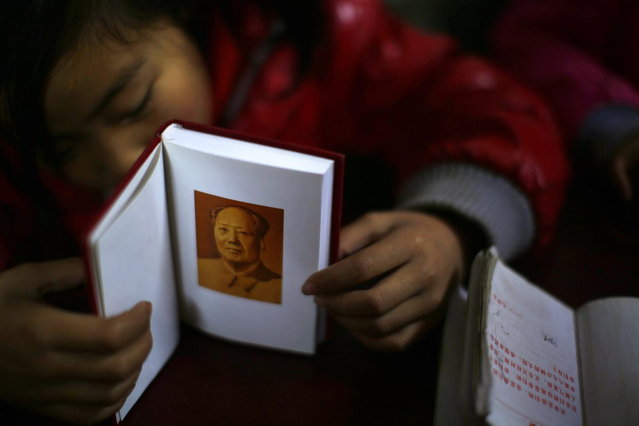
A student falls asleep as she holds a book containing a portrait of China's late chairman Mao Zedong during a lesson at the Democracy Elementary and Middle School in Sitong town, Henan province December 3, 2013. (Photo by Carlos Barria/Reuters)

A student falls asleep as she holds a book containing a portrait of China's late chairman Mao Zedong during a lesson at the Democracy Elementary and Middle School in Sitong town, Henan province December 3, 2013. In a remote part of central China, the day starts at the Democracy Elementary and Middle School with a pre-dawn jog, some revolutionary songs and then an activity long since forgotten at other schools: reciting quotations from Mao Zedong's famed “Little Red Book”. While the ruling Communist Party that Mao led continues to hold him in esteem as the leader of the Communist Revolution, his radical policies and teachings have been largely shelved since his death in 1976 in favour of a pro-market approach that has turned China from a backwater into the world's second biggest economy. The 120th anniversary of Mao's birth is on December 26, 2013. (Photo by Carlos Barria/Reuters)
Details
19 Dec 2013 09:40:00
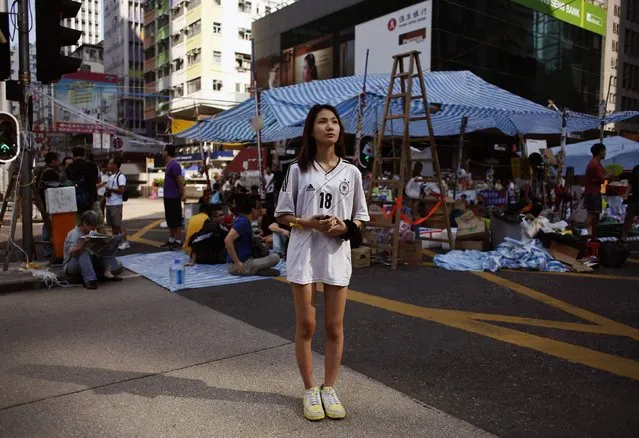
Crystal, 15, a part-time boutique sales assistant, poses on Nathan Road in Mongkok shopping district in Hong Kong October 7, 2014. Holding a walkie talkie for fast communication with other supporters, Crystal said, “I am not demanding Chief Executive Leung Chun-ying to quit, but (want) to protect protesters from being threatened badly by opponents and the police”. (Photo by Bobby Yip/Reuters)

Reuters photographers Carlos Barria and Bobby Yip photographed protestors and details of life on the barricades, asking demonstrators what their role was in the movement, and what they wanted to happen. Here: Crystal, 15, a part-time boutique sales assistant, poses on Nathan Road in Mongkok shopping district in Hong Kong October 7, 2014. Holding a walkie talkie for fast communication with other supporters, Crystal said, “I am not demanding Chief Executive Leung Chun-ying to quit, but (want) to protect protesters from being threatened badly by opponents and the police”. (Photo by Bobby Yip/Reuters)
Details
09 Oct 2014 12:53:00
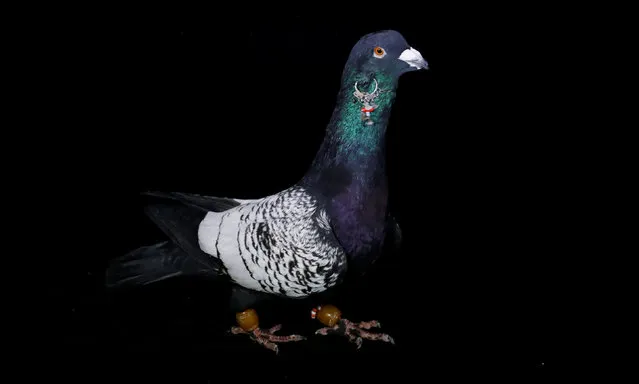
A pigeon, known as Siyah Kinifirli, with an approximate market value of 1000 Turkish Lira ($263), bred by 23-year-old Ismail Ozbek, is pictured in Sanliurfa, Turkey, December 23, 2016. As night-time approaches in Sanliurfa, southeastern Turkey, most of the alleyways of the city's old bazaar are emptying out of buyers and vendors, except for one. The bustle of daytime trading has died down, but on this little street, a stream of men carry cardboard boxes filled with pigeons to a cluster of three teahouses. Here, they sell the birds at Sanliurfa's famed auctions to a dedicated band of pigeon keepers and breeders, a pastime that has been thriving for hundreds of years across the region and over the nearby border into war-torn Syria. In a country where the minimum wage is about 1,400 Liras ($367) a month, enthusiasts regularly easily spend hundreds of dollars for one bird. “I once sold a pair of pigeons for 35,000 Turkish Lira”, says auctioneer Imam Dildas. “This is a passion, a hobby you cannot quit. I've been known to sell the fridge and my wife's gold bracelets to pay for pigeons”. (Photo by Umit Bektas/Reuters)

A pigeon, known as Siyah Kinifirli, with an approximate market value of 1000 Turkish Lira ($263), bred by 23-year-old Ismail Ozbek, is pictured in Sanliurfa, Turkey, December 23, 2016. As night-time approaches in Sanliurfa, southeastern Turkey, most of the alleyways of the city's old bazaar are emptying out of buyers and vendors, except for one. (Photo by Umit Bektas/Reuters)
Details
17 Jan 2017 12:05:00


“Sektor gaza” (Russian: Сектор газа) was a Russian rock band formed on 5 December 1987 in the city of Voronezh, Russia. Despite only semi-officially existing (due to obscene lyrics), the group remains popular in Russia today. The group name was taken from an eponymous industrial district of Voronezh (itself named for high levels of environmental contamination). Their music style could be defined as Russian punk, integrated with elements of different musical genres such as rock, rap, and Russian folk. On 4 July 2000, group leader Yuri “Hoy” Klinskih complained of strong pains in his stomach and the left side of his chest. He suffered heart failure shortly thereafter. Klinskikh died in Voronezh (Russia)at the age of 35. He is buried in the Levoberezhniy Cemetery. The group ceased to exist.

About the music video: The First Chechen War, also known as the War in Chechnya, was a conflict between the Russian Federation and the Chechen Republic of Ichkeria, fought from December 1994 to August 1996. After the initial campaign of 1994 – 1995, culminating in the devastating Battle of Grozny, Russian federal forces attempted to seize control of the mountainous area of Chechnya but were set back by Chechen guerrilla warfare and raids on the flatlands in spite of Russia's overwhelming manpower, weaponry, and air support...
Details
24 May 2012 14:38:00
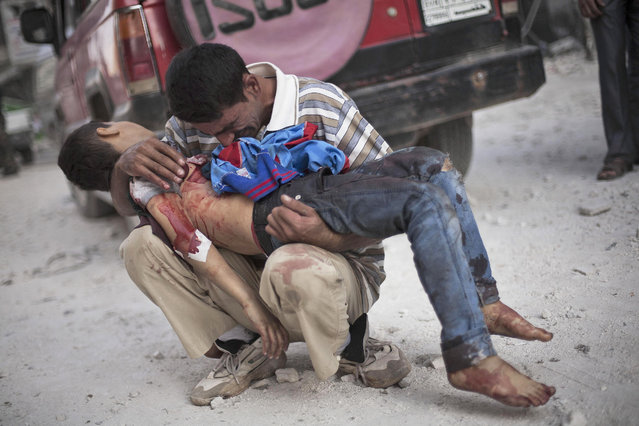
A Syrian man cries while holding the body of his son, killed by the Syrian Army, near Dar El Shifa hospital in Aleppo, Syria, Wednesday, October 3, 2012. (Photo by Manu Brabo/AP Photo)

Manu Brabo was born in Spain in 1981. After studying Photography in The School of Arts and Crafts in Oviedo, he moved to Madrid where he started Journalism in Carlos III University while he was working as a photographer for several humble newspapers and agencies. In 2011, Manu was held captive and then released by by Libyan forces. Brabo, along with fellow AP photographers were awarded the 2013 Pulitzer Prize for Breaking News Photography. Here: a Syrian man cries while holding the body of his son, killed by the Syrian Army, near Dar El Shifa hospital in Aleppo, Syria, Wednesday, October 3, 2012. (Photo by Manu Brabo/AP Photo)
Details
27 Oct 2015 08:04:00


#Resistiré 2020 (# I will resist 2020), the hymn recorded by more than 30 Spanish artists to beat the coronavirus together. Participating in the hymn: Alex Ubago, Andrés Suárez, Álvaro Soler, Blas Cantó, Carlos Baute, Conchita, David Bisbal, David Otero, David Summers, Despistaos, Diana Navarro, Dvicio, Mariposa Effect, Hall Effect, Ele, Georgina, India, Jose Mercé, Josemi Carmona, Manuel Carrasco, Melendi, Mikel Erentxun, Nil Moliner, Pastora Soler, Pedro Guerra, Pitingo, Rosana, Rozalén, Rulo, Sofía Ellar and Vanesa Martín. Promoted by Cadena 100, all these musicians and artists come together under the production of Pablo Cebrián to get this Resistiré, with which all funds will be for the benefit of Cáritas (Caritas Internationalis is a confederation of 165 Catholic relief, development and social service organizations operating in over 200 countries and territories worldwide. Collectively and individually, their claimed missions are to work to build a better world, especially for the poor and oppressed).
Details
14 Apr 2020 00:03:00
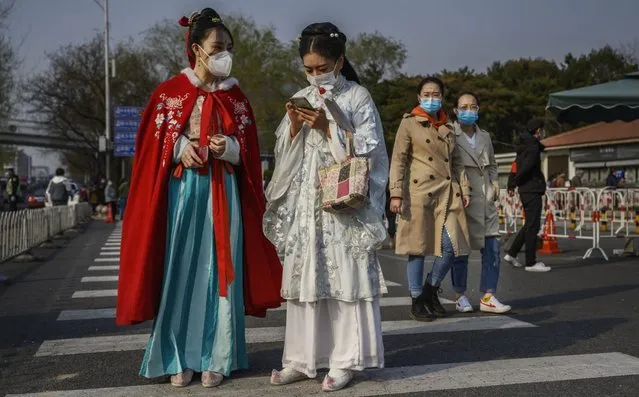
Chinese women wear protective masks as they are dressed in traditional clothing from the Qing Dynasty era outside a park on March 29, 2020 in Beijing, China. A limited section of the iconic tourist site was re-opened to the public this week allowing a smaller number of visitors to reserve tickets online in advance and to enter after passing health screening. With the pandemic hitting hard across the world, China recorded its first day with no new domestic cases of the coronavirus last week, since the government imposed sweeping measures to keep the disease from spreading. For two months, millions of people across China have been restricted in how they move from their homes, while other cities have been locked down in ways that appeared severe at the time but are now being replicated in other countries trying to contain the virus. Officials believe the worst appears to be over in China, though there are concerns of another wave of infections as the government attempts to reboot the worlds second largest economy. In Beijing, it is mandatory to wear masks outdoors, retail stores operate on reduced hours, restaurants employ social distancing among patrons, and tourist attractions at risk of drawing large crowds remain closed. Monitoring and enforcement of virus-related measures and the quarantine of anyone arriving to Beijing is carried out by neighborhood committees and a network of Communist Party volunteers who wear red arm bands. A primary concern for Chinese authorities remains the arrival of flights from Europe and elsewhere, given the exposure of passengers in regions now regarded as hotbeds for transmission. Since January, China has recorded more than 81,000 cases of COVID-19 and at least 3200 deaths, mostly in and around the city of Wuhan, in central Hubei province, where the outbreak first started. (Photo by Kevin Frayer/Getty Images)

Chinese women wear protective masks as they are dressed in traditional clothing from the Qing Dynasty era outside a park on March 29, 2020 in Beijing, China. A limited section of the iconic tourist site was re-opened to the public this week allowing a smaller number of visitors to reserve tickets online in advance and to enter after passing health screening. (Photo by Kevin Frayer/Getty Images)
Details
01 Apr 2020 00:05:00