Loading...
Done
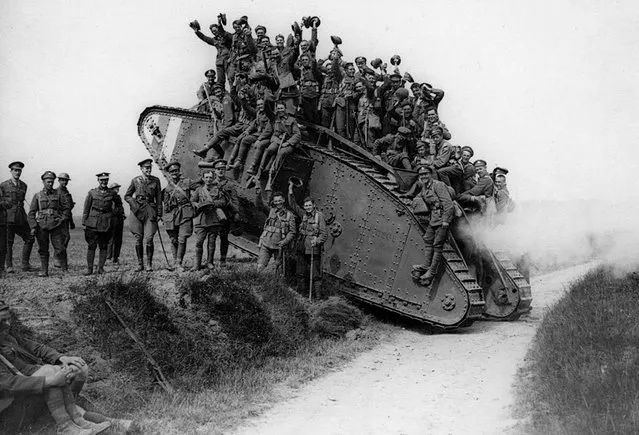
These black-and-white photos are taken from the new book “Armoured Warfare in the First World War 1916 – 1918” by Anthony Tucker-Jones and published by Pen & Sword Military. “Interestingly the British, French and Germans took completely different approaches with varying results”. The British military produced “Little Willie” in Autumn 1915 weighing 18 tonnes, which had a crew of two plus four gunners. “Inspired by a tracked artillery tractor “Little Willie” was referred to as a water tank – hence the name tank – to ensure secrecy”, said Anthony. “This led to the strange looking Mark I with its peculiar rhomboid shape, designed to cross trenches with guns in sponsons on either side. The Germans saw the tank as unchivalrous and were slow to grasp its utility. They favoured the Stormtrooper (specialist soldiers used to infiltrate enemy trenches) and artillery, not the tank”, said Anthony. “However, they didn’t hesitate to make use of captured British tanks. Although the tank helped secure victory and German soldiers dubbed it “Germany’s Downfall” the country was ultimately brought to its knees by the Allies blockade”. Here: British troops hitch a ride on a Mark IV after the massed tank fleet spearheading attack at Cambrai on November 20, 1917. (Photo by Anthony Tucker-Jones/Mediadrumworld.com)

These black-and-white photos are taken from the new book “Armoured Warfare in the First World War 1916 – 1918” by Anthony Tucker-Jones and published by Pen & Sword Military. Here: British troops hitch a ride on a Mark IV after the massed tank fleet spearheading attack at Cambrai on November 20, 1917. (Photo by Anthony Tucker-Jones/Mediadrumworld.com)
Details
23 Feb 2017 00:02:00
In this January 23, 2015 photo, Guillermo Luna Martinez, 36, carries freshly painted piñatas representing Disney's Frozen snowman character Olaf downstairs to where his wife Elvia Vicente Albarran will use paper to craft the character's eyes, teeth, and distinctive tuft of hair, at the family's workshop in the Iztapalapa neighborhood of Mexico City. (Photo by Rebecca Blackwell/AP Photo)

In this January 23, 2015 photo, Guillermo Luna Martinez, 36, carries freshly painted piñatas representing Disney's Frozen snowman character Olaf downstairs to where his wife Elvia Vicente Albarran will use paper to craft the character's eyes, teeth, and distinctive tuft of hair, at the family's workshop in the Iztapalapa neighborhood of Mexico City. Though Luna and his wife have chosen to work in the family business, they plan to let their children, Guillermo, 10, and Melissa, 9, decide for themselves. “Who knows if the business will last forever”, said Luna, “I'd prefer that they study and get a career, for them to have a better future”. (Photo by Rebecca Blackwell/AP Photo)
Details
01 Feb 2015 10:43:00
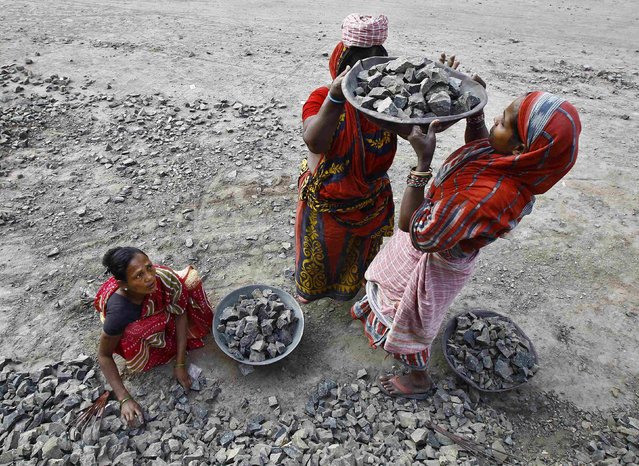
Women labourers work at the construction site of a road in Kolkata January 8, 2015. Across towns and cities in India, it is not uncommon to see women cleaning building sites, carrying bricks and or shoveling gravel - helping construct the infrastructure necessary for the country's economic and social development. (Photo by Rupak De Chowdhuri/Reuters)

Women labourers work at the construction site of a road in Kolkata January 8, 2015. Across towns and cities in India, it is not uncommon to see women cleaning building sites, carrying bricks and or shoveling gravel – helping construct the infrastructure necessary for the country's economic and social development. They help build roads, railway tracks, airports, and offices. They lay pipes for clean water supplies, cables for telecommunications, and dig the drains for sewage systems. But although women make up at least 20 percent of India's 40 million construction workers, they are less recognized than male workers with lower pay and often prone to safety hazards and sexual harassment. They are often unaware of their rights or scared to complain, say activists now trying to campaign for better treatment of women in the construction industry. (Photo by Rupak De Chowdhuri/Reuters)
Details
15 Jan 2015 13:47:00
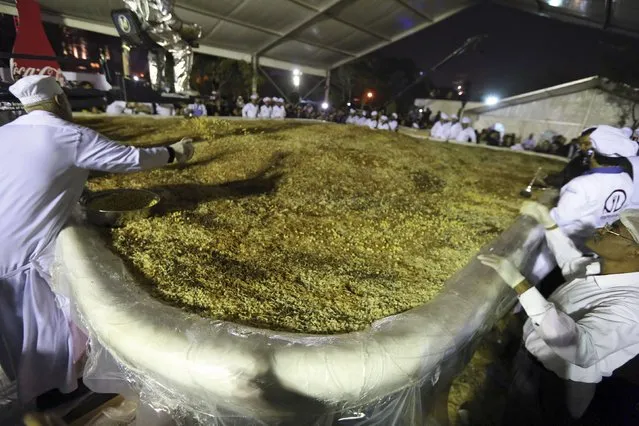
Workers prepare Koshary, a popular Egyptian dish, in an attempt to break the Guinness World Record for the world's biggest plate of Koshary, at a general garden in Zamalek, Cairo, January 17, 2015. (Photo by Mohamed Abd El Ghany/Reuters)

Workers prepare Koshary, a popular Egyptian dish, in an attempt to break the Guinness World Record for the world's biggest plate of Koshary, at a general garden in Zamalek, Cairo, January 17, 2015. Koshary is a traditional Egyptian dish dating to the 19th century in which rice, pasta and lentils are mixed together in one plate with a topping of spicey tomato sauce and some crispy fried onions. With a huge plate of koshary measuring 10 metres long and in width and of 1.2 metres in height, the plate weighed 7 tonnes, or about 7,000 kg. About 6,000 attendees turned up to the festival, earning it a place in the world record books. (Photo by Mohamed Abd El Ghany/Reuters)
Details
20 Jan 2015 12:43:00
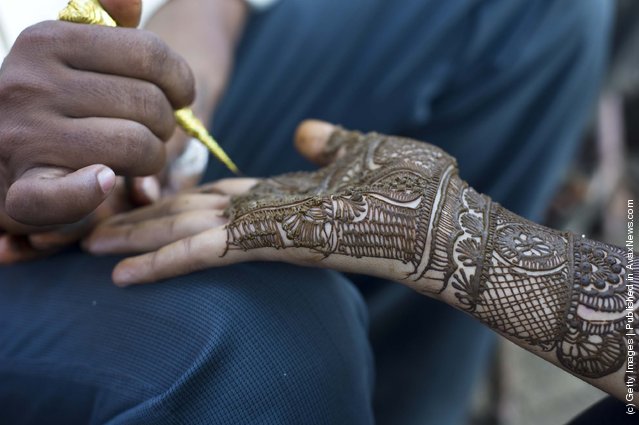
Application of henna or “Mehndi”  to a girls hand in a market in Jaipur, India

“Mehndi or menhdi is the application of henna as a temporary form of skin decoration in India, as well as by expatriate communities from the country. The word mehndi is derived from the Sanskrit word mendhikā. The use of mehndi and turmeric is described in the earliest Vedic ritual books. Haldi (Staining oneself with turmeric paste) as well as mehndi are important Vedic customs as a symbolic representation of the Outer and the Inner Sun. Vedic customs are meant to awaken the “inner light” and so the gold of the inner Sun has an important symbolic function”. – Wikipedia

Photo: Application of henna or “Mehndi” to a girls hand in a market on October 18, 2010 in Jaipur, India. (Photo by Simon de Trey-White/Getty Images)
Details
23 Nov 2011 13:33:00
An erotic danser picks up fake 2-dollar bills during a private dance with a Yakuza customer in a strip tease bar in Kabukicho, a bar which is controlled by the ODO family – 2010. (Photo and caption by Anton Kusters)

The Belgian photographer Anton Kusters spent two years photographing the Yakuza, Japan’s most notorious gang. He returned with some amazing images that he made into a book called “Odo Yakuza Tokyo”. (Odo means “the way of the cherry blossom” and is the credo of the Yakuza family he followed. Photo: An erotic danser picks up fake 2-dollar bills during a private dance with a Yakuza customer in a strip tease bar in Kabukicho, a bar which is controlled by the ODO family – 2010. (Photo and caption by Anton Kusters)
Details
31 Aug 2014 08:42:00
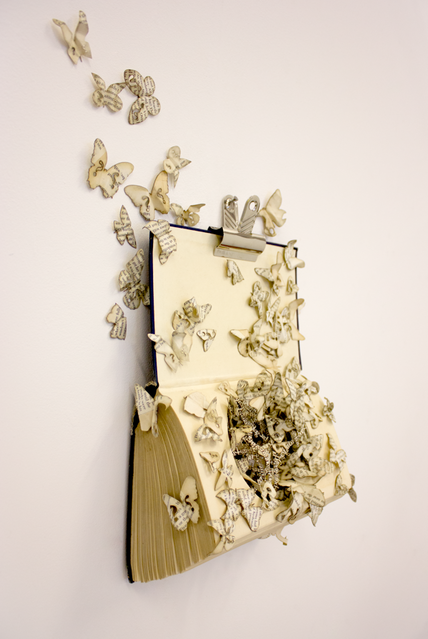
Plagued by Doubt By Thomas Wightman

Thoughts. They fly through the broad expenses of our mind, floating gracefully in midair, going into the clouds, and then reemerging once again. Some are quick and furtive, others are grand and majestic. We reflect upon them as they enter our minds, and once they leave, they are usually gone for good. However, some thoughts are different. These thoughts resemble a flock of angry birds or a swarm of hungry moths that invade your mind, slowly eating away at your sanity, strength, and desire to live. Such thoughts often plague that minds of people with Obsessive Compulsive disorder. They completely occupy their time; constantly there; ever-present. With his book sculpture, Thomas Wightman was able to accurately convey the way these thoughts consume the mind, slowly building a nest within it, resisting all attempts to drive them away.

Thomas Wightman


See Also: Derailing My Train of Thought
Details
19 Mar 2015 09:11:00
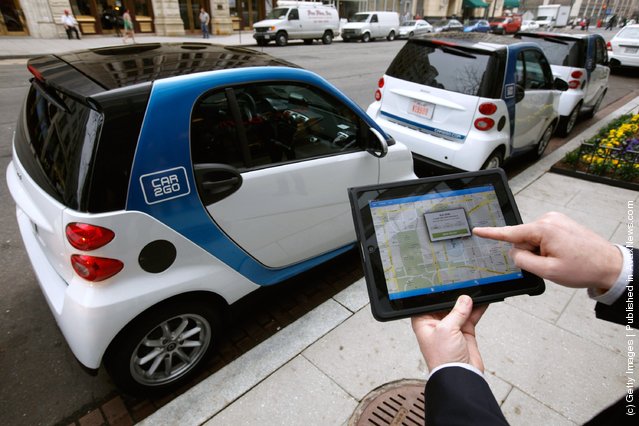
A car2go employee shows how members can use a smartphone or iPad app to locate and reservec car2go vehicles March 22, 2012 in Washington, DC

“Car2go fleet is located throughout the greater downtown area and can be accessed on-demand or booked 24 hours in advance. The members may use the vehicle for as long as they like, without committing to a specific return time or return location”. – Wikipedia

Photo: A car2go employee shows how members can use a smartphone or iPad app to locate and reservec car2go vehicles March 22, 2012 in Washington, DC. Beginning March 24, car2go will offer the first free-floating car-sharing service in Washington and Portland, Oregon, where customers can use the smartphone app within the 34-square-mile “Home Area”. After paying a one-time $35 membership fee, drivers can then rent the Smart Fortwo vehicles by the minute, paying only for the time they use the vehicle, with discounted rates for hourly and daily use. (Photo by Chip Somodevilla/Getty Images)
Details
23 Mar 2012 10:58:00