Loading...
Done
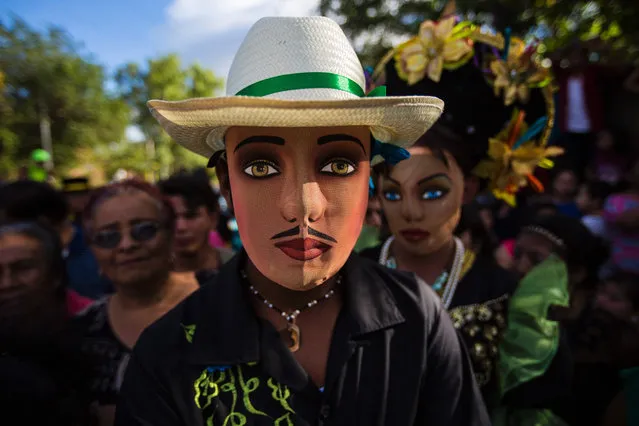
A man dressed as a traditional character in the “Baile de Negras” dance poses for a picture on the feast day of the Virgin of the Candelaria (Candlemas) in the town of Diriomo, some 45 km from Managua, Nicaragua on February 2, 2017 Candlemas falls forty days after Christmas and is celebrated by Catholics as the presentation of Christ at the Temple. (Photo by Inti Ocon/AFP Photo)

A man dressed as a traditional character in the “Baile de Negras” dance poses for a picture on the feast day of the Virgin of the Candelaria (Candlemas) in the town of Diriomo, some 45 km from Managua, Nicaragua on February 2, 2017 Candlemas falls forty days after Christmas and is celebrated by Catholics as the presentation of Christ at the Temple. (Photo by Inti Ocon/AFP Photo)
Details
05 Feb 2017 01:03:00
Switzerland's lead Nicole Schwaegli (L) and second Marisa Winkelhausen sweep during their curling round robin game against Japan at the World Women's Curling Championships in Sapporo March 14, 2015. (Photo by Thomas Peter/Reuters)

Switzerland's lead Nicole Schwaegli (L) and second Marisa Winkelhausen sweep during their curling round robin game against Japan at the World Women's Curling Championships in Sapporo March 14, 2015. (Photo by Thomas Peter/Reuters)
Details
17 Mar 2015 12:15:00
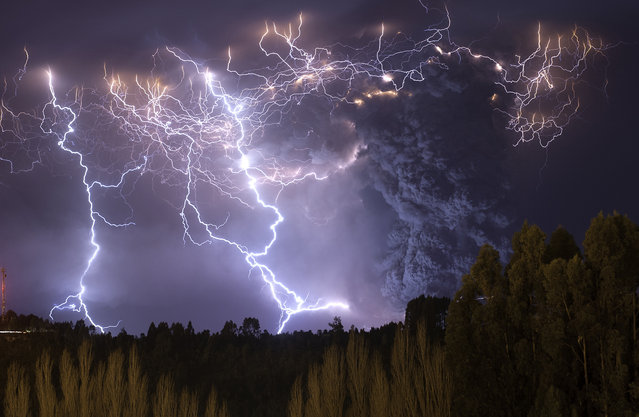
The eruption of Cordon Caulle began on June 4, 2011, located in the Region of Los Rios in Chile. For about 12 months, people and animals became accustomed to living with the daily fall of ash, which also caused problems in the air traffic in South America. The explosions and lightning during first days of the eruption could be seen from hundreds of miles around. This photograph was taken on the second night of eruption from the town of Lago Ranco. (Photo and caption by Francisco Negroni/National Geographic Traveler Photo Contest)

The eruption of Cordon Caulle began on June 4, 2011, located in the Region of Los Rios in Chile. For about 12 months, people and animals became accustomed to living with the daily fall of ash, which also caused problems in the air traffic in South America. The explosions and lightning during first days of the eruption could be seen from hundreds of miles around. This photograph was taken on the second night of eruption from the town of Lago Ranco. (Photo and caption by Francisco Negroni/National Geographic Traveler Photo Contest)

ATTENTION! All pictures are presented in high resolution. To see Hi-Res images – just TWICE click on any picture. In other words, click small picture – opens the BIG picture. Click BIG picture – opens VERY BIG picture.
Details
23 Jun 2013 11:24:00
Mud-covered tourists pretend to be trapped inside a mud prison at the Daecheon Beach Mud Plaza in the city of Boryeong on South Korea's west coast, July 17, as they take part in the Boryeong Mud Festival, which opened that day and runs through July 26. Boryeong mud is rich in natural mineral component and is considered to prevent skin aging. (Photo by EPA/Yonhap)

Mud-covered tourists pretend to be trapped inside a mud prison at the Daecheon Beach Mud Plaza in the city of Boryeong on South Korea's west coast, July 17, as they take part in the Boryeong Mud Festival, which opened that day and runs through July 26. Boryeong mud is rich in natural mineral component and is considered to prevent skin aging. (Photo by EPA/Yonhap)
Details
18 Jul 2015 13:33:00
A Swiss police officer accompanies a migrant from Syria carrying her baby, upon her arrival at the railway station in the north-eastern Swiss town of Buchs September 1, 2015. (Photo by Arnd Wiegmann/Reuters)

A Swiss police officer accompanies a migrant from Syria carrying her baby, upon her arrival at the railway station in the north-eastern Swiss town of Buchs September 1, 2015. (Photo by Arnd Wiegmann/Reuters)
Details
03 Sep 2015 11:58:00
Competitors release their hens during the World Championship Hen Racing Championships in Bonsall, Britain August 1, 2015. (Photo by Darren Staples/Reuters)

Competitors release their hens during the World Championship Hen Racing Championships in Bonsall, Britain August 1, 2015. (Photo by Darren Staples/Reuters)
Details
02 Aug 2015 13:16:00
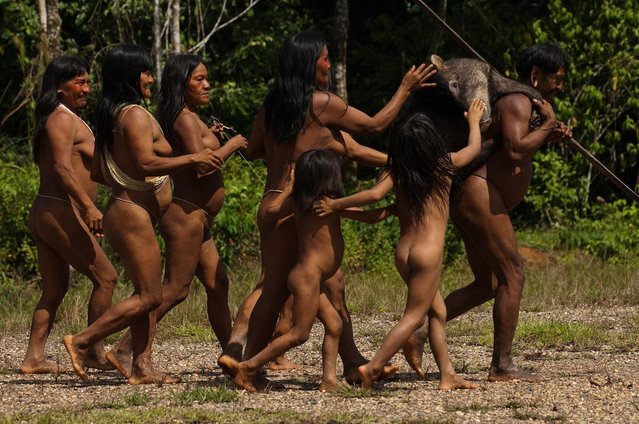
Spectacular images offering insight into the lives of the Huaorani people in the Ecuadorian Amazon have been revealed showing how they use traditional methods to hunt monkeys for food. The stunning pictures were taken by conservation photographer Pete Oxford from Torquay, Devon in the Ecuadorian Amazon. “The Huaorani Indians are a forest people highly in tune with their environment. Many are now totally acculturated since the 1950s by missionaries”, said Pete. “Today they face radical change to their culture to the proximity of oil exploration within their territory and the Yasuni National Park and Biosphere Reserve, they are vastly changed. Some still live very traditionally and for this shoot, through my Huaorani friend, a direct relative of those photographed he wanted to depict them as close to their original culture as possible. They still largely hunt with blow pipes and spears eating a lot of monkeys and peccaries”. The Huaorani are also known as the Waorani, Waodani or the Waos and are native Amerindians. Their lands are located between the Curaray and Napo rivers and speak the Huaorani language. Pete says that during his visit he was welcomed into the group and hopes that ancient cultures can be saved. Here: The tribe were seen celebrating after a hunter returned to camp with a wild pig. (Photo by Pete Oxford/Mediadrumworld.com)

Spectacular images offering insight into the lives of the Huaorani people in the Ecuadorian Amazon have been revealed showing how they use traditional methods to hunt monkeys for food. The stunning pictures were taken by conservation photographer Pete Oxford from Torquay, Devon in the Ecuadorian Amazon. Here: The tribe were seen celebrating after a hunter returned to camp with a wild pig. (Photo by Pete Oxford/Mediadrumworld.com)
Details
20 Jan 2017 07:58:00
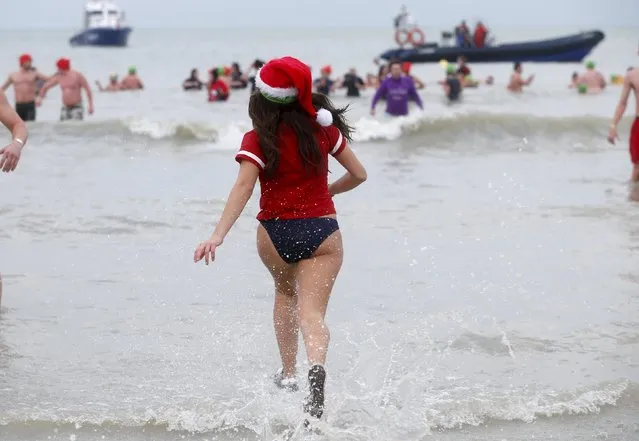
A participant runs towards the waters of the North Sea during the annual New Year's plunge event in Ostend, Belgium, January 2, 2016. (Photo by Francois Lenoir/Reuters)

A participant runs towards the waters of the North Sea during the annual New Year's plunge event in Ostend, Belgium, January 2, 2016. (Photo by Francois Lenoir/Reuters)
Details
04 Jan 2016 08:06:00