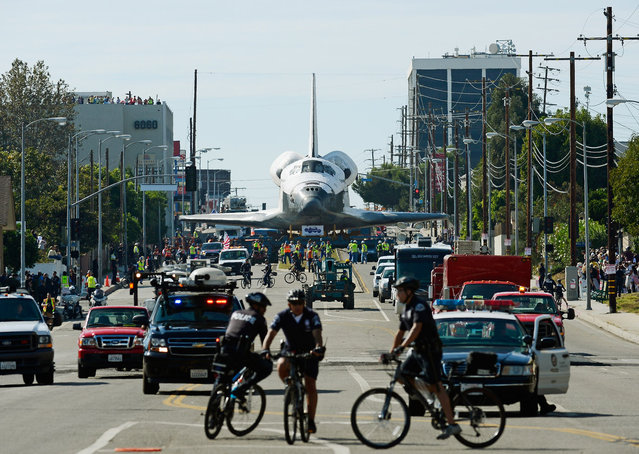
The space shuttle Endeavour is transported to the California Science Center in Exposition Park from Los Angeles International Airport (LAX) in Los Angeles, California. (Photo by Kevork Djansezian)
General view of atmosphere of fans at the “Harry Potter And The Deathly Hallows: Part 2 An IMAX Experience” release party at AMC Loews Kips Bay 15 theater on July 14, 2011 in New York City. (Photo by Rob Kim/Getty Images)
Actors Jason Statham and Rosie Huntington-Whiteley arrive at the Metropolitan Museum of Art Costume Institute Gala (Met Gala) to celebrate the opening of “Manus x Machina: Fashion in an Age of Technology” in the Manhattan borough of New York, May 2, 2016. (Photo by Lucas Jackson/Reuters)
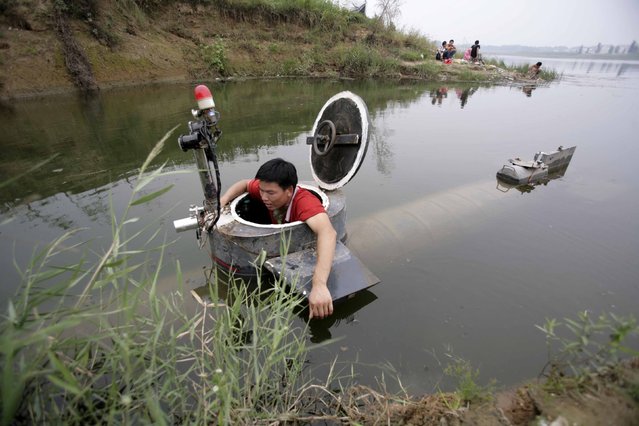
Tao Xiangli gets out of his homemade submarine after operating it in a lake on the outskirts of Beijing September 3, 2009. Amateur inventor Tao, 34, made a fully functional submarine, which has a periscope, depth control tanks, electric motors, manometer, and two propellers, from old oil barrels and tools which he bought at a second-hand market. He took 2 years to invent and test the submarine which costs 30,000 yuan ($4,385). (Photo by Christina Hu/Reuters)
Creators of Mini Cooper continue on with their innovative way of promoting their product. First, it was the huge cardboard boxes, which looked like packaging for full sized Mini Coopers, left all over Amsterdam. Now they’ve hired a famous artist Alexa Meade, who is known for making 3-D objects look as if they are 2-D paintings. For this project, Alexa had to fly to Japan, where she turned a whole Mini Cooper into a “drawing”. Even if you know that what you’re seeing on the picture are 3-D objects, your brain refuses to accept this, making you think that Alexa is standing near a sloppy picture of a Mini Cooper.
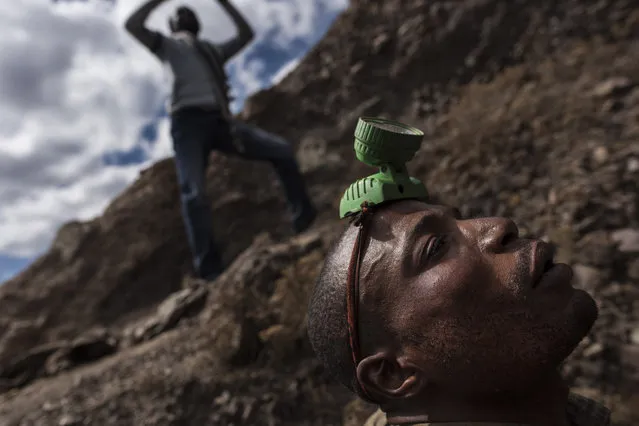
A “creuseur”, or digger, a plastic lantern on his head, readies to enter a copper and cobalt mine in Kawama, Democratic Republic of Congo on June 8, 2016. Cobalt is used in the batteries for electric cars and mobile phones. Working conditions are dangerous, often with no safety equipment or structural support for the tunnels. The diggers say they are paid on average US$2-3/day. (Photo by Michael Robinson Chavez/The Washington Post)