Loading...
Done
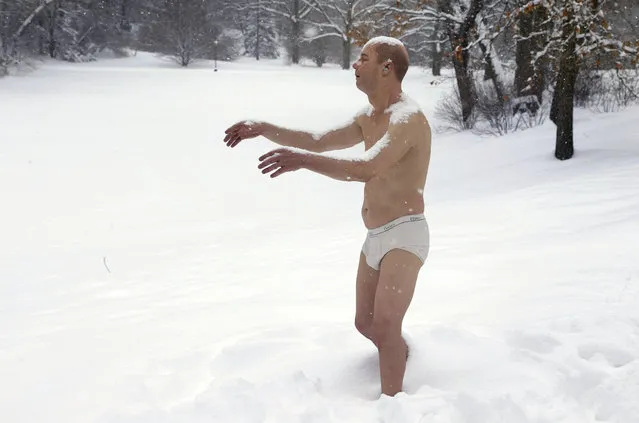
A statue of a man sleepwalking in his underpants is surrounded by snow on the campus of Wellesley College, in Wellesley, Mass., Wednesday, Feb. 5, 2014. The sculpture entitled "Sleepwalker" is part of an exhibit by sculptor Tony Matelli at the college's Davis Museum. (AP Photo/Steven Senne)

A statue of a man sleepwalking in his underpants is surrounded by snow on the campus of Wellesley College, in Wellesley, Mass., Wednesday, February 5, 2014. The sculpture entitled “Sleepwalker” is part of an exhibit by sculptor Tony Matelli at the college's Davis Museum. (Photo by Steven Senne/AP Photo)
Details
07 Feb 2014 07:09:00
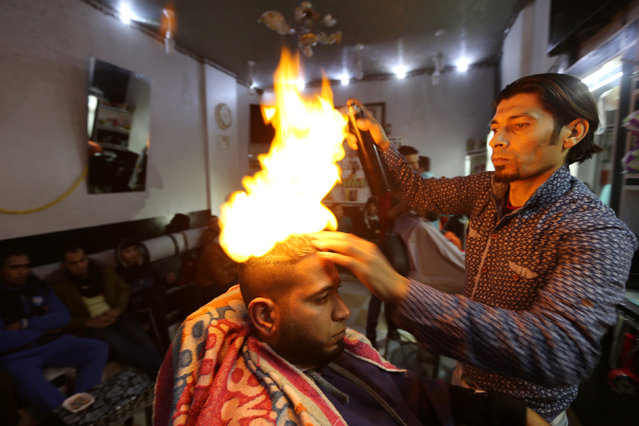
Palestinian barber Ramadan Odwan styles and straightens the hair of a customer with fire at his salon in Rafah, in the southern Gaza Strip February 2, 2017. In Ramadan Odwan's barbershop in Gaza, hair isn't just blow-dried, it's blowtorch-dried. “People have gone crazy about it, many people are curious to go through the experience and they are not afraid”, he told Reuters. “People here love adventures”. Odwan, 37, is not the first stylist in the world to use flame to straighten hair, but his craft is unique in the Gaza Strip. In his salon in the southern Gaza town of Rafah, Odwan applied what he described as a protective liquid coating to a customer's hair – he declined to disclose its contents – before aiming for the head and pressing the button on a small blowtorch. “I control how long I apply fire, I keep it on and off for 10 seconds or 15 seconds. It is completely safe and I have not encountered any accident since I started it two months ago”, Odwan added. Odwan charges 20 shekels ($5.20) for a haircut and fire-straightening. A barber for the past 18 years, he said part of the reason he uses the technique is to show that Palestinian barbers are as “professional as those out there around the world”. (Photo by Ibraheem Abu Mustafa/Reuters)

Palestinian barber Ramadan Odwan styles and straightens the hair of a customer with fire at his salon in Rafah, in the southern Gaza Strip February 2, 2017. In Ramadan Odwan's barbershop in Gaza, hair isn't just blow-dried, it's blowtorch-dried. “People have gone crazy about it, many people are curious to go through the experience and they are not afraid”, he told Reuters. “People here love adventures”. (Photo by Ibraheem Abu Mustafa/Reuters)
Details
11 Feb 2017 00:05:00
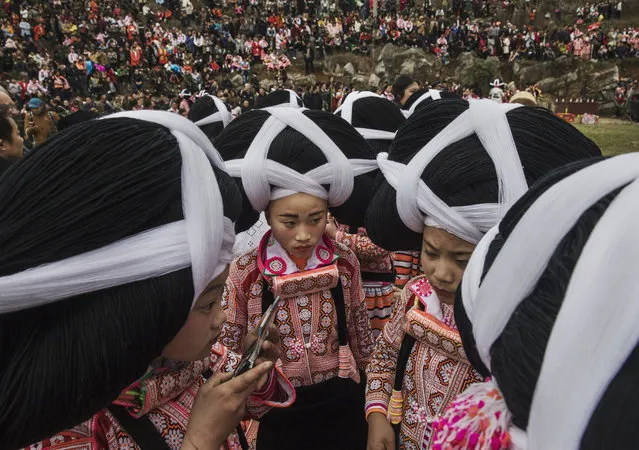
Girls of the Long Horn Miao ethnic minority group wear headdresses as they prepare gather for Tiaohua or Flower Festival as part of the Lunar New Year on February 6, 2017 in Longga village, Guizhou province, southern China. The Long Horn Miao are recognized for their declining practice of wrapping a blend of linen, wool, and the hair of their ancestors around animal horns or a wooden clip to make headdresses. Many young women say they now wear the headdresses only for special occasions and festivals, as the ornaments, which are attached by the horns to their real hair, have proved impractical for modern daily life in a fast changing world. China officially recognizes 56 different ethnic minorities, and statistics show over 7 million Chinese identifying themselves as Miao. But the small Long Horn Miao community counts only around 5000 people living in 12 villages, whose age-old traditions, language, and culture are fading. It is increasingly difficult in a modernizing China, as young people are drawn from remote rural villages to opportunities in bigger cities amongst wide-scale urbanization. Farming and labour remain the mainstays of life for the Long Horn Miao, leaving the area relatively poor in comparison with many parts of China. The government has invested significant amounts into local infrastructure and the tourism industry to try to bolster the local economy. (Photo by Kevin Frayer/Getty Images)

Girls of the Long Horn Miao ethnic minority group wear headdresses as they prepare gather for Tiaohua or Flower Festival as part of the Lunar New Year on February 6, 2017 in Longga village, Guizhou province, southern China. (Photo by Kevin Frayer/Getty Images)
Details
13 Feb 2017 00:01:00
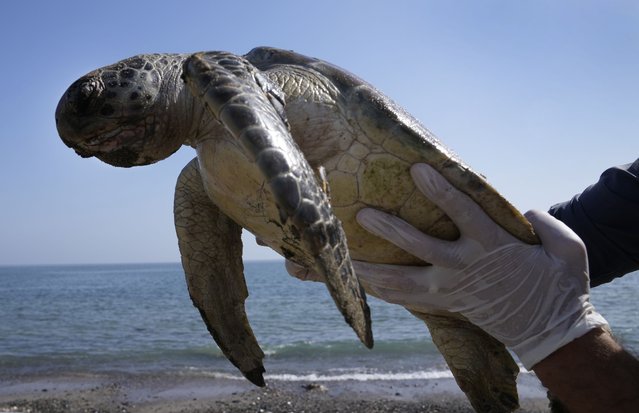
A dead green sea turtle is collected from the beach at the Khor Kalba Conservation Reserve, in the city of Kalba, on the east coast of the United Arab Emirates, Tuesday, February 1, 2022.  A staggering 75% of all dead green turtles and 57% of all loggerhead turtles in Sharjah had eaten marine debris, including plastic bags, bottle caps, rope and fishing nets, a new study published in the Marine Pollution Bulletin. The study seeks to document the damage and danger of the throwaway plastic that has surged in use around the world and in the UAE, along with other marine debris. (Photo by Kamran Jebreili/AP Photo)

A dead green sea turtle is collected from the beach at the Khor Kalba Conservation Reserve, in the city of Kalba, on the east coast of the United Arab Emirates, Tuesday, February 1, 2022. A staggering 75% of all dead green turtles and 57% of all loggerhead turtles in Sharjah had eaten marine debris, including plastic bags, bottle caps, rope and fishing nets, a new study published in the Marine Pollution Bulletin. The study seeks to document the damage and danger of the throwaway plastic that has surged in use around the world and in the UAE, along with other marine debris. (Photo by Kamran Jebreili/AP Photo)
Details
26 Feb 2022 04:58:00
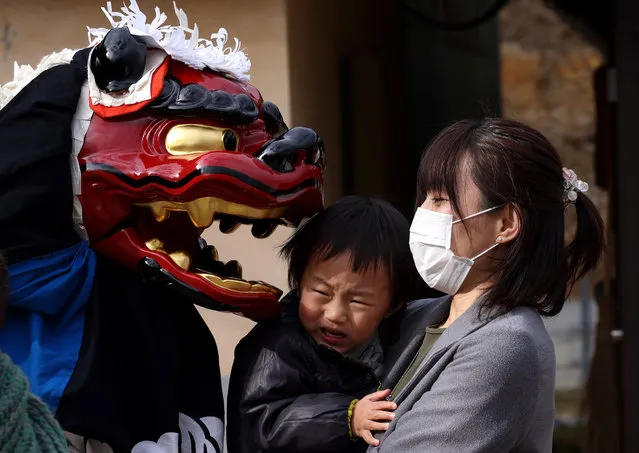
A performer wearing a lion mask performs the Ise Daikagura lion dance at the remote village of Yamanawa on February 08, 2021 in Ryuo, Japan. Ise Daikagura is a group of traditional Lion Dance performers who pray in front of farmers houses and businesses for good grain harvests and disease-free lives. Performers play sacred music using drums and flutes with two lion mask dancers. A lion mask is considered a symbol of God, who enters the house and performs in front of the Shinto God, a statue placed inside the house, mostly in the kitchen. These prayers are called “Kamodo Barai”. After the prayers, they are gifted with money, rice, sake and Japanese sweets from the householders. A group can travel for more than one hundred days to thousands of households and businesses throughout rural-villages in western Japan, and pray to those who are unable to visit the country’s most sacred shrine, the Grand Ise Shrine in Mie Prefecture. The group started its performance in the Edo era between 1603 to 1868 according to Japanese history. The Japanese government designated it as an important folk cultural national property in 1981. (Photo by Buddhika Weerasinghe/Getty Images)

A performer wearing a lion mask performs the Ise Daikagura lion dance at the remote village of Yamanawa on February 08, 2021 in Ryuo, Japan. Ise Daikagura is a group of traditional Lion Dance performers who pray in front of farmers houses and businesses for good grain harvests and disease-free lives. (Photo by Buddhika Weerasinghe/Getty Images)
Details
18 Feb 2021 09:27:00
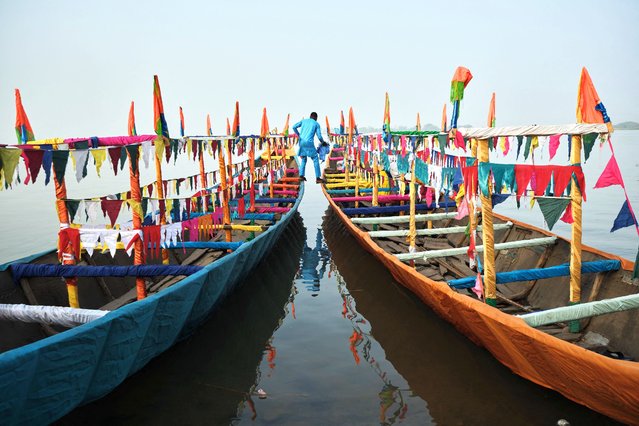
A man crosses from a pirogue to another pirogue during the annual boat regatta in Yauri, Kebbi State, on February 15, 2025. The regatta festival started about 200 years ago as a display of naval strength of the Gungu people, where the Gungu warriors annually attacked dangerous hippopotamus that were destroying farmlands. Warriors would board various sizes of canoes with different types of weapons to attack the animal on the River Niger. This required expertise in canoe paddling and naval warfare. It also served as training exercise for upcoming Gungu warriors. (Photo by Toyin Adedokun/AFP Photo)

A man crosses from a pirogue to another pirogue during the annual boat regatta in Yauri, Kebbi State, on February 15, 2025. The regatta festival started about 200 years ago as a display of naval strength of the Gungu people, where the Gungu warriors annually attacked dangerous hippopotamus that were destroying farmlands. Warriors would board various sizes of canoes with different types of weapons to attack the animal on the River Niger. This required expertise in canoe paddling and naval warfare. It also served as training exercise for upcoming Gungu warriors. (Photo by Toyin Adedokun/AFP Photo)
Details
25 Feb 2025 01:59:00
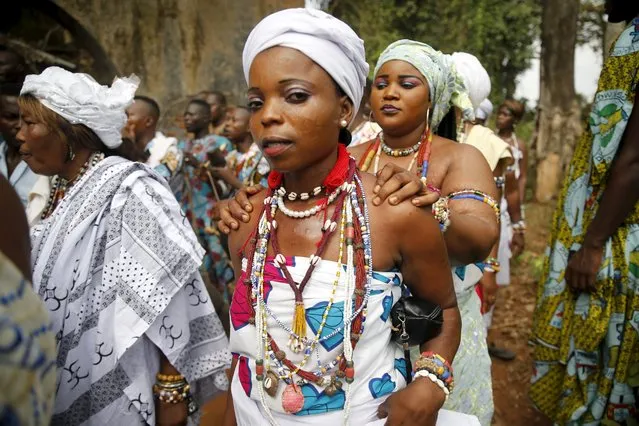
Devotees attend the annual voodoo festival in Ouidah January 10, 2016. (Photo by Akintunde Akinleye/Reuters)

Devotees attend the annual voodoo festival in Ouidah January 10, 2016. The national voodoo holiday in the West African country of Benin had a distinctively political accent this year as practitioners from Africa and the Americas gathered on Sunday to offer prayers and sacrifices for peace. Hundreds of followers of the traditional religion gathered in the Atlantic coast town of Ouidah, once an important port in the slave trade, to pray for calm during the tiny country's presidential election scheduled for February. (Photo by Akintunde Akinleye/Reuters)
Details
12 Jan 2016 08:05:00
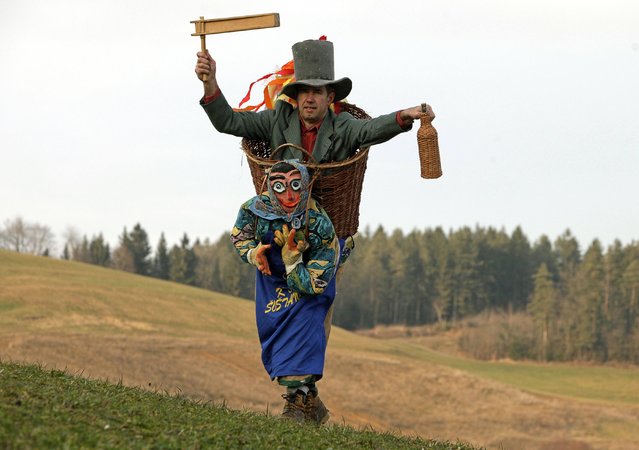
A man wearing a native costume named “Woman Carrying Husband” poses ahead of the Carnival in Sostanj January 15, 2015. (Photo by Srdjan Zivulovic/Reuters)

A man wearing a native costume named “Woman Carrying Husband” poses ahead of the Carnival in Sostanj January 15, 2015. Slovenians and members of various ethnological groups celebrate the annual carnival, also known locally as Pust, by wearing traditional masks and costumes to symbolically “chase away” the winter. Prust runs from February 7 to 17 this year. (Photo by Srdjan Zivulovic/Reuters)
Details
08 Feb 2015 12:07:00