Loading...
Done
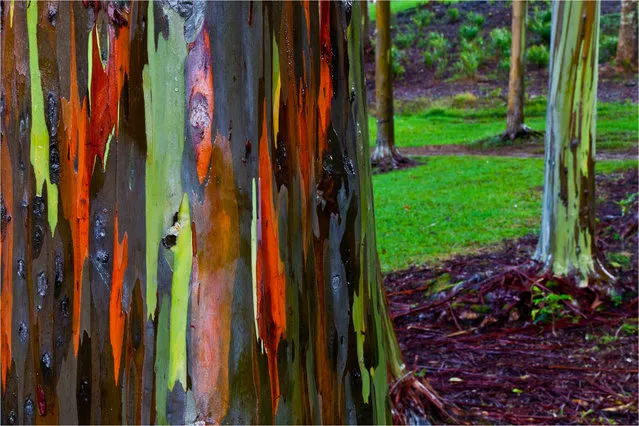
Rainbow Eucalyptus

Eucalyptus deglupta is a tall tree, commonly known as the Rainbow Eucalyptus, the Mindanao Gum, or the Rainbow Gum. It is the only Eucalyptus species found naturally in the Northern Hemisphere. Its natural distribution spans New Britain, New Guinea, Ceram, Sulawesi and Mindanao.
Details
01 Mar 2015 04:29:00
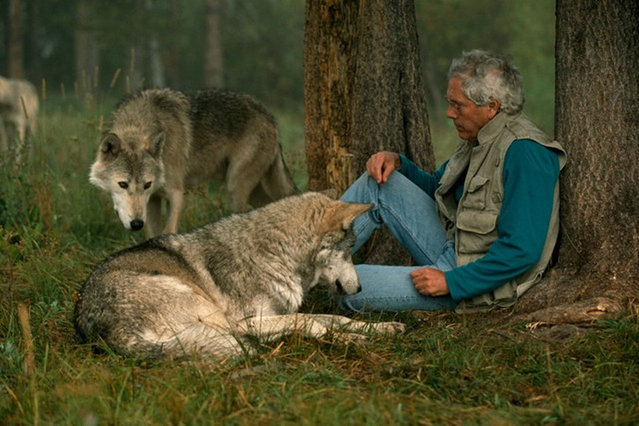
Living With Wolves

Jim and Jamie Dutcher spent six years in Idaho in a tent within the world’s largest wolf enclosure in order to observe and document the behavior of these wild animals. They got really close to the wolves and made many unique photos of wolves in their natural habitat.
Details
04 Dec 2012 10:40:00
A woman wearing a four-leaf clover-like hairpin takes a selfie nearby Nanluoguxiang street in Beijing, China, September 16, 2015. (Photo by Kim Kyung-Hoon/Reuters)

A woman wearing a four-leaf clover-like hairpin takes a selfie nearby Nanluoguxiang street in Beijing, China, September 16, 2015. Wearing antenna styled hairpins in the shape of various flowers and plants at scenic spots has become a new trend in Beijing. (Photo by Kim Kyung-Hoon/Reuters)
Details
18 Sep 2015 15:08:00
Shovava Wing Scarves By Roza Khamitova

Roza Khamitova was born into a family of artists in Kazakhstan. After finishing design school in Manhattan, New York, she was working in fashion industry for about 8 years. As a visual artist Roza had always drawn most of her inspiration from the natural world around her in the mountains of Kazakhstan. In 2011 she launched Shovava, her personal line of women’s clothing based on her hand drawn paintings and prints of the animals, plants and patterns found in nature. Roza was enchanted by the beauty of wings, its structure and symbolism. First, she sketches big wide-spread wings on paper with a light pencil, adds black ink to create a three-dimensional feel and fills with stunning watercolors.
Details
06 Dec 2015 10:42:00
Confiscated weapons hang from a magnet before being destroyed at a foundry in Santiago, Chile, January 18, 2016. (Photo by Ivan Alvarado/Reuters)

Confiscated weapons hang from a magnet before being destroyed at a foundry in Santiago, Chile, January 18, 2016. Nearly 13,000 firearms were destroyed as part of a government arms control program. (Photo by Ivan Alvarado/Reuters)
Details
20 Jan 2016 08:02:00
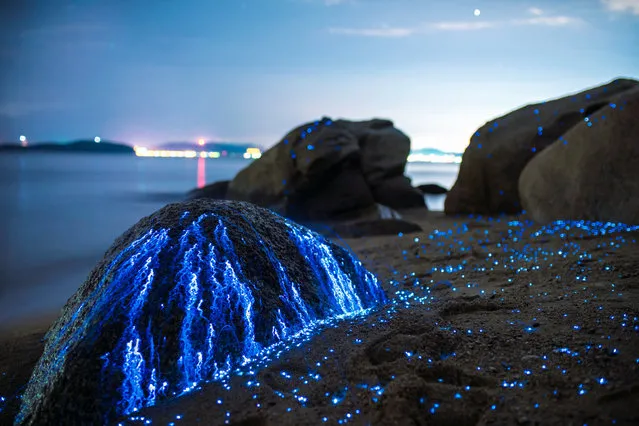
Bioluminescent sea fireflies glittering like diamonds on the rocks and sand. Okayama, Japan. July 2016. (Photo by Trevor Williams/Jonathan Galione/Getty Images)

Those lights are actually bioluminescent shrimp, better known as sea fireflies, or, in Japan, as “umibotaru”. Visible every year from May until the end of October, they live in the sand around very shallow sea water and are often seen floating between the extremes of high and low tides. Here: Bioluminescent sea fireflies glittering like diamonds on the rocks and sand. Okayama, Japan. July 2016. (Photo by Trevor Williams/Jonathan Galione/Getty Images)
Details
23 Aug 2016 10:13:00
Fire Pit By Melissa Crisp

A burning flame and a broad expanse of water are among the few things which do not tire us with their beauty. However, while we have many sources of water around us, it is quite hard to marvel at a burning flame on a daily basis. Melissa Crisp is one of the few people who were able to subdue the element of fire. She is the person who is behind the design of the uniquely-shaped fire pits, which feature mystifying themes, including a pair of lovers, a fire on the rodeo arena, a forest fire, a fiery flower, and a number of others. Each of the fire pits entrances you, and it almost seems like the characters are alive, as the hot fire burns deep within the spheres, casting dancing shadows all around. (Photo by Melissa Crisp)

Details
15 Jan 2015 13:35:00
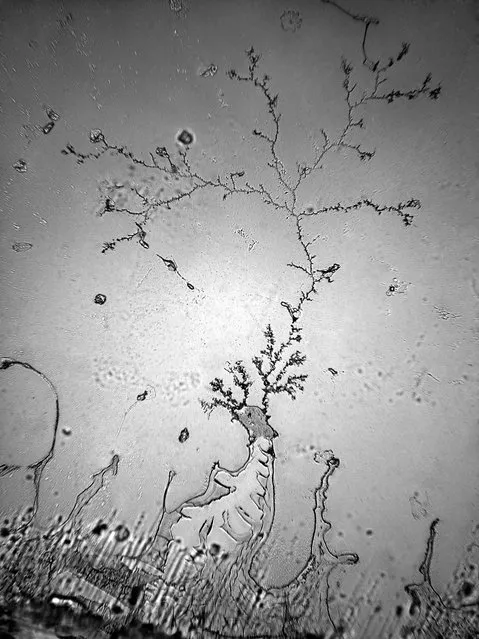
The Topography Of Tears By Rose-Lynn Fisher

Do tears of joy look the same as ones of woe—or ones from chopping onions? In “The Topography of Tears,” the Los Angeles-based photographer Rose-Lynn Fisher explores the physical terrain of one hundred tears emitted during a range of emotional states and physical reactions. Using a Zeiss microscope with an attached digital camera, she captures the composition of tears enclosed in glass slides, magnified between 10x and 40x. “There are many factors that determine the look of each tear image, including the viscosity of the tear, the chemistry of the weeper, the settings of the microscope, and the way I process the images afterwards,” she says.
Details
21 May 2014 17:46:00