Loading...
Done


“Itasha (痛車), literally “painmobile”, is a Japanese term for an otaku fad of individuals decorating the bodies of their cars with fictional characters of anime, manga, or video games (especially bishōjo game or eroge). These characters are predominately “cute” female. The decorations usually involve paint schemes and stickers. Automobiles are called Itasha, while similar motorcycles and bicycles are called itansha (痛単車) and itachari (痛チャリ), respectively”. – Wikipedia


Photo: A visitor takes pictures of an anime-decorated «Itasha» car displayed during the “Moe Fes in Washimiya” at Washimiya Town Hall on July 18, 2009 in Washimiya, Saitama, Japan. Itasha, a word derived from “itai” (painful) and “sha” (car), are vehicles decorated with mostly female characters from Japanese manga, anime and video games. (Photo by Kiyoshi Ota/Getty Images)
Details
02 May 2011 08:38:00
A giant Santa Claus, created and worn by local artist Ed Terrell, 66, walks home with his son and assistant, Rupanuga, 18, following a ceremony to decorate a scraggly Christmas tree with a single red Bulb in Reading, Pennsylvania, December 7, 2014. A ceremony to decorate the scraggly Christmas tree in Reading, Pennsylvania with a single red bulb, much like Charlie Brown's tree in the animated holiday classic, was postponed to Sunday from Saturday because of rain and cold temperatures, officials said. (Photo by Mark Makela/Reuters)

A giant Santa Claus, created and worn by local artist Ed Terrell, 66, walks home with his son and assistant, Rupanuga, 18, following a ceremony to decorate a scraggly Christmas tree with a single red Bulb in Reading, Pennsylvania, December 7, 2014. A ceremony to decorate the scraggly Christmas tree in Reading, Pennsylvania with a single red bulb, much like Charlie Brown's tree in the animated holiday classic, was postponed to Sunday from Saturday because of rain and cold temperatures, officials said. Officials decided to hold a re-dedication ceremony, which will include a Spanish and English reading from the movie's screenplay, and decorate it with a single red bulb, as in the 1965 animated television special, “A Charlie Brown Christmas”. (Photo by Mark Makela/Reuters)
Details
13 Dec 2014 12:05:00
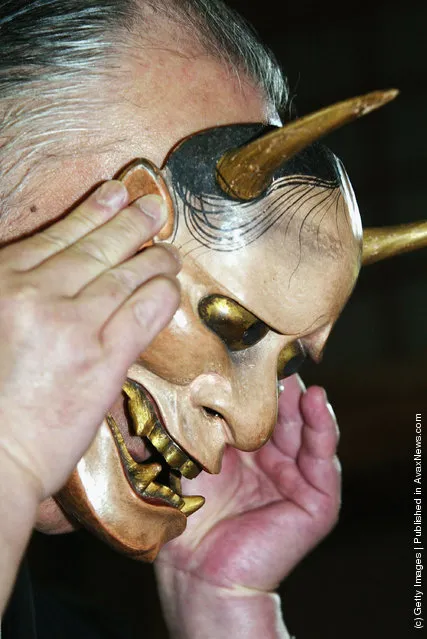
A renowned Noh actor, Otoshige Sakai, demostrates how to put on a Noh mask

“Noh, or Nogaku – derived from the Japanese word for “skill” or “talent” – is a major form of classical Japanese musical drama that has been performed since the 14th century. Many characters are masked, with men playing male and female roles. Traditionally, a Noh “performance day” lasts all day and consists of five Noh plays interspersed with shorter, humorous kyōgen pieces. However, present-day Noh performances often consist of two Noh plays with one Kyōgen play in between”. – Wikipedia

Photo: A renowned Noh actor, Otoshige Sakai, demostrates how to put on a Noh mask, on May 17, 2004 in Tokyo, Japan. (Photo by Koichi Kamoshida/Getty Images)
Details
02 Aug 2011 14:09:00
A long time exposure shows a Igloo at the “Igloo village” (Iglu Dorf) in front of the famous Matterhorn mountain in Zermatt, Switzerland, late 28 January 2016. The hotel-igloo village made of snow and ice at 2'815 meters about sea level with a bar, a restaurant, bedrooms and wellness are celebrating their 20th anniversary. (Photo by Jean-Christophe Bott/EPA)

A long time exposure shows a Igloo at the “Igloo village” (Iglu Dorf) in front of the famous Matterhorn mountain in Zermatt, Switzerland, late 28 January 2016. The hotel-igloo village made of snow and ice at 2'815 meters about sea level with a bar, a restaurant, bedrooms and wellness are celebrating their 20th anniversary. For this occasion the hosts built the largest classic igloo with a diameter of 13 meters and a ceiling hight of 11 meters in front of Matterhorn in Zermatt, and they will attempt the world record for this Igloo. (Photo by Jean-Christophe Bott/EPA)
Details
30 Jan 2016 14:16:00
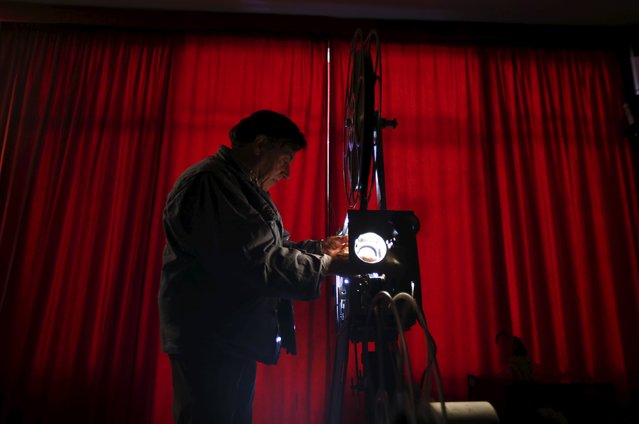
Projectionist Antonio Feliciano, 75, checks his projector before showing a film in Monforte, Portugal May 16, 2015. (Photo by Rafael Marchante/Reuters)

Projectionist Antonio Feliciano, 75, checks his projector before showing a film in Monforte, Portugal May 16, 2015. Shades of Oscar-winning classic "Cinema Paradiso" run through the life of Feliciano, a sprightly 75-year-old who fears he may be the last of Portugal's travelling film projectionists.After six decades travelling four million km (2.5 million miles) to screen 4,000 films in Portugal's far-flung villages, Feliciano does not plan to retire just yet. But he is resigned to the fact that the Internet, digital TV and distribution monopolies have made his craft obsolete. (Photo by Rafael Marchante/Reuters)
Details
12 Nov 2015 08:06:00
A protestor makes a selfie in front of a burning car during a national trade union demonstration in Brussels, Thursday November 6, 2014. Tens of thousands of demonstrators are converging on the Belgian capital to protest government policies that will extend the pension age, contain wages and cut into public services. (Photo by Geert Vanden Wijngaert/AP Photo)

A protestor makes a selfie in front of a burning car during a national trade union demonstration in Brussels, Thursday November 6, 2014. Tens of thousands of demonstrators are converging on the Belgian capital to protest government policies that will extend the pension age, contain wages and cut into public services. (Photo by Geert Vanden Wijngaert/AP Photo)
Details
10 Nov 2014 14:24:00
A woman sells statues of the Ekeko, god of fortune, at the traditional “Alasitas” fair in La Paz January 24, 2015. During the fair, Bolivians buy miniature versions of goods like cars, money and houses they would like to own in real life during the year. (Photo by David Mercado/Reuters)

A woman sells statues of the Ekeko, god of fortune, at the traditional “Alasitas” fair in La Paz January 24, 2015. During the fair, Bolivians buy miniature versions of goods like cars, money and houses they would like to own in real life during the year. (Photo by David Mercado/Reuters)
Details
25 Jan 2015 09:59:00
Tourists ride a cable car in the form a of a Chiva, a bus used to serve rural routes, in Pitalito, Colombia, Tuesday, April 5, 2017. The ride called “La Chiva Voladora” costs about $0.70 and you zip along about 800 meters from one side of a hill to another. (Photo by Fernando Vergara/AP Photo)

Tourists ride a cable car in the form a of a Chiva, a bus used to serve rural routes, in Pitalito, Colombia, Tuesday, April 5, 2017. The ride called “La Chiva Voladora” costs about $0.70 and you zip along about 800 meters from one side of a hill to another. (Photo by Fernando Vergara/AP Photo)
Details
21 Dec 2017 06:51:00