Loading...
Done
Sasha, a police dog, wears a cap and gown, on the day of the 374th Commencement exercises at Harvard University in Cambridge, Massachusetts on May 29, 2025. (Photo by Brian Snyder/Reuters)

Sasha, a police dog, wears a cap and gown, on the day of the 374th Commencement exercises at Harvard University in Cambridge, Massachusetts on May 29, 2025. (Photo by Brian Snyder/Reuters)
Details
07 Jun 2025 03:29:00
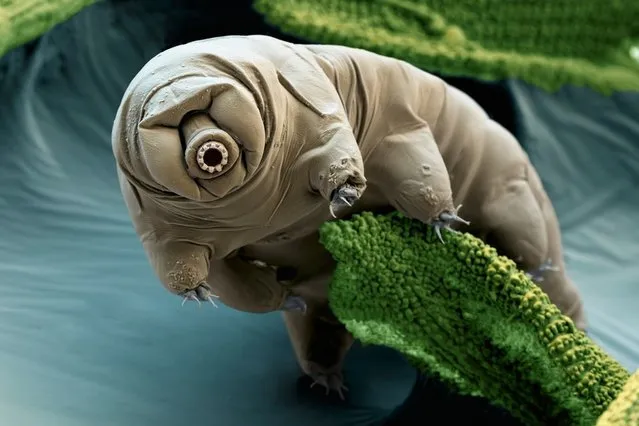
Tardigrades (commonly known as waterbears or moss piglets). (Photo by SPL/East News)

“Tardigrades (commonly known as waterbears or moss piglets) are small, water-dwelling, segmented animals with eight legs. Tardigrades were first discovered in 1773 by Johann August Ephraim Goeze, who called them kleiner Wasserbär, meaning “little water bear” in German. The name Tardigrada means “slow walker” and was given by Lazzaro Spallanzani in 1777. The name water bear comes from the way they walk, reminiscent of a bear's gait. The biggest adults may reach a body length of 1.5 millimetres (0.059 in), the smallest below 0.1 mm. Freshly hatched tardigrades may be smaller than 0.05 mm”. – Wikipedia. Photo: Tardigrades. (Photo by SPL/East News)
Details
26 Sep 2012 09:55:00
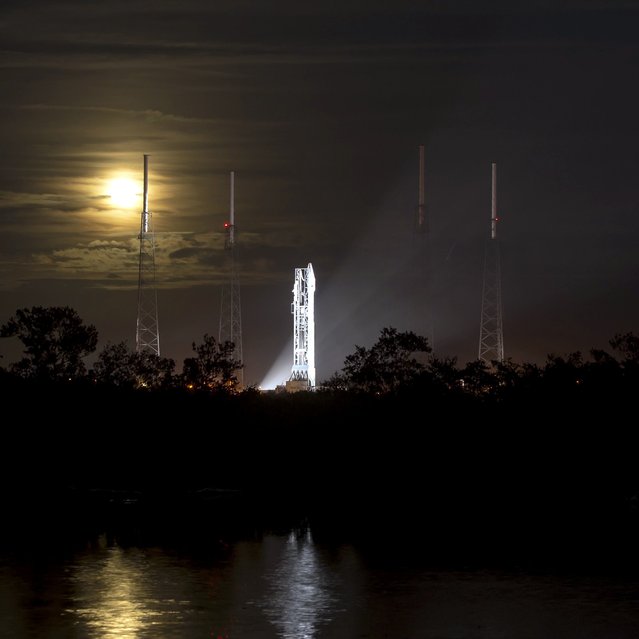
This photo provided by NASA shows a full moon rising behind the United Launch Alliance Atlas V rocket with NASA's Mars Atmosphere and Volatile Evolution (MAVEN) spacecraft onboard at the Cape Canaveral Air Force Station Space Launch Complex 41, Sunday, Nov. 17, 2013, Cape Canaveral, Florida. NASA's next Mars-bound spacecraft, the Mars Atmosphere and Volatile Evolution, or MAVEN, is the first spacecraft devoted to exploring and understanding the Martian upper atmosphere. (AP Photo/NASA, Bill Ingalls)

This photo provided by NASA shows a full moon rising behind the United Launch Alliance Atlas V rocket with NASA's Mars Atmosphere and Volatile Evolution (MAVEN) spacecraft onboard at the Cape Canaveral Air Force Station Space Launch Complex 41, Sunday, November 17, 2013, Cape Canaveral, Florida. NASA's next Mars-bound spacecraft, the Mars Atmosphere and Volatile Evolution, or MAVEN, is the first spacecraft devoted to exploring and understanding the Martian upper atmosphere. (Photo by Bill Ingalls/AP Photo/NASA)

Details
19 Nov 2013 06:42:00
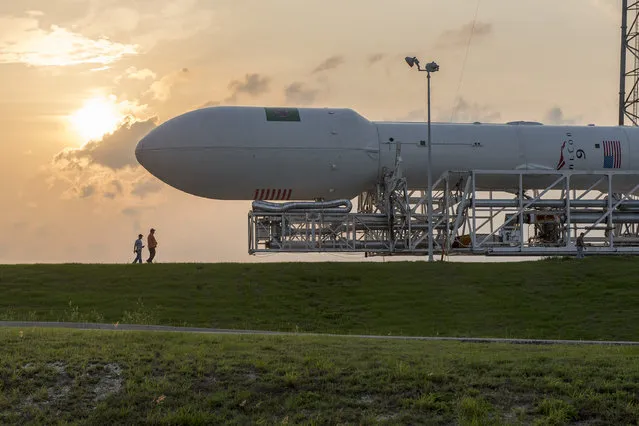
In this handout provided by the National Aeronautics and Space Administration (NASA), SpaceX's Falcon 9 is moved to the launch pad prior to the rocket's Thales Alenia Space launch attempt on April 26, 2015 in Cape Canaveral, Florida. (Photo by NASA via Getty Images)

In this handout provided by the National Aeronautics and Space Administration (NASA), SpaceX's Falcon 9 is moved to the launch pad prior to the rocket's Thales Alenia Space launch attempt on April 26, 2015 in Cape Canaveral, Florida. (Photo by NASA via Getty Images)
Details
05 Jun 2017 07:25:00
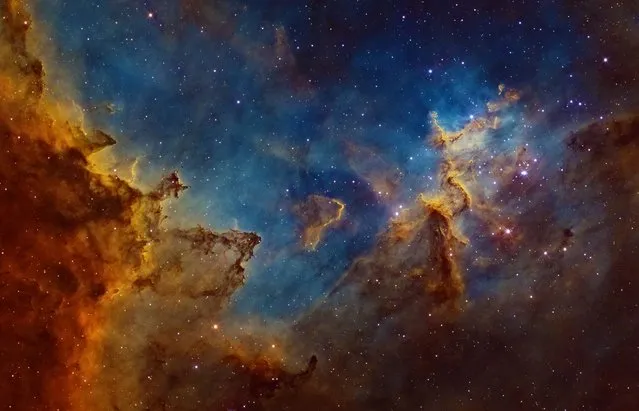
Centre of the Heart Nebula by Ivan Eder (Hungary). Situated 7500 light years away in the ‘W’-shaped constellation of Cassiopeia, the Heart Nebula is a vast region of glowing gas, energized by a cluster of young stars at its centre. The image depicts the central region, where dust clouds are being eroded and moulded into rugged shapes by the searing cosmic radiation. (Photo by Ivan Eder)

The competition, which is run by the Royal Observatory Greenwich in association with BBC Sky at Night Magazine, is now in its sixth year and has received over 2,500 entries. Photo: Centre of the Heart Nebula by Ivan Eder (Hungary). Situated 7500 light years away in the “W”-shaped constellation of Cassiopeia, the Heart Nebula is a vast region of glowing gas, energized by a cluster of young stars at its centre. The image depicts the central region, where dust clouds are being eroded and moulded into rugged shapes by the searing cosmic radiation. (Photo by Ivan Eder)
Details
03 Jul 2014 11:59:00
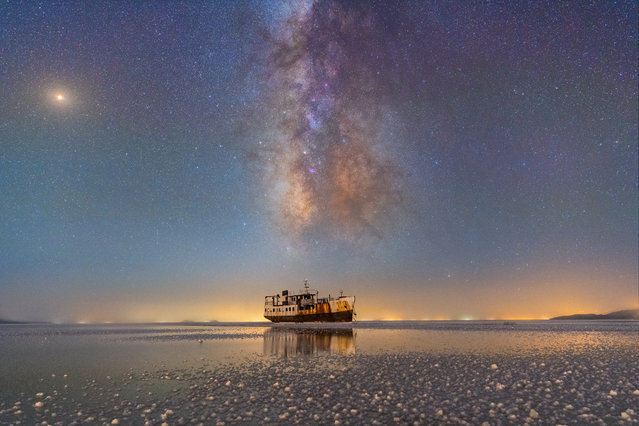
Sharafkhaneh port and lake Urmia. Masoud Ghadiri (Iran). The summer Milky Way is very prominent in this photo. On the galaxy zone, Saturn is located besides the Lagoon nebula. On the right of the horizon, you can see the extreme light pollution of Urmia, which is caused by ever-increasing city development. (Photo by Masoud Ghadiri/National Maritime Museum)

Sharafkhaneh port and lake Urmia. Masoud Ghadiri (Iran). The summer Milky Way is very prominent in this photo. On the galaxy zone, Saturn is located besides the Lagoon nebula. On the right of the horizon, you can see the extreme light pollution of Urmia, which is caused by ever-increasing city development. (Photo by Masoud Ghadiri/National Maritime Museum)
Details
20 Jun 2019 00:01:00
Balinese I Ketut Widanta or known as Lelut rides to collect fodder with his dogs sits on his motorbike in Canggu, Bali, Indonesia on November 05, 2021. Lelut becomes famous for his attractive style of carrying six of his rescued dogs with a modified motorbike while collecting food waste from restaurants. Currently, he takes care of twenty rescued dogs which some of them were dumped by the owners on the street due to the Covid-19 pandemic. Often he receives dog food donations from dog lovers since the collapse of Bali tourism affects his income. (Photo by Johannes P. Christo/Anadolu Agency via Getty Images)

Balinese I Ketut Widanta or known as Lelut rides to collect fodder with his dogs sits on his motorbike in Canggu, Bali, Indonesia on November 05, 2021. Lelut becomes famous for his attractive style of carrying six of his rescued dogs with a modified motorbike while collecting food waste from restaurants. Currently, he takes care of twenty rescued dogs which some of them were dumped by the owners on the street due to the Covid-19 pandemic. Often he receives dog food donations from dog lovers since the collapse of Bali tourism affects his income. (Photo by Johannes P. Christo/Anadolu Agency via Getty Images)
Details
01 Dec 2021 08:57:00
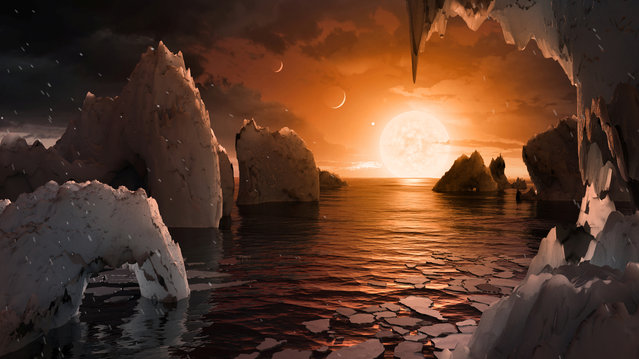
The possible surface of TRAPPIST-1f, one of seven newly discovered planets in the TRAPPIST-1 system that scientists using the Spitzer Space Telescope and ground based telescopes have discovered. (Photo by Reuters/NASA/JPL-Caltech)

The possible surface of TRAPPIST-1f, one of seven newly discovered planets in the TRAPPIST-1 system that scientists using the Spitzer Space Telescope and ground based telescopes have discovered. (Photo by Reuters/NASA/JPL-Caltech)
Details
07 Mar 2017 00:02:00