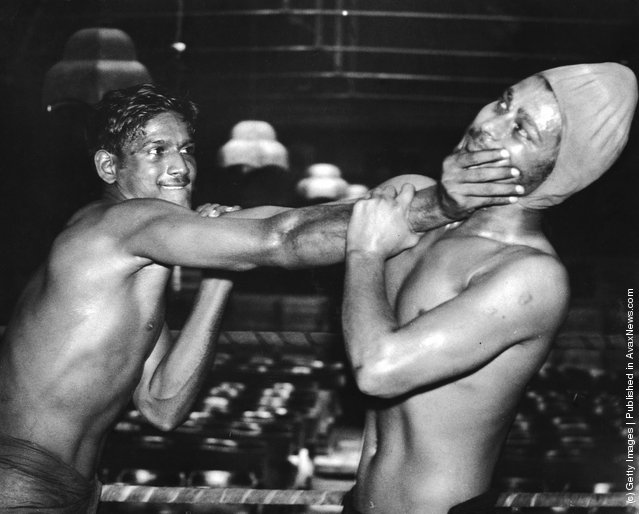
Indian wrestlers Rashid Anwar (left) and Ajaib Singh in a training bout at Lane's Club in Baker Street London before the Empire Games, 19th July 1934. (Photo by Keystone/Hulton Archive/Getty Images)
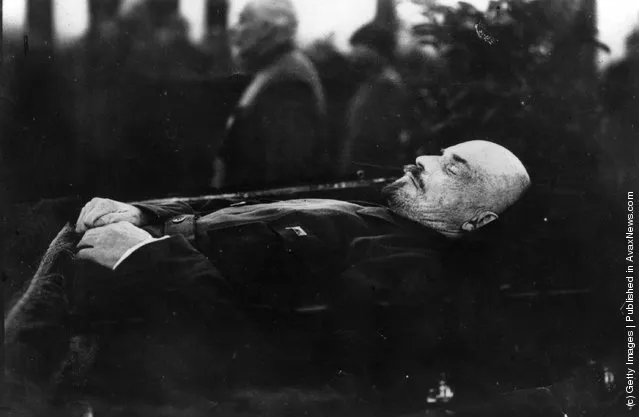
Photo: Vladimir Ilyich Lenin (1870 – 1924) lying in state in the Kremlin. (Photo by Hulton Archive/Getty Images). 1924
Important! For the same article in Russian language click here.
Something quite intriguing is happening within Russian-speaking internet during the last few – should you type a fully academic inquiry (at least, according to Russian academic requirements) in national search engines for "Lenin's mausoleum" – the first thing you get (even in top 10 searches) is website pages talking about black magic and occult. Website authors view this construction differently, but unconditionally agree on one thing: the mausoleum of the "leader of the world proletariat” – the essence of a magical artifact, a sort of “energy vampire”. It was built with a certain purpose: to drain the energy out of miserable Soviet citizens on one hand; and to poison the anthroposphere of one-sixth part of the earth with its vibes (the exact territory that was occupied by the former Soviet Union), depriving the Russian people of will to resist on the other hand. Complete nonsense? No doubt. Nevertheless, an intriguing one. Well, probably because some oddities do exist in mausoleum's history. These oddities are the thing we are going to discuss this time. First, let me refresh you memory on the subject.
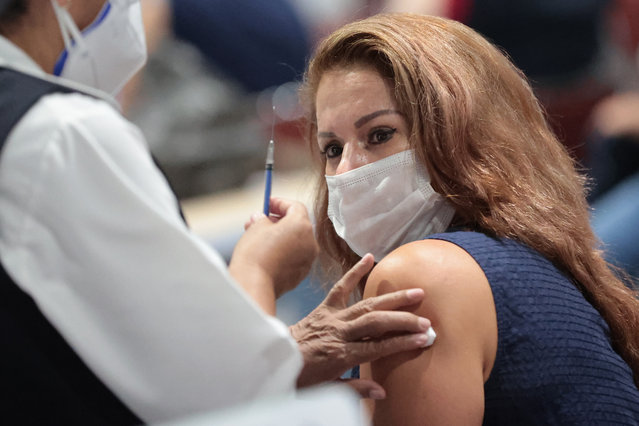
A nurse shows a syringe with a dose of the COVID-19 vaccine to a citizen who is about to receive it during a vaccination day as part of the campaign in Mexico City at Pepsi Center WTC on May 25, 2021 in Mexico City, Mexico. According to the head of Govermnment, Claudia Sheinbaum, seven municipalities will start their campaign today which plans to apply the first dose to over 500,000 citizens between 50 and 59 years old. (Photo by Hector Vivas/Getty Images)
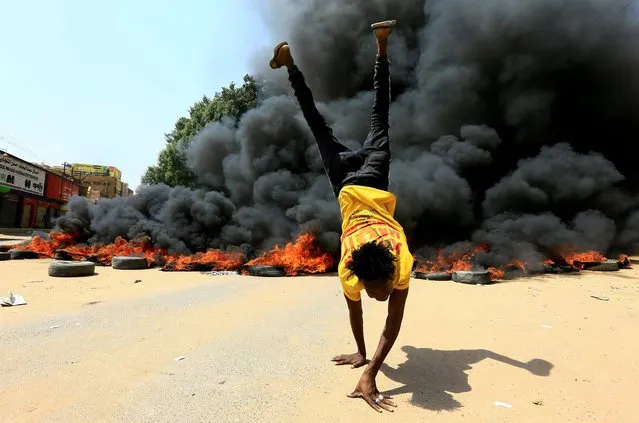
A person does a handstand in front of a burning pile of tyres during a protest against prospect of military rule in Khartoum, Sudan on October 21, 2021. (Photo by Mohamed Nureldin Abdallah/Reuters)
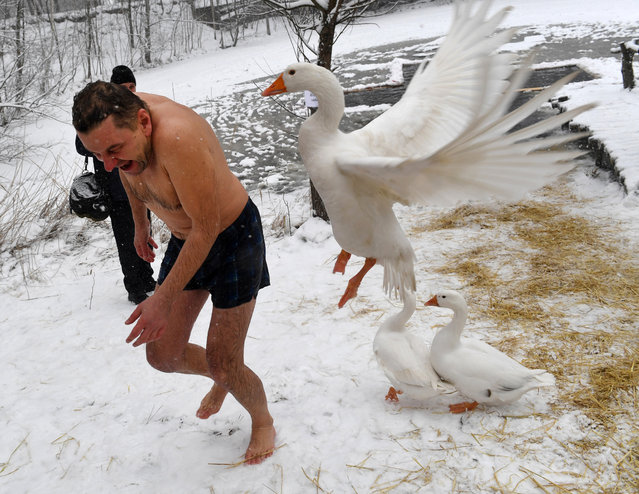
A goose attacks an Orthodox believer as he leaves the icy waters of a pond during the celebration of the Orthodox Epiphany holiday in Kiev on January 19, 2018. Thousands of Ukrainian Orthodox Church followers plunged into icy rivers and ponds across the country to mark Epiphany, cleansing themselves with water deemed holy for the day. (Photo by Sergei Supinsky/AFP Photo)
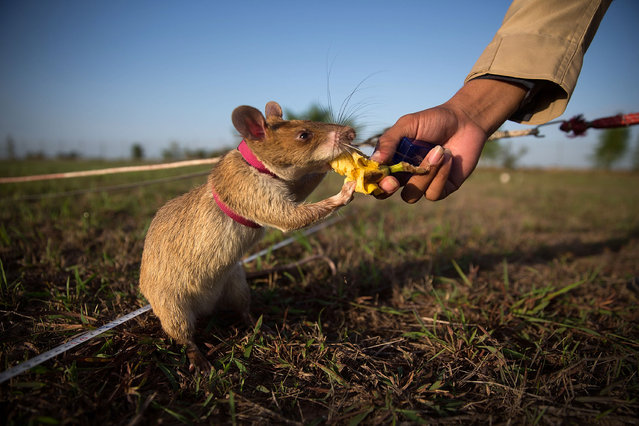
A mine detection rat is given banana as a reward after successfully identifying an inactive mine on July 2, 2015 in Siem Reap, Cambodia. The Cambodian Mine Action Center (CMAC) working with the Belgian NGO APOPO has recently begun testing the feasability of using large mine detection rats from Tanzania to help clear fields of mines and unexploded ordnance in one of the most bombed and mined countries in the world. (Photo by Taylor Weidman/Getty Images)
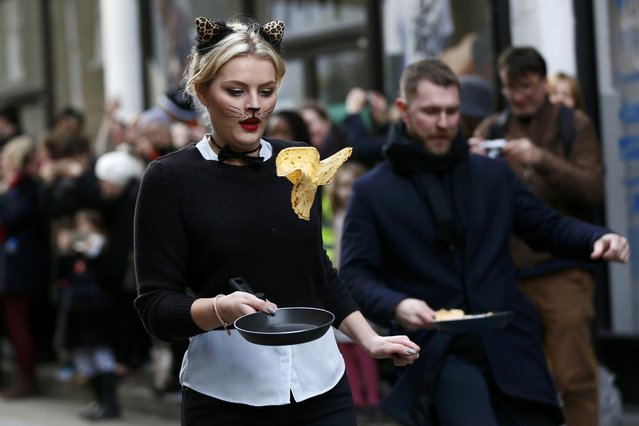
Participants take part in the annual Great Spitalfields Pancake Race in aid of London's Air Ambulance in London, Britain February 9, 2016. (Photo by Stefan Wermuth/Reuters)
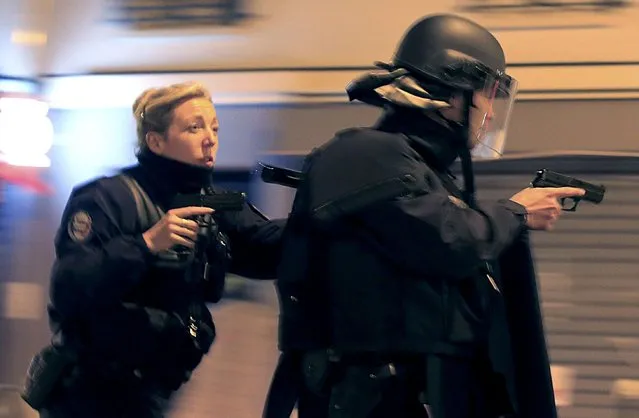
Police react to a suspicious vehicle near La Carillon restaurant following a series of deadly attacks in Paris, November 15, 2015. Thousands of French troops deployed around Paris on Sunday and tourist sites stood shuttered in one of the most visited cities on Earth while investigators questioned the relatives of a suspected suicide bomber involved in the country's deadliest violence since World War II. (Photo by Pascal Rossignol/Reuters)