Loading...
Done
Deconstructed Objects By Todd McLellan

It is simply staggering how complicated some items really are. We never think about it, but some items that we use every day consist of hundreds of parts meticulously put together and working perfectly. Todd McLellan is a photographer who based his newest book “Things Come Apart” on the complexity of various old and new tech. By carefully taking apart various items and arranging all of the parts in perfect order, Todd has allowed us not only to look inside various appliances, but also to appreciate the astounding complexity of these items. Just like the human mind, we are so used to seeing and talking with people that we forget just how complicated their minds really are. It would be great if we could “take apart” the human mind in order to gain some insight into the person’s thoughts and desires. However, very few people are capable of doing it, while the rest will remain blind to the obvious. (Photo by Todd McLellan)
Details
15 Nov 2014 12:30:00
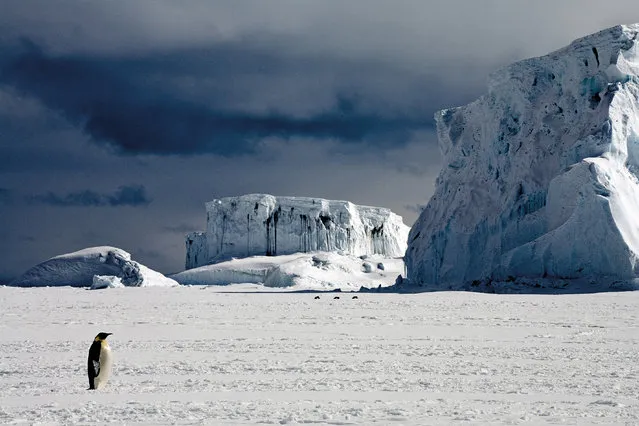
Image from Camille Seamans new book, “Melting Away”. (Photo by Camille Seaman/Barcroft Media)

Documenting the effects of climate change first hand over the past eight years, Camille Seaman fears we may be on the road to the last iceberg. Photographing the enormous frozen floats at both poles for the past eight years, the Californian adventurer has seen the receding ice shelves and experienced the changing warmer weather. Feeling that her intimate and emotional work documents a snapshot of history, Camille presents her series “The Last Iceberg” as a study of what she sees as the personality of each huge iceberg. Drawing parallels with the famous novel, “The Last of the Mohicans”, Camille, 42, wonders whether these unique, almost alien natural features will become a thing of the past or part of nature's renewal process. (Photo by Camille Seaman/Barcroft Media)
Details
02 Dec 2014 12:10:00


“The Trabant is a car that was produced by former East German auto maker VEB Sachsenring Automobilwerke Zwickau in Zwickau, Sachsen. It was the most common vehicle in East Germany, and was also exported to countries both inside and outside the communist bloc. The main selling points was that it had room for four adults and luggage in a compact, light and durable shell and that it was fast (when introduced) and durable. With its mediocre performance, smoky two-stroke engine, and production shortages, the Trabant is often cited as an example of the disadvantages of centralized planning; on the other hand, it is regarded with derisive affection as a symbol of the failed former East Germany and of the fall of communism (in former West Germany, as many East Germans streamed into West Berlin and West Germany in their Trabants after the opening of the Berlin Wall in 1989). It was in production without any significant changes for nearly 30 years with 3,096,099 Trabants produced in total”. – Wikipedia

Photo: Enthusiasts weared in uniforms of the former eastern german army trive in a military Trabant car as fans and owners of East German-era Trabant cars gather at the 2011 International Trabantfahrer Treffen (International Trabant Drivers Meeting) on June 26, 2011 in Zwickau, Germany. The Trabant, also known as the Trabi, was among the main cars produced in communist East Germany and built by VEB Sachsenring Automobilwerke in Zwickau for 30 years until 1989. Today the car has cult status for many followers and one company, IndiKar, is even seeking to revive the brand in a modern, electric version. (Photo by Carsten Koall/Getty Images)
Details
27 Jun 2011 12:21:00
A dead crocodile is seen on Huangsha Seafood Market in Guangzhou, Guandong Province, China, 22 January 2018. Tsukiji Market of China or Huangsha Seafood Market is biggest one in Southern China and one of the biggest in China, as there are literally hundreds of different varieties of fish and seafood scattered throughout the market. Since the proximity of the fish market is so close to the Zhujiang River, it's quite easy for the large fishing vessels and fishermen to unload their fresh catch right at the market, which ensures that the fish and seafood remain fresh. Fish and other seafood are coming there from all around the globe. Seafood Market is full of different kinds of live fish, live shellfish, and live seafood on display in crystal clear tanks and it's common to see 5-star chefs, retailers and expats to source for fresh and high-quality seafood supplies for reasonable prices. While it is a wholesale fish market, since many Guangzhou restaurants and businesses come to purchase their seafood here, the public is welcome to come and even purchase. Many local Chinese have the vendors slice up fresh salmon fillets to take home or carry seafood into one of the nearby specialty restaurants, where they will cook if for them and serve it with vegetables and other side dishes of their choice. One of the biggest attractions for both, tourists and buyers, on market are crocodiles, which are brought there alive in wooden cases with taped jaws so they can?t accidentally bite. They are from crocodile farms from Guangdong, China and from Vietnam. Crocodile meat is popular in most Asian countries and it is consider as delicate one. Crocodiles weight from 10 to 25 kg and bigger ones are about 2 years old. They cost about 70 RMB (8.90 EURO) when bout as whole, or if you buy as parts most expensive and appreciated parts are paws 120 RMB (15.26 EURO) per kg, and tail 100 RMB (12.72 EURO) per kg. (Photo by Aleksandar Plavevski/EPA/EFE)

A dead crocodile is seen on Huangsha Seafood Market in Guangzhou, Guandong Province, China, 22 January 2018. Tsukiji Market of China or Huangsha Seafood Market is biggest one in Southern China and one of the biggest in China, as there are literally hundreds of different varieties of fish and seafood scattered throughout the market. (Photo by Aleksandar Plavevski/EPA/EFE)
Details
17 Apr 2020 00:05:00
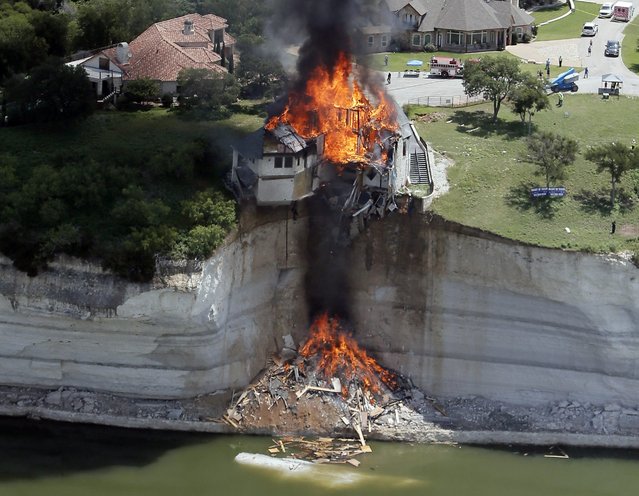
Smoke rises from a house days after part of the ground it was resting on collapsed into Lake Whitney, Texas in this June 13, 2014 file photo. I was covering the controlled burn of a house slowly falling into Lake Whitney due to the decaying cliff underneath.  Asked to take photos from an aerial perspective, an instructor and I took off from Grand Prairie Municipal Airport around 9am. (Photo and caption by Brandon Wade/Reuters)

Smoke rises from a house days after part of the ground it was resting on collapsed into Lake Whitney, Texas in this June 13, 2014 file photo. I was covering the controlled burn of a house slowly falling into Lake Whitney due to the decaying cliff underneath. Asked to take photos from an aerial perspective, an instructor and I took off from Grand Prairie Municipal Airport around 9am. The burn, scheduled to start an hour later, was delayed. I love flying, but patience proved challenging as circling for nearly three hours gets boring fast. Once the fire started we only had 15 minutes to take photos because the plane was booked at 1pm. The owners invested their retirement savings in the house and were even advised by geologists that the ground was stable. To watch your investment literally go up in flames must take its toll emotionally. The owners said they don't expect their insurance to cover the loss. (Photo and caption by Brandon Wade/Reuters)
Details
27 Nov 2014 15:01:00
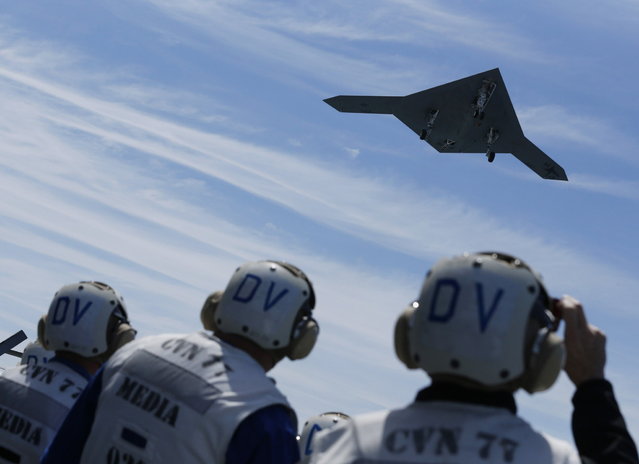
An X-47B pilot-less drone combat aircraft is launched for the first time off an aircraft carrier, the USS George H. W. Bush, in the Atlantic Ocean off the coast of Virginia, May 14, 2013. The U.S. Navy made aviation history on Tuesday by catapulting an unmanned jet off an aircraft carrier for the first time, testing a long-range, stealthy, bat-winged plane that represents a jump forward in drone technology. (Photo by Jason Reed/Reuters)

The X-47B prototype on Tuesday flew off an aircraft carrier and into the history books. Today's achievement, the first-ever catapult launch of an unmanned aircraft from the flight deck of a carrier, promises to open up a new chapter in the annals of naval aviation. Photo: An X-47B pilot-less drone combat aircraft is launched for the first time off an aircraft carrier, the USS George H. W. Bush, in the Atlantic Ocean off the coast of Virginia, May 14, 2013. The U.S. Navy made aviation history on Tuesday by catapulting an unmanned jet off an aircraft carrier for the first time, testing a long-range, stealthy, bat-winged plane that represents a jump forward in drone technology. (Photo by Jason Reed/Reuters)
Details
16 May 2013 12:39:00
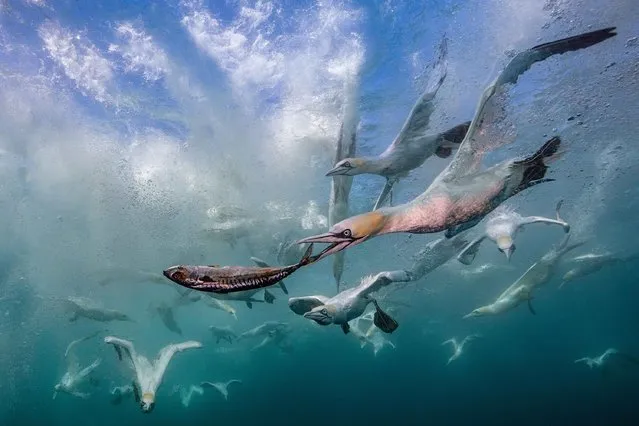
Hundreds of gannets dive for mackerel off the coast of Shetland, Northern Isles of Scotland on July 2020, where they plunge into the water from heights of up to 100ft at speeds of 60mph. (Photo by David Keep/The Times)

Hundreds of gannets dive for mackerel off the coast of Shetland, Northern Isles of Scotland on July 2020, where they plunge into the water from heights of up to 100ft at speeds of 60mph. (Photo by David Keep/The Times)
Details
09 Aug 2020 00:03:00
Breanna Ziehlke encourages her frog to get on with it at the Calaveras County Fair & Jumping Frog Jubilee. (Photo by Sol Neelman)

Since 2005, photographer Sol Neelman, has photographed people having fun. More specifically, Neelman has documented the wacky and wildly diverse world of “weird sports”. Photo: Breanna Ziehlke encourages her frog to get on with it at the Calaveras County Fair & Jumping Frog Jubilee. (Photo by Sol Neelman)
Details
07 Apr 2014 09:17:00