Loading...
Done
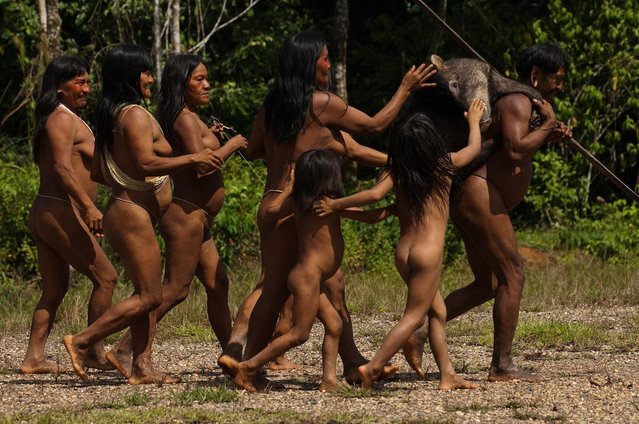
Spectacular images offering insight into the lives of the Huaorani people in the Ecuadorian Amazon have been revealed showing how they use traditional methods to hunt monkeys for food. The stunning pictures were taken by conservation photographer Pete Oxford from Torquay, Devon in the Ecuadorian Amazon. “The Huaorani Indians are a forest people highly in tune with their environment. Many are now totally acculturated since the 1950s by missionaries”, said Pete. “Today they face radical change to their culture to the proximity of oil exploration within their territory and the Yasuni National Park and Biosphere Reserve, they are vastly changed. Some still live very traditionally and for this shoot, through my Huaorani friend, a direct relative of those photographed he wanted to depict them as close to their original culture as possible. They still largely hunt with blow pipes and spears eating a lot of monkeys and peccaries”. The Huaorani are also known as the Waorani, Waodani or the Waos and are native Amerindians. Their lands are located between the Curaray and Napo rivers and speak the Huaorani language. Pete says that during his visit he was welcomed into the group and hopes that ancient cultures can be saved. Here: The tribe were seen celebrating after a hunter returned to camp with a wild pig. (Photo by Pete Oxford/Mediadrumworld.com)

Spectacular images offering insight into the lives of the Huaorani people in the Ecuadorian Amazon have been revealed showing how they use traditional methods to hunt monkeys for food. The stunning pictures were taken by conservation photographer Pete Oxford from Torquay, Devon in the Ecuadorian Amazon. Here: The tribe were seen celebrating after a hunter returned to camp with a wild pig. (Photo by Pete Oxford/Mediadrumworld.com)
Details
20 Jan 2017 07:58:00
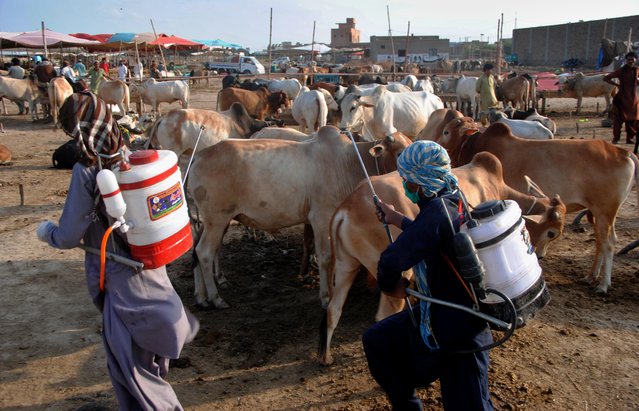
Health workers wearing face masks spray disinfectant liquid on sacrificial animals amid concerns over the spread of the SARS-CoV-2 coronavirus that causes the pandemic COVID-19 disease ahead of the Muslim festival of Eid al-Adha at an animal market in Hyderabad, southern Pakistan, 21 July 2020. Eid al-Adha, also known as the Festival of the Sacrifice, is the second and holiest of the two main Islamic holidays celebrated each year (the other one being Eid al-Fitr). Every year, on the 10th day of the Islamic lunar month of Dhu al-Hijjah, Muslims around the world ritually slaughter a sacrificial animal and split the meat into three parts: one is reserved for the family, another for friends and relatives, and the third is given to the poor and needy. The Saudi Supreme Court has declared that the first day of Eid al-Adha this year falls on 31 July. (Photo by Nadeem Khawar/EPA/EFE)

Health workers wearing face masks spray disinfectant liquid on sacrificial animals amid concerns over the spread of the SARS-CoV-2 coronavirus that causes the pandemic COVID-19 disease ahead of the Muslim festival of Eid al-Adha at an animal market in Hyderabad, southern Pakistan, 21 July 2020. (Photo by Nadeem Khawar/EPA/EFE)
Details
23 Jul 2020 00:07:00
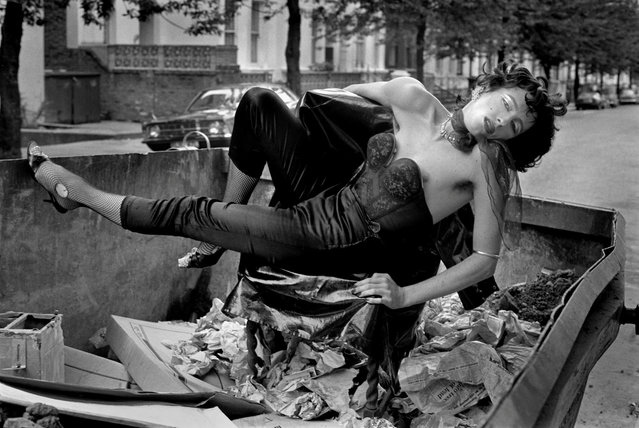
“A very delicate person, beneath the flamboyance”. Jasper, Ladbroke Grove, 1977. “In the 1970s, Australia was rather cut off. I’d always wanted to live abroad, so I moved to Rome and then London. I was an art historian, but started studying photography part-time. I was interested in the demi-monde culture and began mixing in all sorts of circles. Jasper was a rather wonderful character. He was from Sydney, but he was living downstairs from me in Ladbroke Grove, in a flat rented to some gay friends. It was fairly eclectic. Jasper was always playing around with clothes and makeup. If he was looking particularly wonderful, I might get out my lights and take a shot. Or he might put makeup on me. He wasn’t always in drag, but he was permanently in diva mode, dependably louche, funny and naughty. I think all that comes across in the image. He was actually a very delicate person, though, beneath the wit and flamboyance. Jasper floated through London all too briefly. His real name was Peter MacMahon, but to us he was only ever Jasper Havoc, an alter ego he’d created while part of a transvestite troupe called Sylvia and the Synthetics. They were legendary in Sydney gay culture. On this day, we’d been taking some pictures inside and had gone out into the streets to fool around some more. Jasper was wearing a corset and fishnets ensemble, with other bits and pieces, and we joked about him being trashy as he lay in the skip. We just took the shot for ourselves. It wasn’t done with any publication in mind, or anything else. This was way before the internet and people didn’t share images. If you dressed up, it was just for that moment”. (Photo by Jane England)

“A very delicate person, beneath the flamboyance”. Jasper, Ladbroke Grove, 1977. “In the 1970s, Australia was rather cut off. I’d always wanted to live abroad, so I moved to Rome and then London. I was an art historian, but started studying photography part-time. I was interested in the demi-monde culture and began mixing in all sorts of circles. Jasper was a rather wonderful character...”. (Photo by Jane England)
Details
26 Jun 2017 09:04:00
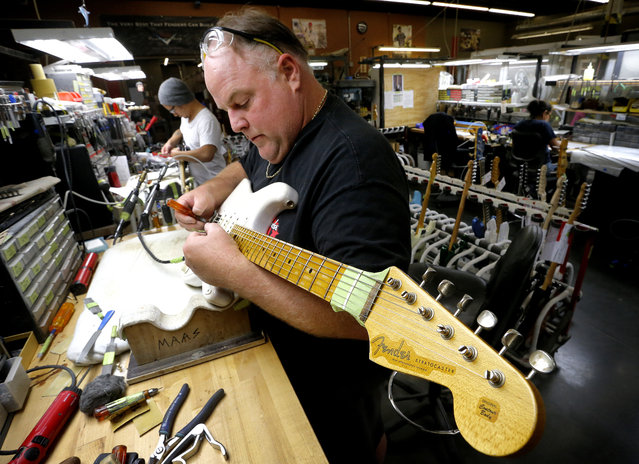
A finished Fender Stratocaster is adjusted by Kenneth Maas in the Fender Custom Shop in Corona, Calif. on Tuesday, October 15, 2013. Leo Fender developed the instrument in a small workshop in Fullerton, Calif. six decades ago. (Photo by Matt York/AP Photo)

“Jimi Hendrix made it shriek. Buddy Holly made it swing. Stevie Ray Vaughn made it snarl. Some of the most legendary guitarists in music history have elicited unforgettable sounds from the Fender Stratocaster, the distinctive double-cutaway guitar born in a small Fullerton, Calif., workshop 60 years ago this month”. – Associated Press. Photo: A finished Fender Stratocaster is adjusted by Kenneth Maas in the Fender Custom Shop in Corona, Calif. on Tuesday, October 15, 2013. Leo Fender developed the instrument in a small workshop in Fullerton, Calif. six decades ago. (Photo by Matt York/AP Photo)
Details
22 Apr 2014 10:52:00
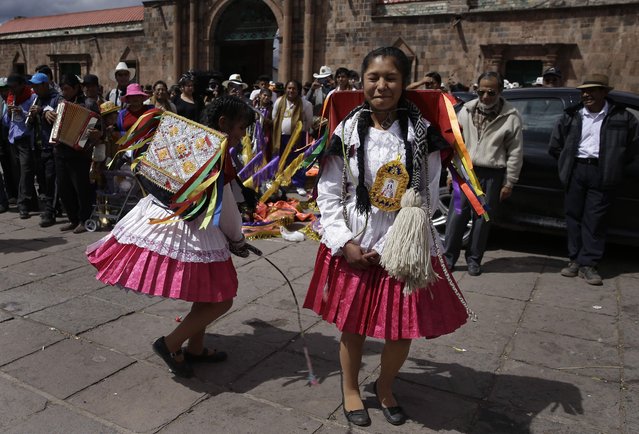
In this Sunday, August 5, 2018 photo, a dancer winces in pain as she is whipped by a fellow dancer in an adaptation of the Inca warrior dance known as “Kachampa”, during celebrations honoring Our Lady of Copacabana, in Cuzco, Peru. (Photo by Martin Mejia/AP Photo)

In this Sunday, August 5, 2018 photo, a dancer winces in pain as she is whipped by a fellow dancer in an adaptation of the Inca warrior dance known as “Kachampa”, during celebrations honoring Our Lady of Copacabana, in Cuzco, Peru. (Photo by Martin Mejia/AP Photo)
Details
10 Aug 2018 00:01:00
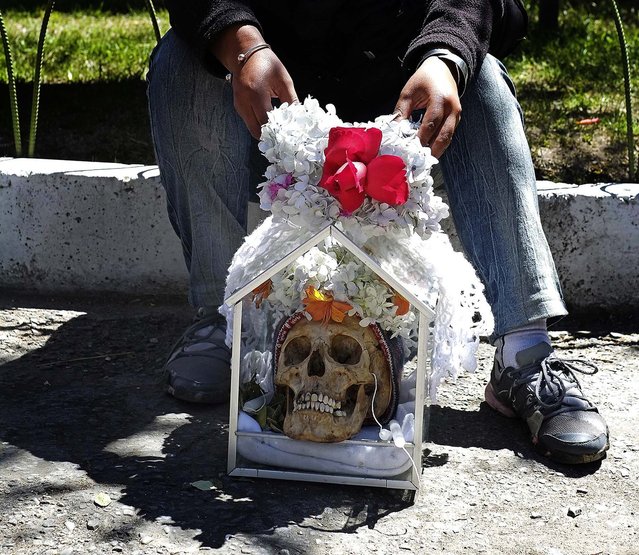
A woman holds a skull during a “Dia de los natitas” (Day of the Skull) ceremony at the Cementerio General of La Paz. (Photo by David Mercado/Reuters)

A woman holds a skull during a “Dia de los natitas” (Day of the Skull) ceremony at the Cementerio General of La Paz. (Photo by David Mercado/Reuters)
Details
10 Nov 2013 06:59:00
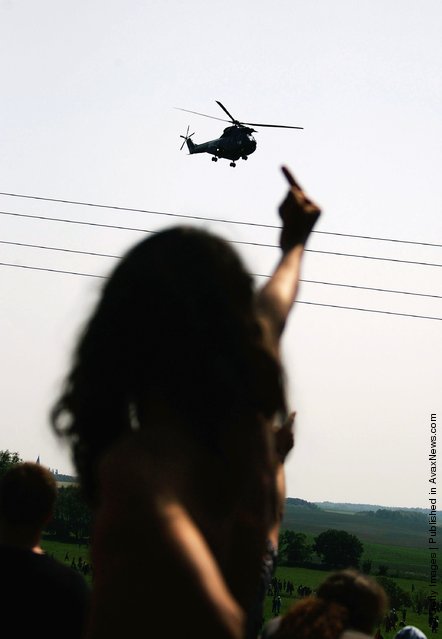
An activist of the anti-G8 forum 'Block G8' shows his middle finger to a police helicopter passing overhead

An activist of the anti-G8 forum “Block G8” shows his middle finger to a police helicopter passing overhead June 07, 2007 at Bollhagen, near Heiligendamm, Germany. (Photo by Carsten Koall/Getty Images)
Details
27 Dec 2011 15:40:00
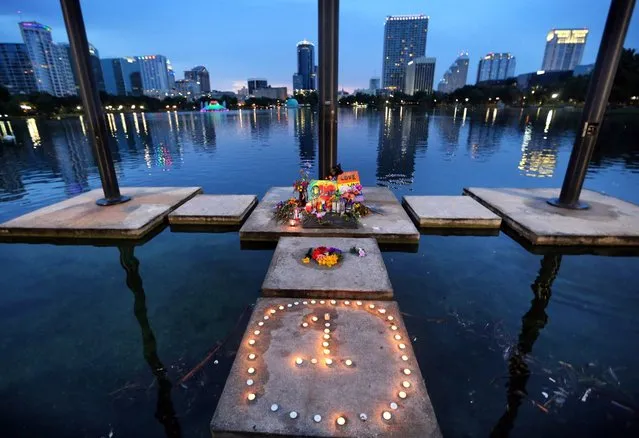
The symbol for “One Orlando” is spelled out at a makeshift memorial at Lake Eola in downtown Orlando, Fla., Saturday, June 18, 2016. Nearby, visitors lit candles and prayed at a larger memorial, at the Dr. Phillips Center for the Performing Arts, to mourn the victims of the Pulse massacre. (Photo by Joe Burbank/Orlando Sentinel via AP Photo)

The symbol for “One Orlando” is spelled out at a makeshift memorial at Lake Eola in downtown Orlando, Fla., Saturday, June 18, 2016. Nearby, visitors lit candles and prayed at a larger memorial, at the Dr. Phillips Center for the Performing Arts, to mourn the victims of the Pulse massacre. (Photo by Joe Burbank/Orlando Sentinel via AP Photo)
Details
19 Jun 2016 09:44:00