Loading...
Done
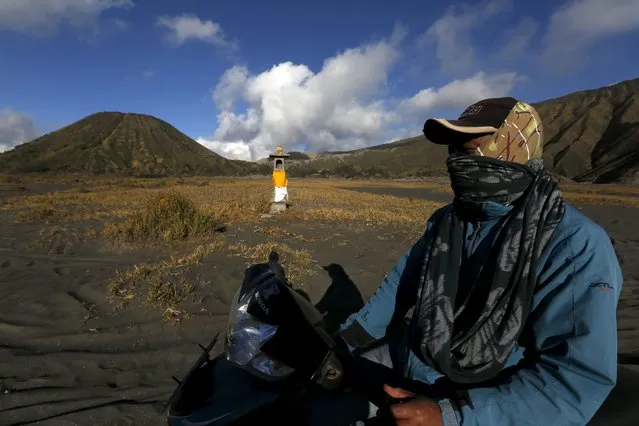
A Hindu villager rides a motorcycle past an altar ahead of the annual Kasada festival at the Mount Bromo in Indonesia's East Java province, July 30, 2015. (Photo by Reuters/Beawiharta)

A Hindu villager rides a motorcycle past an altar ahead of the annual Kasada festival at the Mount Bromo in Indonesia's East Java province, July 30, 2015. The Kasada festival will be held on August 1, when the worshippers throw offerings such as livestock and other crops into the volcanic crater of Mount Bromo to give thanks to the Hindu gods for ensuring their safety and prosperity. (Photo by Reuters/Beawiharta)
Details
31 Jul 2015 11:25:00
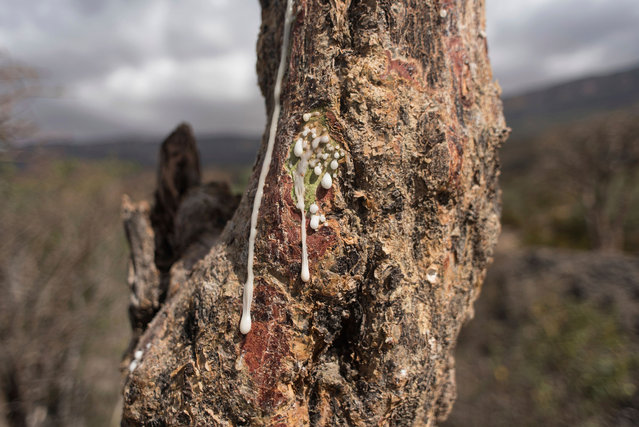
Sap runs out of a frankincense tree near Mader Moge, Somaliland, a breakaway region of Somalia on August 4, 2016. (Photo by Jason Patinkin/AP Photo)

Sap runs out of a frankincense tree near Mader Moge, Somaliland, a breakaway region of Somalia on August 4, 2016In a tradition dating to Biblical times, men rise at dawn in the rugged Cal Madow mountains of Somaliland in the Horn of Africa to scale rocky outcrops in search of the prized sap of wild frankincense trees. (Photo by Jason Patinkin/AP Photo)
Details
27 Dec 2016 08:06:00
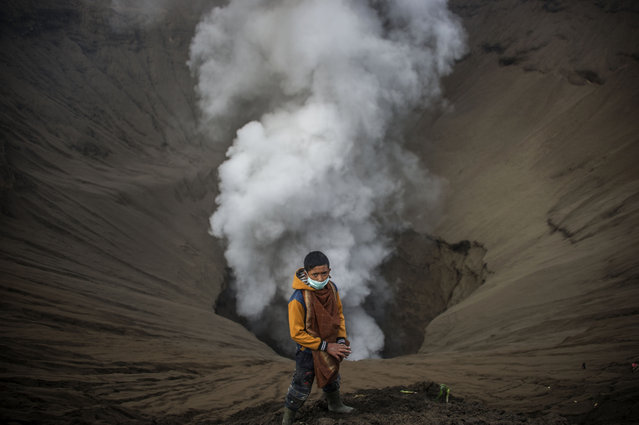
An Indonesian boy waits as he prepares to catch offerings released by Hindu devotees of the Tengger tribe during the Yadnya Kasada festival, on the crater of Mount Bromo in Probolinggo on July 21, 2016. During the annual Yadnya Kasada festival the Tenggerese climb Mount Bromo, an active volcano, and seek the blessing from the main deity Hyang Widi Wasa by presenting offerings of rice, fruit, livestock and other local produce. (Photo by Juni Kriswanto/AFP Photo)

An Indonesian boy waits as he prepares to catch offerings released by Hindu devotees of the Tengger tribe during the Yadnya Kasada festival, on the crater of Mount Bromo in Probolinggo on July 21, 2016. During the annual Yadnya Kasada festival the Tenggerese climb Mount Bromo, an active volcano, and seek the blessing from the main deity Hyang Widi Wasa by presenting offerings of rice, fruit, livestock and other local produce. (Photo by Juni Kriswanto/AFP Photo)
Details
22 Jul 2016 12:33:00
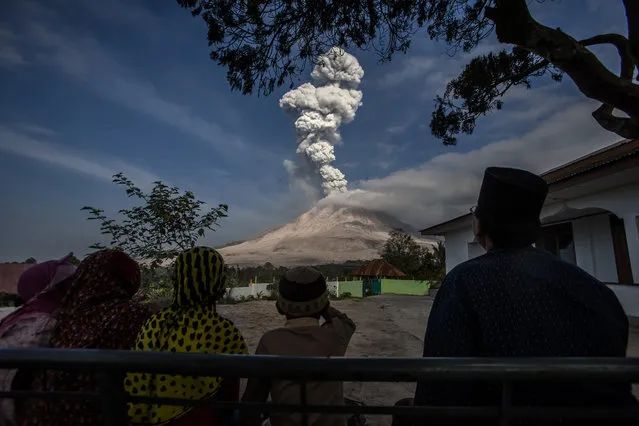
Residents watch volcanic smoking and ashes rising from Mount Sinabung during an eruption in Karo, North Sumatra, Indonesia, February 24, 2016. Authorities have repeatedly called on local residents to remain patient in dealing with the impact of Sinabung's eruptions, which some experts have predicted will continue for five more years. (Photo by Xinhua/Barcroft Media)

Residents watch volcanic smoking and ashes rising from Mount Sinabung during an eruption in Karo, North Sumatra, Indonesia, February 24, 2016. Authorities have repeatedly called on local residents to remain patient in dealing with the impact of Sinabung's eruptions, which some experts have predicted will continue for five more years. (Photo by Xinhua/Barcroft Media)
Details
28 Feb 2016 11:36:00
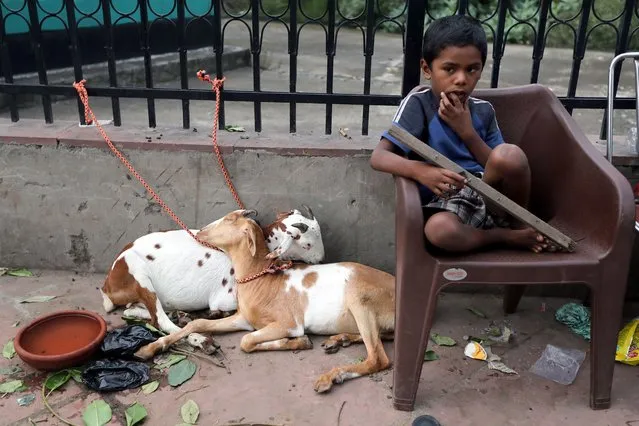
A boy sits next to sacrificial goats resting during Eid al-Adha in New Delhi, India, 29 June 2023. Muslims around the world celebrate Eid al-Adha or feast of sacrifice, by slaughtering sheep, goats and cows to commemorate Prophet Abraham's willingness to sacrifice his son Ismail at God's command. (Photo by Harish Tyagi/EPA)

A boy sits next to sacrificial goats resting during Eid al-Adha in New Delhi, India, 29 June 2023. Muslims around the world celebrate Eid al-Adha or feast of sacrifice, by slaughtering sheep, goats and cows to commemorate Prophet Abraham's willingness to sacrifice his son Ismail at God's command. (Photo by Harish Tyagi/EPA)
Details
07 Jul 2023 02:48:00
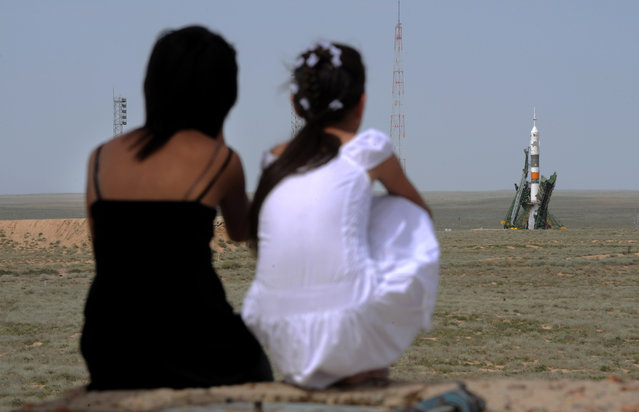
Kazakh girls watch as the Russian Soyuz TMA-15 rocket carrying Canadian astronaut Robert Thirsk, European Space Agency (ESA) astronaut Frank De Winne of Belgium and Russian cosmonaut Roman Romanenko readies for take-off from the Baikonur cosmodrome, in Kazakhstan on May 27, 2009. Three astronauts, from Canada, Belgium and Russia, blasted off for the International Space Station in a landmark mission that will double its crew to six for the first time. (Photo by Dmitry Kostyukov/AFP Photo)

Kazakh girls watch as the Russian Soyuz TMA-15 rocket carrying Canadian astronaut Robert Thirsk, European Space Agency (ESA) astronaut Frank De Winne of Belgium and Russian cosmonaut Roman Romanenko readies for take-off from the Baikonur cosmodrome, in Kazakhstan on May 27, 2009. Three astronauts, from Canada, Belgium and Russia, blasted off for the International Space Station in a landmark mission that will double its crew to six for the first time. (Photo by Dmitry Kostyukov/AFP Photo)
Details
21 Jun 2020 00:01:00
A seagull files over a man sitting at a coffee shop backdropped by the Bosporus Strait in Istanbul, Tuesday, November 17, 2020. (Photo by Emrah Gurel/AP Photo)

A seagull files over a man sitting at a coffee shop backdropped by the Bosporus Strait in Istanbul, Tuesday, November 17, 2020. (Photo by Emrah Gurel/AP Photo)
Details
05 Dec 2020 00:05:00
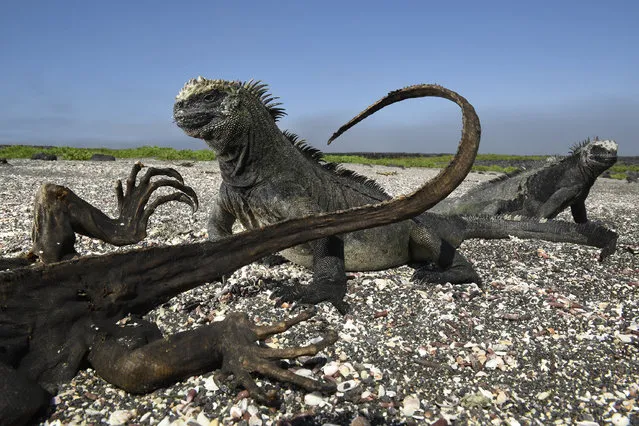
Galapagos – Rocking the Cradle: Four major ocean currents converge along the Galapagos archipelago, creating the conditions for an extraordinary diversity of animal life, April 25, 2016. The islands are home to at least 7,000 flora and fauna species, of which 97 percent of the reptiles, 80 percent of the land birds, 50 percent of the insects and 30 percent of the plants are endemic. The local ecosystem is highly sensitive to the changes in temperature, rainfall and ocean currents that characterize the climatic events known as El Niño and La Niña. These changes cause marked fluctuations in weather and food availability. Many scientists expect the frequency of El Niño and La Niña to increase as a result of climate change, making the Galapagos a possible early-warning location for its effects. (Photo by Thomas P. Peschak for National Geographic/World Press Photo)

Galapagos – Rocking the Cradle: Four major ocean currents converge along the Galapagos archipelago, creating the conditions for an extraordinary diversity of animal life, April 25, 2016. The islands are home to at least 7,000 flora and fauna species, of which 97 percent of the reptiles, 80 percent of the land birds, 50 percent of the insects and 30 percent of the plants are endemic. (Photo by Thomas P. Peschak for National Geographic/World Press Photo)
Details
16 Apr 2018 00:01:00