Loading...
Done
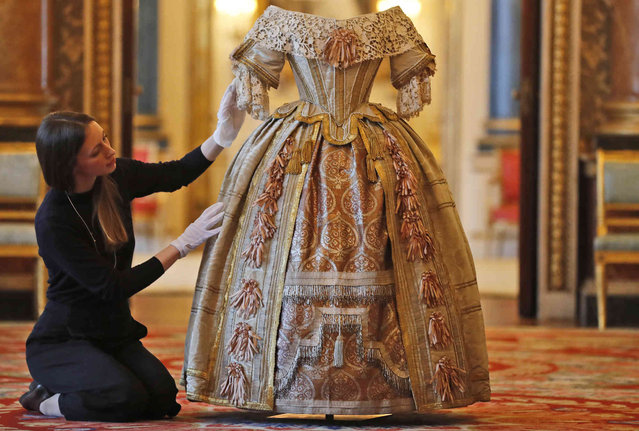
A member of the Palace staff arranges Queen Victoria's Stuart Ball costume which is part of an exhibition to mark the 200th anniversary of the birth of Queen Victoria (1819–1901) this year at Buckingham Palace in London, Tuesday, April 2, 2019. The exhibition, Queen Victoria's Palace at the Summer Opening of Buckingham Palace from 20 July – 29 September 2019, will tell the story of her 62-year reign and her life at Buckingham Palace, which began when she ascended to the throne in June 1837. (Photo by Frank Augstein/AP Photo)

A member of the Palace staff arranges Queen Victoria's Stuart Ball costume which is part of an exhibition to mark the 200th anniversary of the birth of Queen Victoria (1819–1901) this year at Buckingham Palace in London, Tuesday, April 2, 2019. The exhibition, Queen Victoria's Palace at the Summer Opening of Buckingham Palace from 20 July – 29 September 2019, will tell the story of her 62-year reign and her life at Buckingham Palace, which began when she ascended to the throne in June 1837. (Photo by Frank Augstein/AP Photo)
Details
04 Apr 2019 00:05:00
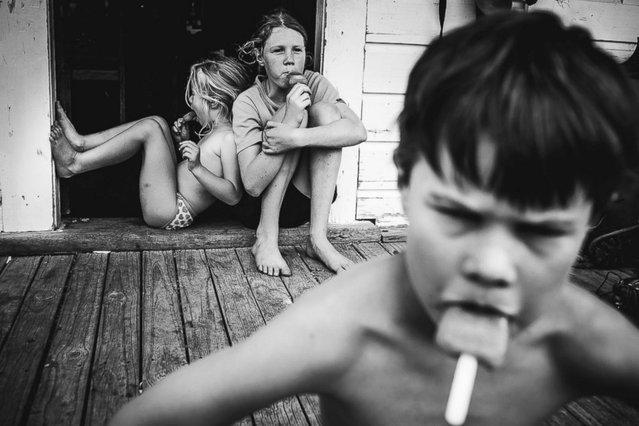
New Zealand photographer Niki Boon captured her children, who are growing up with limited electronics, in the photo series “Childhood in the Raw Photos”. Niki Boon began taking photos as a hobby while she was working as a physiotherapist in Scotland. However, the New Zealand native found her interest in the art waning while she travelled, and it wasn’t until she had returned home and started raising a family that her passion was rekindled. “Childhood in the Raw”, an ongoing photo series of her four children’s technology-free life on her 10-acre property in New Zealand, is the perennial fruit of this passion. (Photo by Niki Boon)

New Zealand photographer Niki Boon captured her children, who are growing up with limited electronics, in the photo series “Childhood in the Raw Photos”. Niki Boon began taking photos as a hobby while she was working as a physiotherapist in Scotland. However, the New Zealand native found her interest in the art waning while she travelled, and it wasn’t until she had returned home and started raising a family that her passion was rekindled. “Childhood in the Raw”, an ongoing photo series of her four children’s technology-free life on her 10-acre property in New Zealand, is the perennial fruit of this passion. (Photo by Niki Boon)
Details
20 Apr 2016 12:01:00
People drink in the street in the Soho area of London, on April 12, 2021 as coronavirus restrictions are eased across the country in step two of the government's roadmap out of England's third national lockdown. Britons on Monday toasted a significant easing of coronavirus restrictions, with early morning pints – and much-needed haircuts – as the country took a tentative step towards the resumption of normal life. Businesses including non-essential retail, gyms, salons and outdoor hospitality were all able to open for the first time in months in the second step of the government's roadmap out of lockdown. (Photo by Tolga Akmen/AFP Photo)

People drink in the street in the Soho area of London, on April 12, 2021 as coronavirus restrictions are eased across the country in step two of the government's roadmap out of England's third national lockdown. Britons on Monday toasted a significant easing of coronavirus restrictions, with early morning pints – and much-needed haircuts – as the country took a tentative step towards the resumption of normal life. Businesses including non-essential retail, gyms, salons and outdoor hospitality were all able to open for the first time in months in the second step of the government's roadmap out of lockdown. (Photo by Tolga Akmen/AFP Photo)
Details
13 Apr 2021 08:02:00
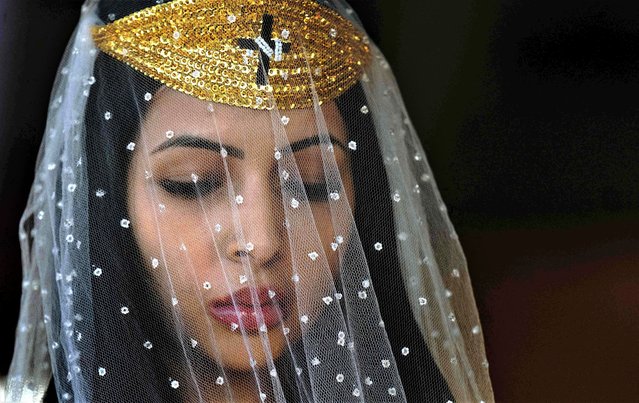
A Nymph or female devotee of the Vale do Amanhecer religious community, prays at their temple complex in Vale do Amanhecer (Sunrise Valley), a community on the outskirts of Planaltina, 50 km from the Brazilian capital, Brasilia, on April 29, 2023. This eclectic community holds its most important ritual of the year on Labour Day to honour the mediums who communicate with good and bad spirits. The group combines a range of religious practices, including Christian and Hindu, with symbols borrowed from the Incas and Mayans, as well as a belief in extraterrestrial life and intergalactic travel. The religion claims hundred temples throughout Brazil, Portugal and other countries. (Photo by Carl de Souza/AFP Photo)

A Nymph or female devotee of the Vale do Amanhecer religious community, prays at their temple complex in Vale do Amanhecer (Sunrise Valley), a community on the outskirts of Planaltina, 50 km from the Brazilian capital, Brasilia, on April 29, 2023. This eclectic community holds its most important ritual of the year on Labour Day to honour the mediums who communicate with good and bad spirits. The group combines a range of religious practices, including Christian and Hindu, with symbols borrowed from the Incas and Mayans, as well as a belief in extraterrestrial life and intergalactic travel. The religion claims hundred temples throughout Brazil, Portugal and other countries. (Photo by Carl de Souza/AFP Photo)
Details
08 Aug 2024 05:51:00
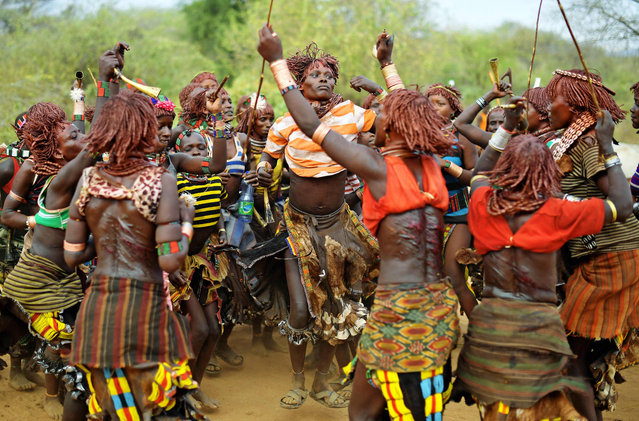
Hamar women dance before a bull jumping ceremony in Ethiopia's southern Omo Valley region near Turmi on September 19, 2016. The Hamar are a Nilotic ethnic group in Ethiopia. The construction of the Gibe III dam, the third largest hydroelectric plant in Africa, and large areas of very “thirsty” cotton and sugar plantations and factories along the Omo river are impacting heavily on the lives of tribes living in the Omo Valley who depend on the river for their survival and way of life. Human rights groups fear for the future of the tribes if they are forced to scatter, give up traditional ways through loss of land or ability to keep cattle as globalisation and development increases. (Photo by Carl De Souza/AFP Photo)

Hamar women dance before a bull jumping ceremony in Ethiopia's southern Omo Valley region near Turmi on September 19, 2016. The Hamar are a Nilotic ethnic group in Ethiopia. The construction of the Gibe III dam, the third largest hydroelectric plant in Africa, and large areas of very “thirsty” cotton and sugar plantations and factories along the Omo river are impacting heavily on the lives of tribes living in the Omo Valley who depend on the river for their survival and way of life. (Photo by Carl De Souza/AFP Photo)
Details
02 Oct 2016 08:45:00
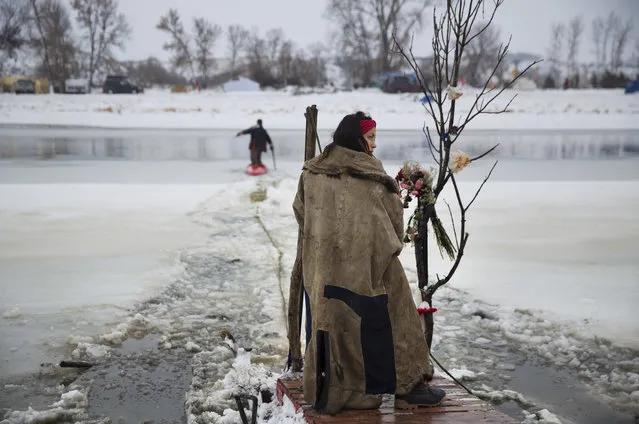
In this Thursday, December 1, 2016 photo, Cat Bigney, part of the Oglala Native American tribe, waits on the shore of the Cannonball river for travelers to arrive by canoe at the Oceti Sakowin camp where people have gathered to protest the Dakota Access oil pipeline in Cannon Ball, N.D. So far, those at the camp have shrugged off the heavy snow, icy winds and frigid temperatures. But if they defy next week's government deadline to abandon the camp, demonstrators know the real deep freeze lies ahead. Life-threatening wind chills and towering snow drifts could mean the greatest challenge is simple survival. (Photo by David Goldman/AP Photo)

In this Thursday, December 1, 2016 photo, Cat Bigney, part of the Oglala Native American tribe, waits on the shore of the Cannonball river for travelers to arrive by canoe at the Oceti Sakowin camp where people have gathered to protest the Dakota Access oil pipeline in Cannon Ball, N.D. So far, those at the camp have shrugged off the heavy snow, icy winds and frigid temperatures. But if they defy next week's government deadline to abandon the camp, demonstrators know the real deep freeze lies ahead. Life-threatening wind chills and towering snow drifts could mean the greatest challenge is simple survival. (Photo by David Goldman/AP Photo)
Details
06 Dec 2016 10:22:00
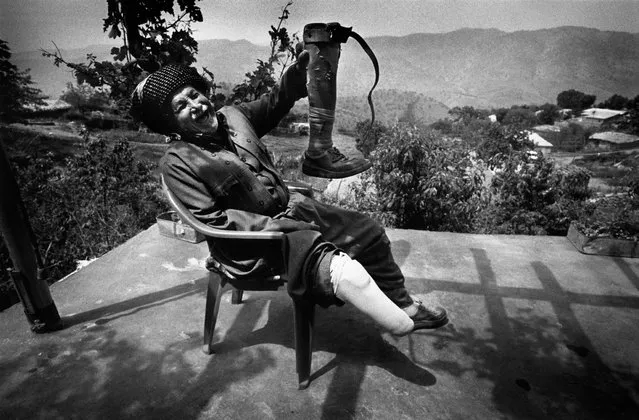
Ismail Mustafa, seen in 2007. “I was collecting mushrooms on the hill near here. I didn’t see the mine. There was a huge explosion. When I woke up I saw that both my legs were gone; I thought my life was over. My brother and another guy were with me. They made a stretcher from sticks and tied it together with clothing. It took two hours to get off the mountain. ‘My daughter has also been injured. She found a shell and brought it into the house and put it on the fire. She didn’t know what she was doing at the time – she was only three. She is blind and has lost an arm”. (Photo by Sean Sutton for the Mines Advisory Group/The Guardian)

Ismail Mustafa, seen in 2007. “I was collecting mushrooms on the hill near here. I didn’t see the mine. There was a huge explosion. When I woke up I saw that both my legs were gone; I thought my life was over. My brother and another guy were with me. They made a stretcher from sticks and tied it together with clothing. It took two hours to get off the mountain. ‘My daughter has also been injured. She found a shell and brought it into the house and put it on the fire. She didn’t know what she was doing at the time – she was only three. She is blind and has lost an arm”. (Photo by Sean Sutton for the Mines Advisory Group/The Guardian)
Details
08 Sep 2017 09:33:00
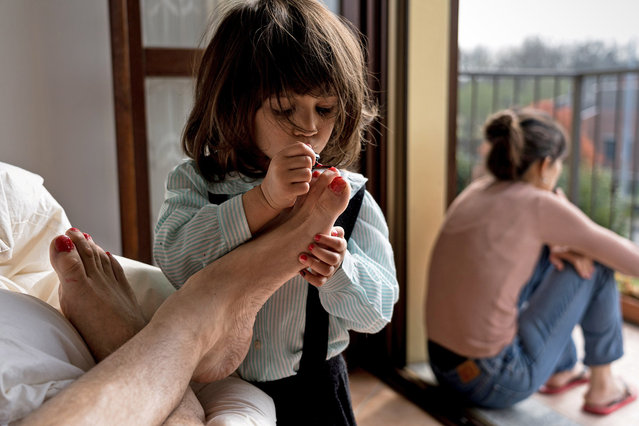
Life in lockdown: Schoolteacher Marzio Toniolo, 35, takes a picture of his two-year-old daughter Bianca painting his toenails as they while away time at home in San Fiorano, one of the original “red zone” towns in northern Italy that has now been extended to the whole country, as his wife, Bianca's mum Chiara Zuddas looks out from their balcony, March 20, 2020. Toniolo has been documenting how his family has dealt with being under quarantine since it began for them in February. (Photo by Marzio Toniolo via Reuters)

Life in lockdown: Schoolteacher Marzio Toniolo, 35, takes a picture of his two-year-old daughter Bianca painting his toenails as they while away time at home in San Fiorano, one of the original “red zone” towns in northern Italy that has now been extended to the whole country, as his wife, Bianca's mum Chiara Zuddas looks out from their balcony, March 20, 2020. Toniolo has been documenting how his family has dealt with being under quarantine since it began for them in February. (Photo by Marzio Toniolo via Reuters)
Details
09 Apr 2020 00:03:00