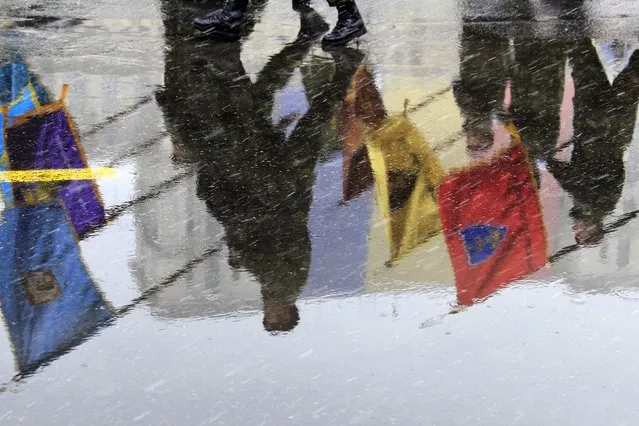
Soldiers are reflected in a puddle during a military parade during the celebrations for Romania's National Day in Bucharest December 1, 2014. (Photo by Radu Sigheti/Reuters)
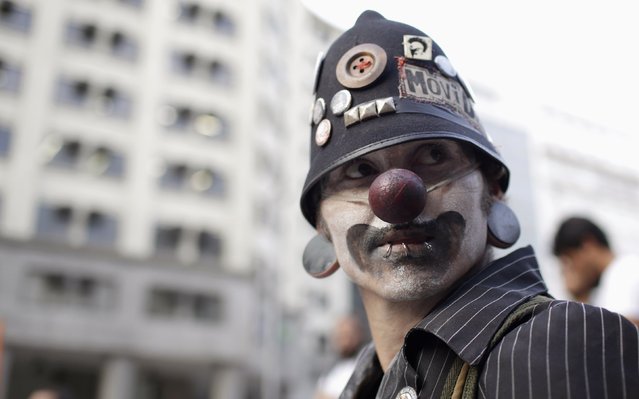
A demonstrator attends a protest against fare hikes for city buses in Rio de Janeiro January 16, 2015. Amid a marked economic downturn and high inflation, bus fares went up in Sao Paulo, Brazil's largest city, from 3 to 3.50 reais, and in Rio, the former capital, from 3.0 to 3.40 reais. (Photo by Mauro Pimentel/Reuters)
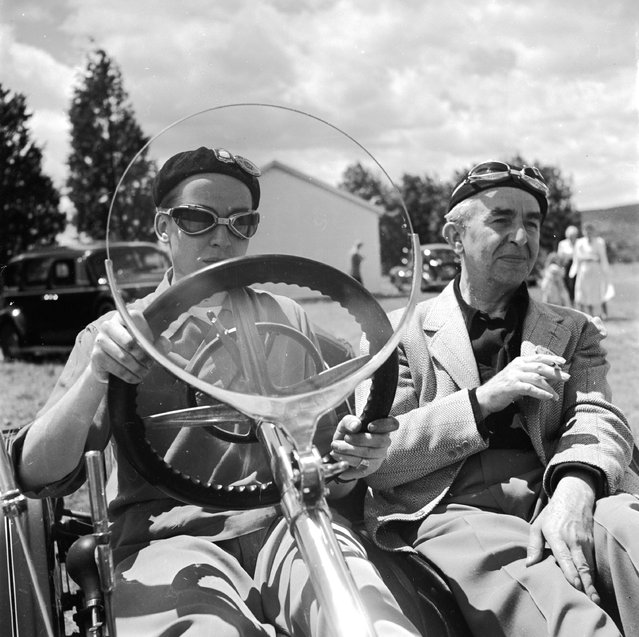
At the 50th anniversary of the Hartford Automobile Club a 1914 Mercer with an economical wind screen, looking like a large magnifying glass, designed to offer minimum wind resistance. Brass is used instead of chrome for the “shiny” parts, circa 1955. (Photo by Three Lions)
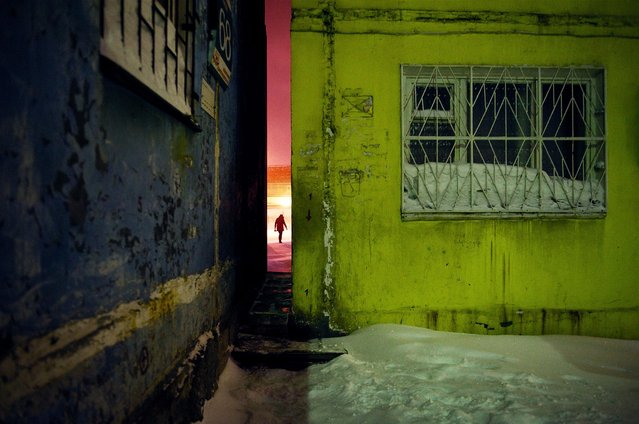
Elena Chernyshova's vision of Norilsk, Russia, the northernmost city in the world, is a series of surprises by which she extracts otherworldly beauty from ugly realities. Here: 2013. A woman is visible through a narrow passageway between two buildings. Norilsk's urban spaces were designed to shorten distances around large developments and give residents maximum protection from arctic winds. (Photo by Elena Chernyshova)
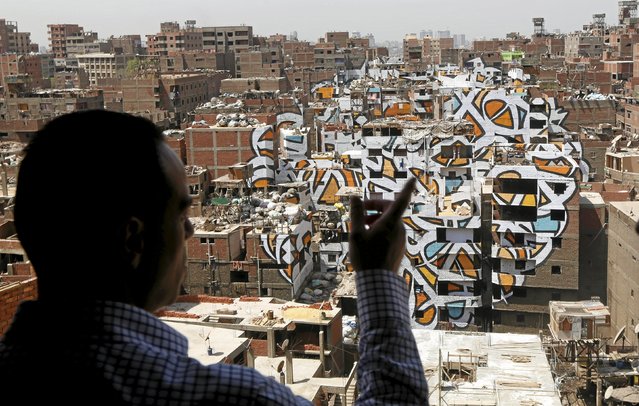
A man looks at a mural painted on the walls of houses in Zaraeeb, created by French-Tunisian artist El Seed, in the shanty area known also as Zabaleen or “Garbage City” on the Mokattam Hills in eastern Cairo, Egypt, April 4, 2016. (Photo by Amr Abdallah Dalsh/Reuters)
A woman holds her umbrella while walking against strong winds as Typhoon Soudelor approaches Taiwan in Taipei, August 7, 2015. (Photo by Pichi Chuang/Reuters)
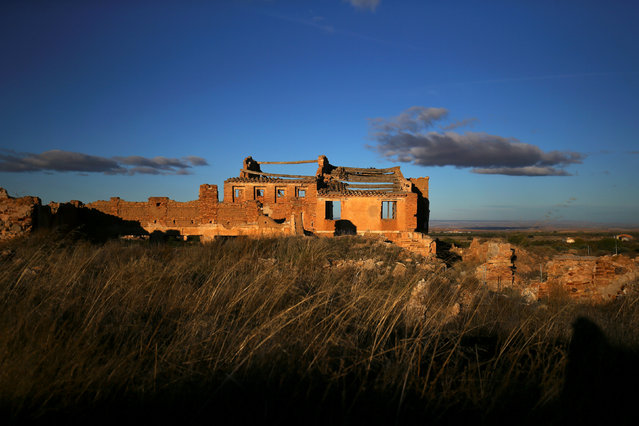
Ruins of a building are seen in the old village of Belchite, in northern Spain, November 13, 2016. Almost 80 years ago Tomas Ortin fled under the cover of night from his home in the small town of Belchite on Spain's northern plains to escape with hundreds of others from one of the bloodiest battles of the country's civil war. At 94 years old, Ortin now lives just across the road from Belchite, which has lain in ruins since Republican forces attacked it, a symbol of the destruction caused by the 1936-1939 war in which an estimated 500,000 people died. (Photo by Andrea Comas/Reuters)