Loading...
Done
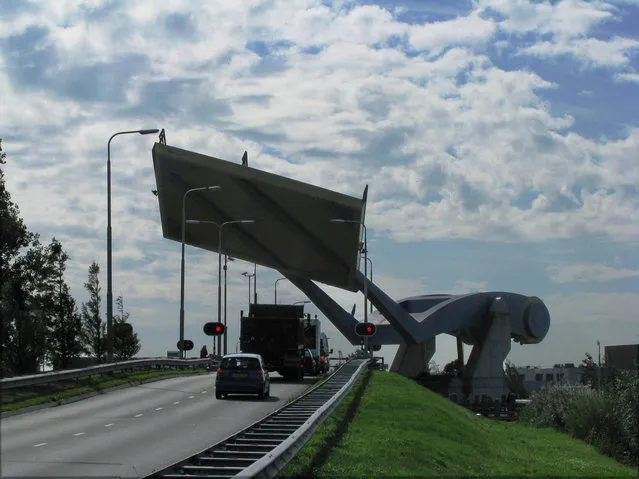
Slauerhoff Bridge, Netherlands

The Slauerhoffbrug (English: Slauerhoff Bridge) is a fully automatic bascule bridge (aka tail bridge) in the city of Leeuwarden in the Netherlands. It uses two arms to swing a section of road in and out of place within the road itself. It is also known as the “Slauerhoffbrug ‘Flying’ Drawbridge”. A tail bridge can quickly and efficiently be raised and lowered from one pylon (instead of hinges). This quickly allows water traffic to pass while only briefly stalling road traffic. The deck is 15 m by 15 m. It is painted in yellow and blue, representative of Leeuwarden's flag and seal.
Details
06 Nov 2013 10:34:00
A former paratrooper demonstrates his strength and skills while lifting a chair during the celebrations for the Paratroopers Day at the Central park in the Siberian city of Krasnoyarsk, Russia, August 2, 2015. (Photo by Ilya Naymushin/Reuters)

A former paratrooper demonstrates his strength and skills while lifting a chair during the celebrations for the Paratroopers Day at the Central park in the Siberian city of Krasnoyarsk, Russia, August 2, 2015. Paratroopers are an elite unit of the Soviet Army, and everyone in the country recognize their blue berets. (Photo by Ilya Naymushin/Reuters)
Details
03 Aug 2015 12:13:00
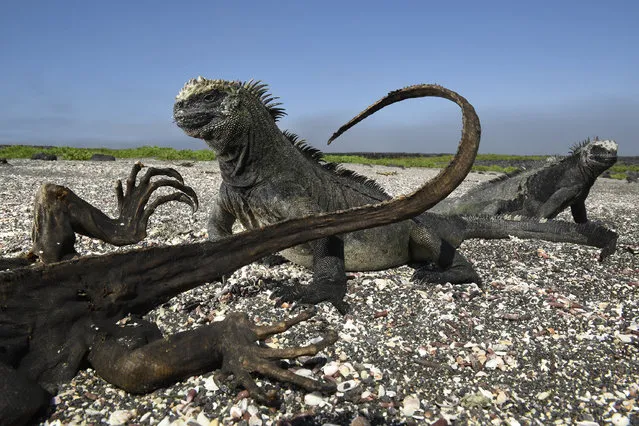
Galapagos – Rocking the Cradle: Four major ocean currents converge along the Galapagos archipelago, creating the conditions for an extraordinary diversity of animal life, April 25, 2016. The islands are home to at least 7,000 flora and fauna species, of which 97 percent of the reptiles, 80 percent of the land birds, 50 percent of the insects and 30 percent of the plants are endemic. The local ecosystem is highly sensitive to the changes in temperature, rainfall and ocean currents that characterize the climatic events known as El Niño and La Niña. These changes cause marked fluctuations in weather and food availability. Many scientists expect the frequency of El Niño and La Niña to increase as a result of climate change, making the Galapagos a possible early-warning location for its effects. (Photo by Thomas P. Peschak for National Geographic/World Press Photo)

Galapagos – Rocking the Cradle: Four major ocean currents converge along the Galapagos archipelago, creating the conditions for an extraordinary diversity of animal life, April 25, 2016. The islands are home to at least 7,000 flora and fauna species, of which 97 percent of the reptiles, 80 percent of the land birds, 50 percent of the insects and 30 percent of the plants are endemic. (Photo by Thomas P. Peschak for National Geographic/World Press Photo)
Details
16 Apr 2018 00:01:00
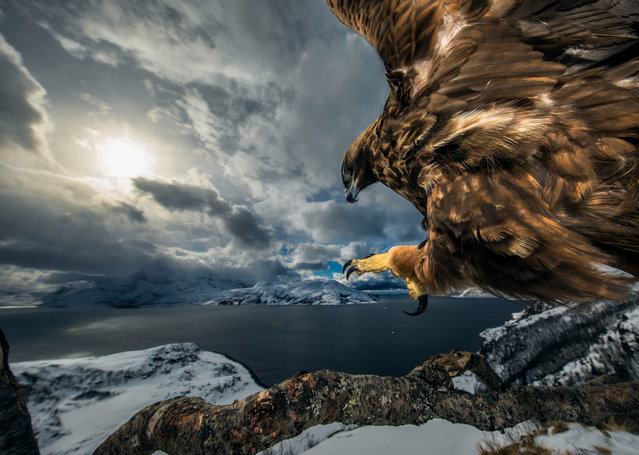
Birds behaviour winner: Land of the Eagle by Audun Rikardsen, Norway. High on a ledge, on the coast near his home in northern Norway, Rikardsen carefully positioned an old tree branch that he hoped would make a perfect golden eagle lookout. To this, he bolted a tripod head with a camera, flashes and motion sensor attached, and built himself a hide a short distance away. From time to time, he left road‑kill carrion nearby. Very gradually – over the next three years – a golden eagle got used to the camera and started to use the branch regularly to survey the coast below. (Photo by Audun Rikardsen/2019 Wildlife Photographer of the Year)

Birds behaviour winner: Land of the Eagle by Audun Rikardsen, Norway. High on a ledge, on the coast near his home in northern Norway, Rikardsen carefully positioned an old tree branch that he hoped would make a perfect golden eagle lookout. To this, he bolted a tripod head with a camera, flashes and motion sensor attached, and built himself a hide a short distance away. From time to time, he left road‑kill carrion nearby. Very gradually – over the next three years – a golden eagle got used to the camera and started to use the branch regularly to survey the coast below. (Photo by Audun Rikardsen/2019 Wildlife Photographer of the Year)
Details
17 Oct 2019 00:03:00
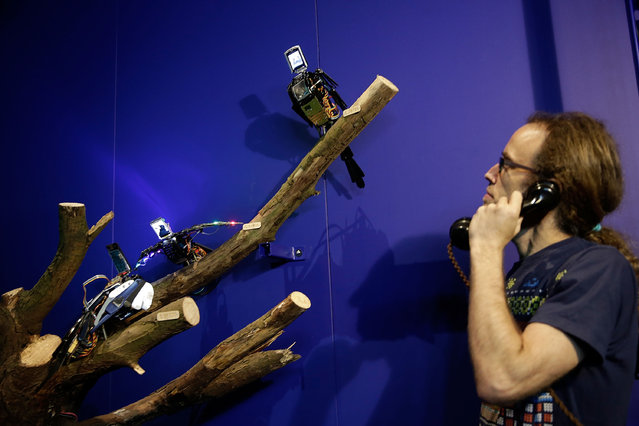
Unwanted phones recreated as interactive birds, part of "Escape III" by Anthony Goh and Neil Mendoza seen on display at the Barbican's Digital Revolution exhibition on July 2, 2014 in London, England. The exhibition brings together artists, designers, film makers, musicians and architects who push the boundaries of creativity that digitial technology can offer, and runs from July 3 until September 14, 2014.  (Photo by Matthew Lloyd/Getty Images for Barbican Art Gallery)

Unwanted phones recreated as interactive birds, part of “Escape III” by Anthony Goh and Neil Mendoza seen on display at the Barbican's Digital Revolution exhibition on July 2, 2014 in London, England. The exhibition brings together artists, designers, film makers, musicians and architects who push the boundaries of creativity that digitial technology can offer, and runs from July 3 until September 14, 2014. (Photo by Matthew Lloyd/Getty Images for Barbican Art Gallery)
Details
04 Jul 2014 10:18:00
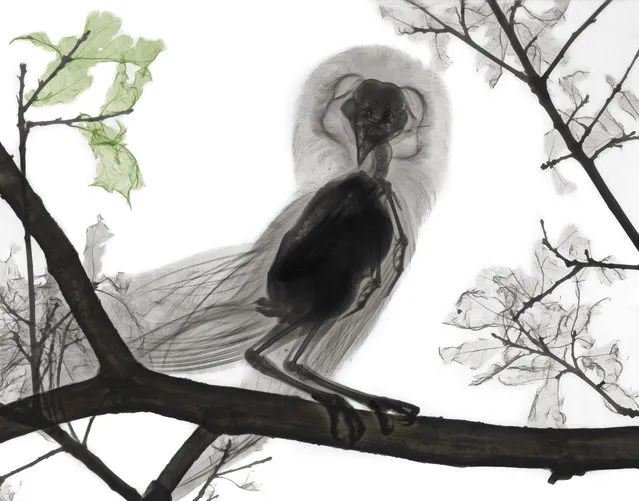
Coloured X-ray of a barn owl. A physicist has used X-ray to create an extraordinary collection of artwork. Arie van't Riets pictures reveal birds, fish, monkeys and flowers in an incredible new light. The 66-year-old, from Bathmen in the Netherlands, began X-raying flowers as a means to teach radiographers and physicians how the machine worked. But after adding a bit of colour to the pictures, the retired medical physicist realised the potential for an exciting new collection of art. (Photo by Arie van't Riet/Barcroft Media)

Coloured X-ray of a barn owl. A physicist has used X-ray to create an extraordinary collection of artwork. Arie van't Riets pictures reveal birds, fish, monkeys and flowers in an incredible new light. The 66-year-old, from Bathmen in the Netherlands, began X-raying flowers as a means to teach radiographers and physicians how the machine worked. But after adding a bit of colour to the pictures, the retired medical physicist realised the potential for an exciting new collection of art. (Photo by Arie van't Riet/Barcroft Media)
Details
08 Jul 2014 13:25:00
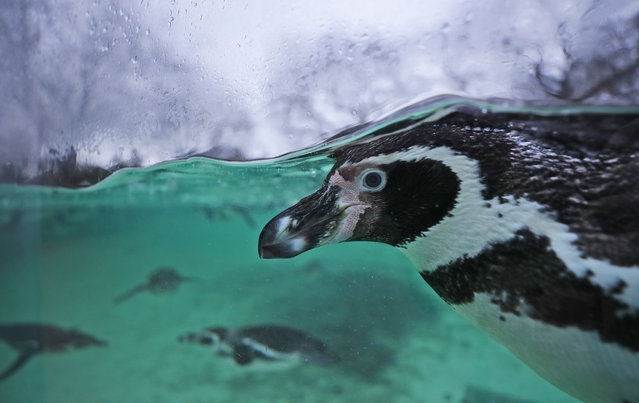
A Humboldt penguin swims in a pool during the annual stock take at ZSL London Zoo in London, Thursday, January 2, 2020. Caring for more than 500 different species, ZSL London Zoo's keepers face the challenging task of tallying up every animal large and small, every mammal, bird, reptile, fish and invertebrate at the Zoo. (Photo by Frank Augstein/AP Photo)

A Humboldt penguin swims in a pool during the annual stock take at ZSL London Zoo in London, Thursday, January 2, 2020. Caring for more than 500 different species, ZSL London Zoo's keepers face the challenging task of tallying up every animal large and small, every mammal, bird, reptile, fish and invertebrate at the Zoo. (Photo by Frank Augstein/AP Photo)
Details
05 Jan 2020 00:03:00
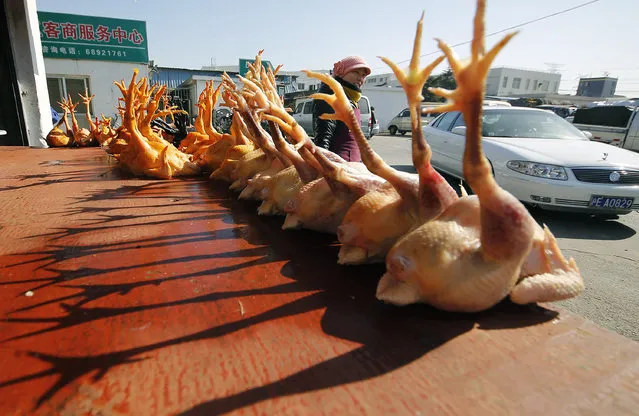
In this Tuesday January 21, 2014, file photo, slaughtered chickens are displayed for sale at a wholesale poultry market in Shanghai. The Chinese government on Tuesday, June 1, 2021, says a 41-year-old man has contracted what might be the world’s first human case of the H10N3 strain of bird flu, but the risk of large-scale spread is low. (Photo by AP Photo/File)

In this Tuesday January 21, 2014, file photo, slaughtered chickens are displayed for sale at a wholesale poultry market in Shanghai. The Chinese government on Tuesday, June 1, 2021, says a 41-year-old man has contracted what might be the w0orld’s first human case of the H10N3 strain of bird flu, but the risk of large-scale spread is low. (Photo by AP Photo/File)
Details
17 Jul 2021 08:51:00