Loading...
Done
Human Dolls: Anastasiya Shpagina with Valeria Lukyanova. (Photo by Anastasiya Shpagina & Valeria Lukyanova)

“Anastasiya Shpagina is one of the famous women who have transformed themselves into looking like human dolls. Hailing from Ukraine, 19-year-old Anastasiya Shpagina always loved Japanese cartoon characters, and has dreamed of becoming a living doll that appears in animes. She transformed her look into something that can be seen in the pages of a manga book”.

Photo: “Human Anime Doll” Anastasiya Shpagina (R) with “Human Barbie Doll” Valeria Lukyanova. (Photo by Anastasiya Shpagina & Valeria Lukyanova)
Details
15 Dec 2012 10:46:00
Sakura and Kazuhiro, Tokyo, 2015. Kazuhiro is a tattoo artist and Sakura is a photographer. They love cooking, live with their dog and two cats and each have the date of their wedding tattooed to their ring fingers. (Photo by Mami Kiyoshi/Galerie Annie Gabrielli/The Guardian)

Japanese artist Mami Kiyoshi has spent 15 years creating vivid portraits of people surrounded by their belongings – from wine bottles and violins to the odd stray pet. Mami Kiyoshi’s ongoing series “New Reading Portraits” is, in part, a nod to the mise-en-scène found in traditional woodcut printing. Here: Sakura and Kazuhiro, Tokyo, 2015. (Photo by Mami Kiyoshi/Galerie Annie Gabrielli/The Guardian)
Details
04 Aug 2017 08:48:00
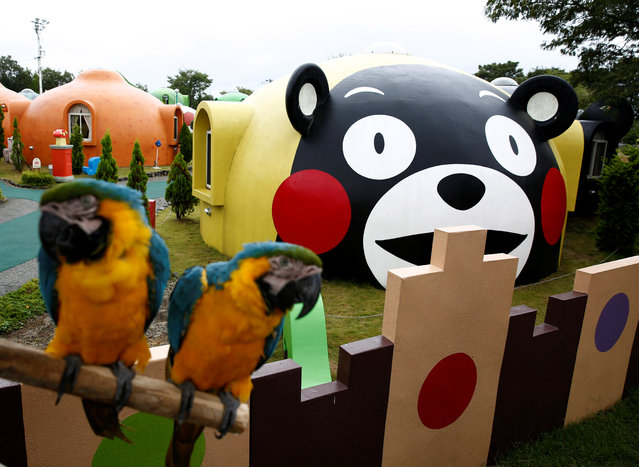
A quake-resistant dome house decorated with Japan's popular “Kumamon” bear character is pictured at the Aso Farm Land resort in Aso, Japan on November 6, 2017. (Photo by Kim Kyung-Hoon/Reuters)

A quake-resistant dome house decorated with Japan's popular “Kumamon” bear character is pictured at the Aso Farm Land resort in Aso, Japan on November 6, 2017. Cabins modelled after Japanese sweets and made from polystyrene foam withstood last year's deadly earthquakes in Kumamoto prefecture. (Photo by Kim Kyung-Hoon/Reuters)
Details
09 Nov 2017 05:18:00


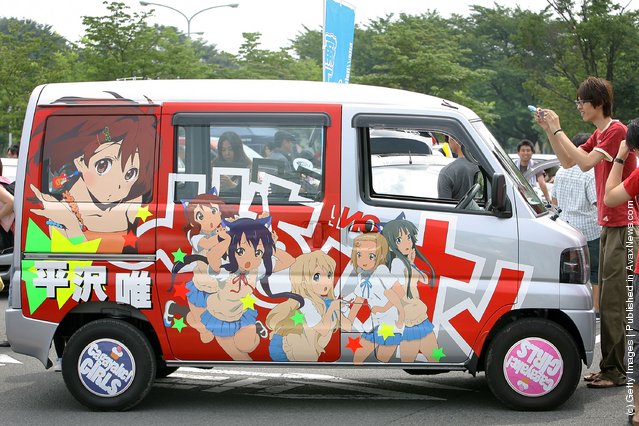
“Itasha (痛車), literally “painmobile”, is a Japanese term for an otaku fad of individuals decorating the bodies of their cars with fictional characters of anime, manga, or video games (especially bishōjo game or eroge). These characters are predominately “cute” female. The decorations usually involve paint schemes and stickers. Automobiles are called Itasha, while similar motorcycles and bicycles are called itansha (痛単車) and itachari (痛チャリ), respectively”. – Wikipedia


Photo: A visitor takes pictures of an anime-decorated «Itasha» car displayed during the “Moe Fes in Washimiya” at Washimiya Town Hall on July 18, 2009 in Washimiya, Saitama, Japan. Itasha, a word derived from “itai” (painful) and “sha” (car), are vehicles decorated with mostly female characters from Japanese manga, anime and video games. (Photo by Kiyoshi Ota/Getty Images)
Details
02 May 2011 08:38:00
Japanese sumo wrestler Kisenosato (C) holds a red sea bream next to his stablemaster Tagonoura's wife Kotomi as he celebtares after receiving messengers from the Japan Sumo Association bringing official notice of his promotion to Yokozuna, or grand champion, during a ceremony in Tokyo, Japan, January 25, 2017. (Photo by Toru Hanai/Reuters)

Japanese sumo wrestler Kisenosato (C) holds a red sea bream next to his stablemaster Tagonoura's wife Kotomi as he celebtares after receiving messengers from the Japan Sumo Association bringing official notice of his promotion to Yokozuna, or grand champion, during a ceremony in Tokyo, Japan, January 25, 2017. (Photo by Toru Hanai/Reuters)
Details
26 Jan 2017 13:11:00
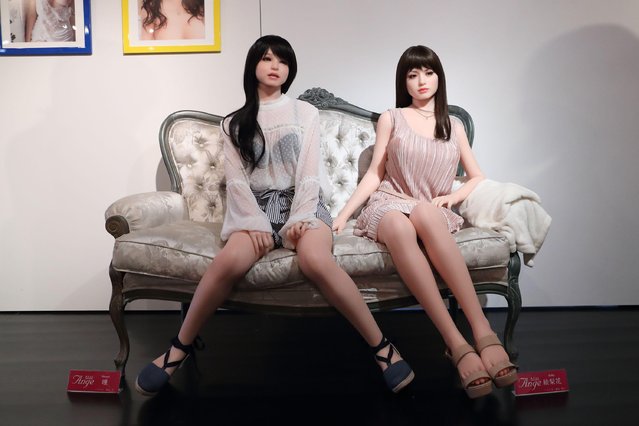
Orient Industry 40th Anniversary-Love Doll in Tokyo, Japan on May 19,  2017. Orient industry prides itself on its detail with two looking extremely real as they sit flirtatiously on a couch. (Photo by Masatoshi Okauchi/Rex Features/Shutterstock)

Japanese sеx doll exhibition attracts hundreds of mannequin-fetishists to celebrate 40 years of the X-rated love bots in Tokyo, Japan on May 19, 2017. These silicon seductresses were the star of an extraordinary exhibition in Japan showcasing sеx dolls that cost as little as a second hand car. Japanese sеx doll maker Orient Industry (originally Orient made dolls for disabled people) were laying bare their dazzling bevvy of beauties in an extravaganza to mark its 40th anniversary this week. Here: Orient industry prides itself on its detail with two looking extremely real as they sit flirtatiously on a couch. (Photo by Masatoshi Okauchi/Rex Features/Shutterstock)
Details
20 May 2017 10:03:00
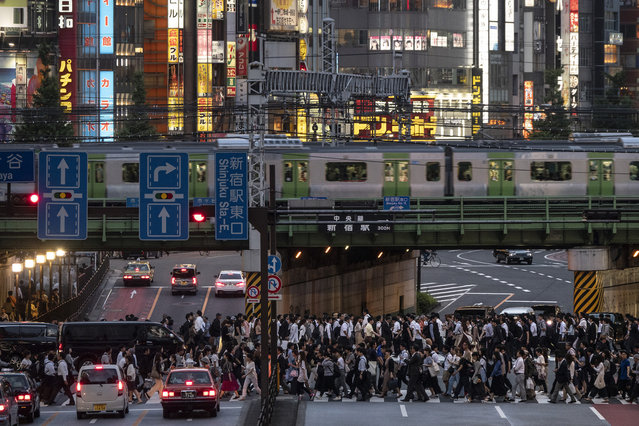
In this Tuesday, June 4, 2019, photo, a Yamanote Line train travels above commuters walking across the crossing during evening rush hours in the Shinjuku district of Tokyo. Operated by the East Japan Railway Co., the Yamanote Line in Tokyo makes a loop around the center of the city, connecting 29 stations that include key stops such as Shinjuku, Shibuya and Ikebukuro. A complete loop of about an hour offers scenes of Japanese daily lives. (Photo by Jae C. Hong/AP Photo)

In this Tuesday, June 4, 2019, photo, a Yamanote Line train travels above commuters walking across the crossing during evening rush hours in the Shinjuku district of Tokyo. Operated by the East Japan Railway Co., the Yamanote Line in Tokyo makes a loop around the center of the city, connecting 29 stations that include key stops such as Shinjuku, Shibuya and Ikebukuro. A complete loop of about an hour offers scenes of Japanese daily lives. (Photo by Jae C. Hong/AP Photo)
Details
27 Jun 2019 00:03:00
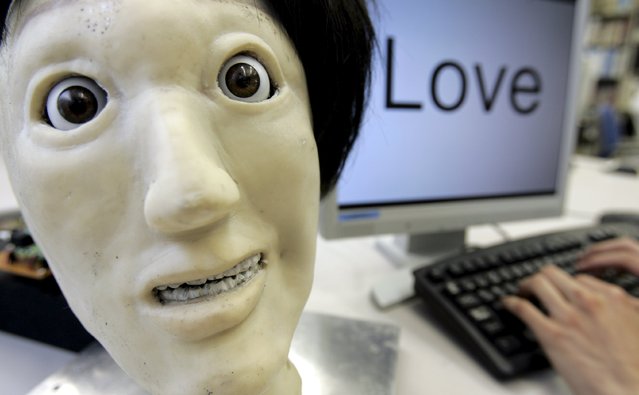
A humanoid robot named Kansei, meaning “sensibility” in Japanese, makes a facial expression depicting “happiness”, next to the word “Love” during a demonstration at a laboratory of Meiji University's Robot and Science Institute in Kawasaki, south of Tokyo in this June 4, 2007 file photo. (Photo by Yuriko Nakao/Reuters)

A humanoid robot named Kansei, meaning “sensibility” in Japanese, makes a facial expression depicting “happiness”, next to the word “Love” during a demonstration at a laboratory of Meiji University's Robot and Science Institute in Kawasaki, south of Tokyo in this June 4, 2007 file photo. Three-fourths of robot installations over the next decade are expected to be concentrated in four areas: transportation equipment, including the automotive sector; computer and electronic products; electrical equipment and machinery. Labor costs have climbed in countries such as China that have been popular for outsourcing production, while technological advances for robots allow them to be more flexible and perform more tasks. (Photo by Yuriko Nakao/Reuters)
Details
17 Apr 2015 09:39:00