Loading...
Done
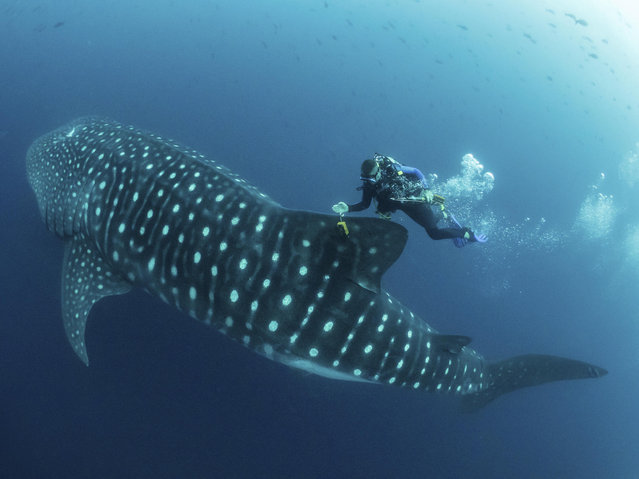
In this 2017 photo provided by Simon Pierce, Jonathan Green checks on a fin-mounted satellite tag on a whale shark in the Galapagos Islands area of Ecuador.  Despite typically being bigger than a double-decker bus, the elusive whale shark has only tiny, almost useless teeth. It's also one of the least understood animals in the ocean. (Photo by Simonjpierce.com via AP Photo)

In this 2017 photo provided by Simon Pierce, Jonathan Green checks on a fin-mounted satellite tag on a whale shark in the Galapagos Islands area of Ecuador. Despite typically being bigger than a double-decker bus, the elusive whale shark has only tiny, almost useless teeth. It's also one of the least understood animals in the ocean. (Photo by Simonjpierce.com via AP Photo)
Details
02 Mar 2018 00:03:00
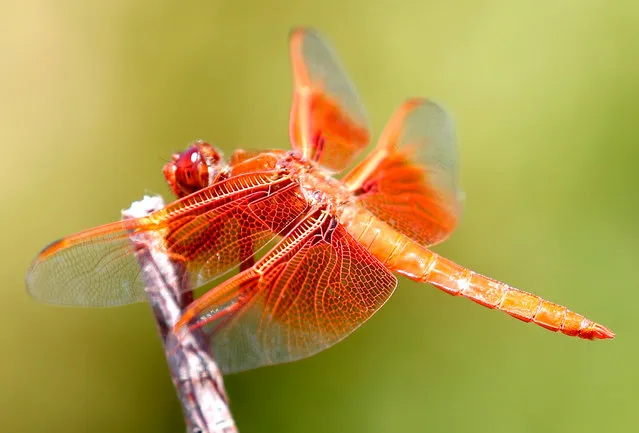
A Flame Skimmer or Firecracker Skimmer dragonfly (Libellula saturata) rests on a small branch in Topanga, California, USA, 18 June 2018. The Flame Skimmer dragonfly is found in the Western United States near ponds and creeks. (Photo by Mike Nelson/EPA/EFE)

A Flame Skimmer or Firecracker Skimmer dragonfly (Libellula saturata) rests on a small branch in Topanga, California, USA, 18 June 2018. The Flame Skimmer dragonfly is found in the Western United States near ponds and creeks. (Photo by Mike Nelson/EPA/EFE)
Details
24 Jun 2018 00:03:00
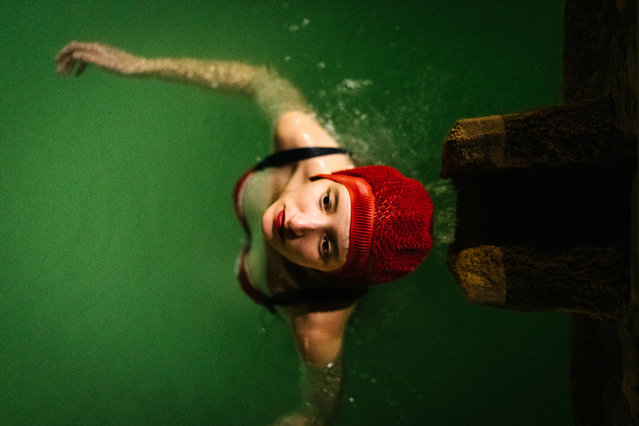
Shortlist, open competition, lifestyle. Healing Vibes – the hot springs of Bagno Vignoni in Italy flow out at a temperature of about 49°C. They were appreciated by the Romans for their healing powers, and have been used as therapeutic treatments since the 12th century, under Emperor Federico II. (Photo by Stefano Butturini/Sony World Photography Awards)

Shortlist, open competition, lifestyle. Healing Vibes – the hot springs of Bagno Vignoni in Italy flow out at a temperature of about 49°C. They were appreciated by the Romans for their healing powers, and have been used as therapeutic treatments since the 12th century, under Emperor Federico II. (Photo by Stefano Butturini/Sony World Photography Awards)
Details
20 Mar 2021 10:27:00
Magbola Alhadi, 20, and her three children pose for a portrait in Jamam refugee camp in Maban County, South Sudan on August 11th, 2012. Magboola and her family weathered aerial bombing raids for several months, but decided it was time to leave their village of Bofe the night that soldiers arrived and opened fire. (Photo by Brian Sokol/Panos Pictures)

Magbola Alhadi, 20, and her three children pose for a portrait in Jamam refugee camp in Maban County, South Sudan on August 11th, 2012. Magboola and her family weathered aerial bombing raids for several months, but decided it was time to leave their village of Bofe the night that soldiers arrived and opened fire. With her three children, she travelled for 12 days from Bofe to the town of El Fudj, on the South Sudanese border. The most important thing that Magboola was able to bring with her is the saucepan she holds in this photograph. It wasn't the largest pot that she had in Bofe, but it was small enough she could travel with it, yet big enough to cook sorghum for herself and her three daughters (from left: Aduna Omar, 6, Halima Omar, 4, and Arfa Omar, 2) during their journey. (Photo by Brian Sokol/Panos Pictures)
Details
18 Sep 2015 15:04:00
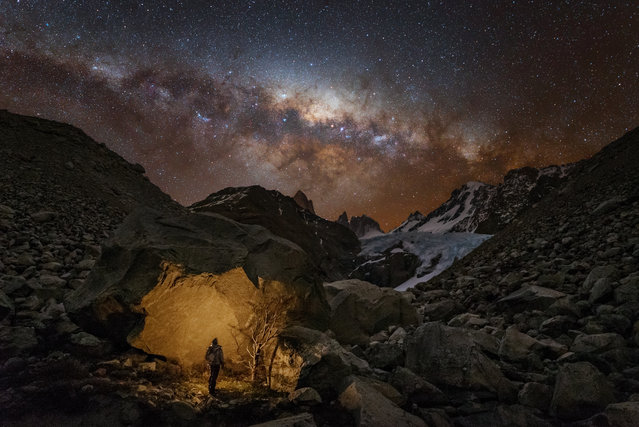
“People and Space”. Winner: Wanderer in Patagonia by Yuri Zvezdny (Russia) A lone stargazer stares up at the stars of our galaxy, the Milky Way, as they stretch across the night sky over the glacier “White Stones” (Piedras Blancas) in the Los Glaciares National Park, Argentina. El Chaltén, Santa Cruz Province, Argentina, 27 September 2016 iOptron Sky-Tracker mount, Sony A7S camera, 18 mm f/2.8 lens, ISO 5000, 30-second exposure Wanderer in Patagonia. (Photo by Yuri Zvezdny/Insight Astronomy Photographer of the Year 2017)

“People and Space”. Winner: Wanderer in Patagonia by Yuri Zvezdny (Russia) A lone stargazer stares up at the stars of our galaxy, the Milky Way, as they stretch across the night sky over the glacier “White Stones” (Piedras Blancas) in the Los Glaciares National Park, Argentina. El Chaltén, Santa Cruz Province, Argentina, 27 September 2016 iOptron Sky-Tracker mount, Sony A7S camera, 18 mm f/2.8 lens, ISO 5000, 30-second exposure Wanderer in Patagonia. (Photo by Yuri Zvezdny/Insight Astronomy Photographer of the Year 2017)
Details
18 Sep 2017 07:09:00
Swiss Company Turns People’s Ashes Into Diamonds

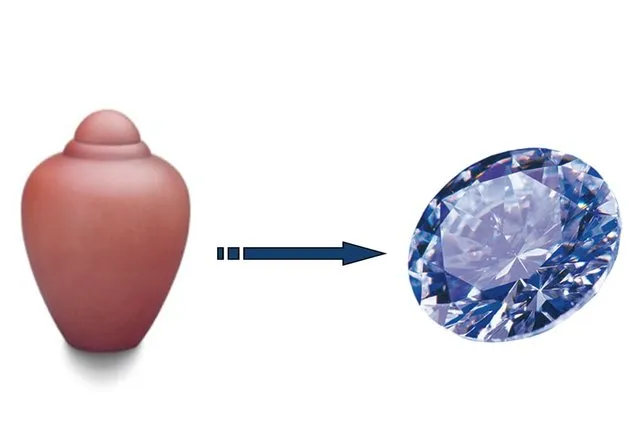
In the past people used to bury their loved ones or turn them into ashes. However, now there is a completely new possibility. Since having an urn with ashes in your house may be a bit weird, you may want to choose the option of turning your deceased relative into a diamond. Yes, diamond! You’ve heard us correctly. By using immense heat and pressure, the ashes you get after cremating a person can be turned into a real diamond. After this, the diamond can be left as it is, and stored in a jewelry box, or it can be used as a piece of jewelry, such as a ring or a pendant, allowing you to always keep your loved one close to your heart. (Photo by djd/Algordanza memorial diamonds)
Details
20 Oct 2014 08:52:00
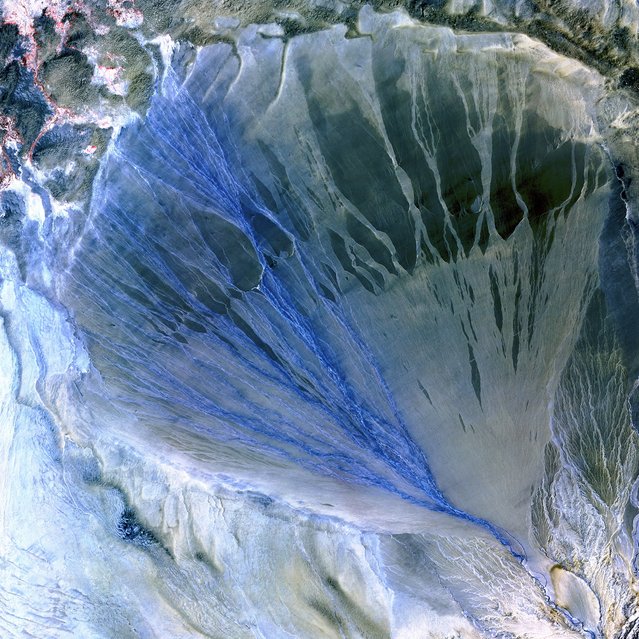
Alluvial Fan, China. A vast alluvial fan blossoms across the desolate landscape between the Kunlun and Altun mountain ranges that form the southern border of the Taklimakan Desert in China’s XinJiang Province. Image taken by the ASTER instrument on NASA’s Terra satellite on May 2nd, 2002. (Photo by NASA/GSFC/USGS EROS Data Center)

Alluvial Fan, China. A vast alluvial fan blossoms across the desolate landscape between the Kunlun and Altun mountain ranges that form the southern border of the Taklimakan Desert in China’s XinJiang Province. Image taken by the ASTER instrument on NASA’s Terra satellite on May 2nd, 2002. (Photo by NASA/GSFC/USGS EROS Data Center)
Details
07 Jan 2013 09:27:00
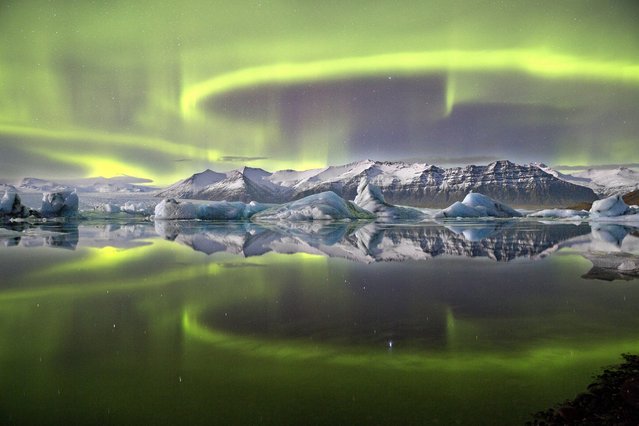
“Aurora over a glacier lagoon”. A vivid green overheaded aurrora pictured in Iceland's Vatnajokull National Park reflected almost symetrically in Jokulsrlon Glacier lagoon. A complete lack of wind and currrent combin in this sheltred lagoon scene to crete an arresting mirror effect giving the image a sensation of utter stillness. Despite theis there is motion on a suprising scale, as the loops and arcs of the aurora are shaped by the shifting forces of the Earth's magnetic field. (Photo by  James Woodend/The Astronomy Photographer of the Year 2014 Contest)

“Aurora over a glacier lagoon”. A vivid green overheaded aurrora pictured in Iceland's Vatnajokull National Park reflected almost symetrically in Jokulsrlon Glacier lagoon. A complete lack of wind and currrent combin in this sheltred lagoon scene to crete an arresting mirror effect giving the image a sensation of utter stillness. Despite theis there is motion on a suprising scale, as the loops and arcs of the aurora are shaped by the shifting forces of the Earth's magnetic field. James Woodend of Great Britain won the grand prize with the image, beating out more than 2,500 other entries. The Astronomy Photographer of the Year 2014 contest is judged by the Royal Observatory Greenwich and BBC Sky at Night magazine. (Photo by James Woodend/The Astronomy Photographer of the Year 2014 Contest)
Details
26 Sep 2014 13:39:00