Loading...
Done
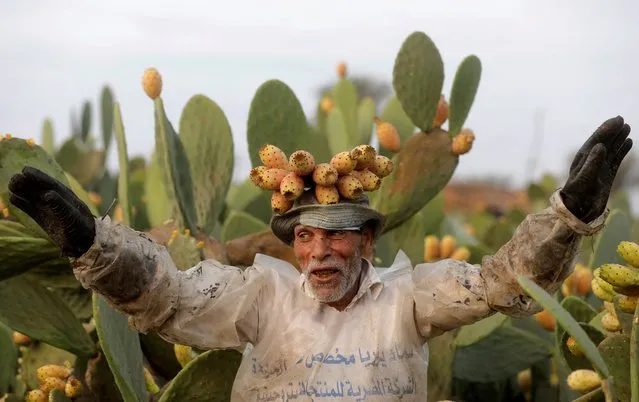
A worker sings while carrying prickly pears on his head as their production is on the rise due to low water consumption and ability to withstand extreme temperatures, according to farmers, at a farm in Al Qalyubia Governorate, Egypt on August 2, 2022. (Photo by Mohamed Abd El Ghany/Reuters)

A worker sings while carrying prickly pears on his head as their production is on the rise due to low water consumption and ability to withstand extreme temperatures, according to farmers, at a farm in Al Qalyubia Governorate, Egypt on August 2, 2022. (Photo by Mohamed Abd El Ghany/Reuters)
Details
27 Sep 2022 04:34:00
The Lun-class Ekranoplane was used by the Soviet Navy starting in 1987, and wasn't retired until the late 1990s, after the Soviet Union's fall. (Igor113)

“The Lun-class ekranoplan (NATO reporting name Duck) was a ground effect vehicle (GEV) designed by Rostislav Evgenievich Alexeev and used by the Soviet and Russian navies from 1987 until sometime in the late 1990s. It “flew” using the lift generated by the ground effect of its large wings when close to the surface of the water – about four metres or less. Although they might look similar and/or have related technical characteristics, ekranoplans like the Lun are not aircraft, seaplanes, hovercraft, or hydrofoils – ground effect is a separate technology altogether. The International Maritime Organization classifies these vehicles as maritime ships. The name Lun comes from the Russian for harrier”. – Wikipedia (Photo by Igor113)
Details
08 Aug 2014 10:51:00
Albertus in the church of St George in Burgrain, Germany. Incredibly, some of the skeletons, which took up to five years to decorate, were even found hidden away in lock-ups and containers. (Photo by Paul Koudounaris/BNPS)

A relic hunter dubbed “Indiana Bones” has lifted the lid on a macabre collection of 400-year-old jewel-encrusted skeletons unearthed in churches across Europe. Art historian Paul Koudounaris has hunted down and photographed dozens of gruesome skeletons in some of the world's most secretive religious establishments. Photo: Albertus in the church of St George in Burgrain, Germany. Incredibly, some of the skeletons, which took up to five years to decorate, were even found hidden away in lock-ups and containers. (Photo by Paul Koudounaris/BNPS)
Details
08 Sep 2013 07:20:00
People release floating lanterns during the festival of Yee Peng in the northern capital of Chiang Mai, Thailand November 14, 2016. Yi Peng refers to the full moon day in the second month according to the Lanna lunar calendar (the twelfth month according to the Thai lunar calendar). Swarms of Lanna-style sky lanterns are launched into the air where they resemble large shoals of giant fluorescent jellyfish gracefully floating through the sky. The festival is meant as a time for tham bun, to make merit. Khom loi are made from a thin fabric, such as rice paper, stretched over a bamboo or wire frame, to which a candle or fuel cell is attached. When the fuel cell is lit, the resulting hot air is trapped inside the lantern and creates enough lift for the khom loi to float up into the sky. (Photo by Athit Perawongmetha/Reuters)

People release floating lanterns during the festival of Yee Peng in the northern capital of Chiang Mai, Thailand November 14, 2016. Yi Peng refers to the full moon day in the second month according to the Lanna lunar calendar (the twelfth month according to the Thai lunar calendar). Swarms of Lanna-style sky lanterns are launched into the air where they resemble large shoals of giant fluorescent jellyfish gracefully floating through the sky. The festival is meant as a time for tham bun, to make merit. Khom loi are made from a thin fabric, such as rice paper, stretched over a bamboo or wire frame, to which a candle or fuel cell is attached. When the fuel cell is lit, the resulting hot air is trapped inside the lantern and creates enough lift for the khom loi to float up into the sky. (Photo by Athit Perawongmetha/Reuters)

Details
15 Nov 2016 11:54:00
Highly commended, mammals: Gelada after the storm – Marco Gaiotti (Italy). “Gelada baboons are the only monkey species in the world that feed on grasses. They are native to the tableland of Ethiopia. Every morning large family groups wander from their sleeping places in the steep rock face, up to 1,000 metres high, to the feeding grounds at the tablelands. This image clearly depicts their feeding strategy: they pull out bunches of grass, sort the stalks and then lift them to their mouth. This shot was taken towards the end of the rainy season after a heavy storm”. (Photo by Marco Gaiotti/2019 GDT European Wildlife Photographer of the Year)

Highly commended, mammals: Gelada after the storm – Marco Gaiotti (Italy). “Gelada baboons are the only monkey species in the world that feed on grasses. They are native to the tableland of Ethiopia. Every morning large family groups wander from their sleeping places in the steep rock face, up to 1,000 metres high, to the feeding grounds at the tablelands. This image clearly depicts their feeding strategy: they pull out bunches of grass, sort the stalks and then lift them to their mouth. This shot was taken towards the end of the rainy season after a heavy storm”. (Photo by Marco Gaiotti/2019 GDT European Wildlife Photographer of the Year)
Details
31 Oct 2019 00:03:00
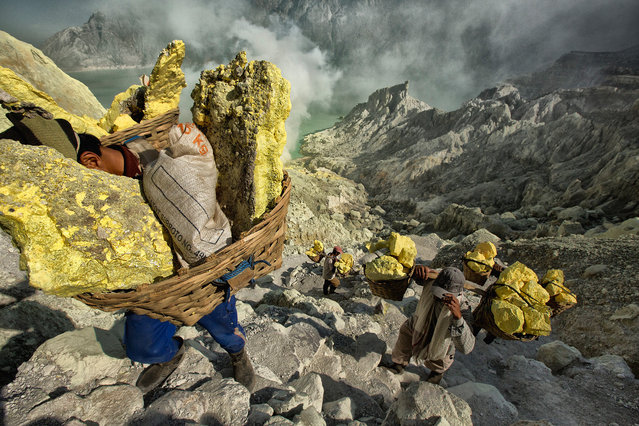
Sulphur miners haul sulphur up an arduous path out of Indonesia’s Ijen volcano. The average carry out of the volcano is 70 kilograms per load per miner.  The all-time record carry was 120 kilograms in one load.  Extraordinary numbers given most of the miners only weigh around 55 kilograms.  Ijen volcano, Indonesia, 2012. (Photo by Hugh Brown/South West News Service)

Sulphur miners haul sulphur up an arduous path out of Indonesia’s Ijen volcano. The average carry out of the volcano is 70 kilograms per load per miner. The all-time record carry was 120 kilograms in one load. Extraordinary numbers given most of the miners only weigh around 55 kilograms. Ijen volcano, Indonesia, 2012. (Photo by Hugh Brown/South West News Service)
Details
30 Jul 2018 00:05:00
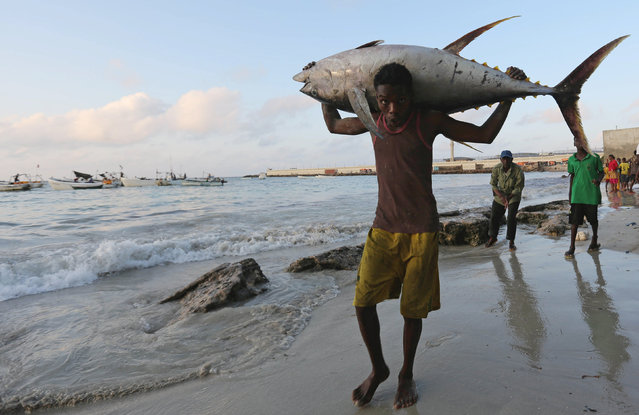
A Somali fisherman carries a fish from his vessel on the shores of the Indian Ocean on Liido beach, in Mogadishu, Somalia November 4, 2016. (Photo by Feisal Omar/Reuters)

A Somali fisherman carries a fish from his vessel on the shores of the Indian Ocean on Liido beach, in Mogadishu, Somalia November 4, 2016. (Photo by Feisal Omar/Reuters)
Details
05 Nov 2016 12:59:00
A girl carries a rifle as she attends a rally by followers of the Shi'ite Houthi movement commemorating the death of Imam Zaid bin Ali in Sanaa, Yemen October 26, 2016. (Photo by Khaled Abdullah/Reuters)

A girl carries a rifle as she attends a rally by followers of the Shi'ite Houthi movement commemorating the death of Imam Zaid bin Ali in Sanaa, Yemen October 26, 2016. (Photo by Khaled Abdullah/Reuters)
Details
22 Nov 2016 10:50:00