Loading...
Done
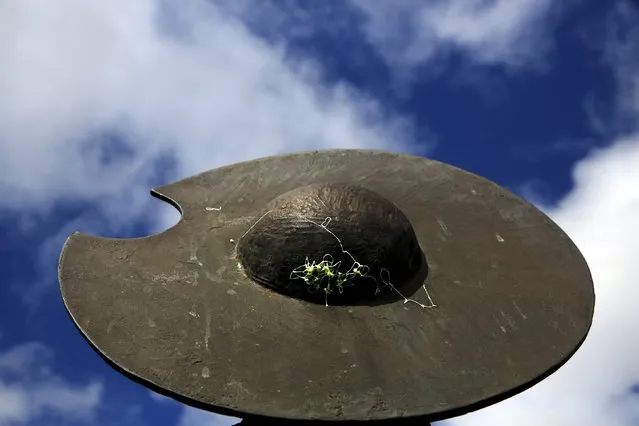
A sculpture of Don Quixote shows him wearing the basin he mistook for the enchanted helmet of the fictional Moorish king Mambrino in Alcazar de San Juan, Spain, April 5, 2016. (Photo by Susana Vera/Reuters)

A sculpture of Don Quixote shows him wearing the basin he mistook for the enchanted helmet of the fictional Moorish king Mambrino in Alcazar de San Juan, Spain, April 5, 2016. The arid central Spanish region of La Mancha is the setting for “Don Quixote”, the seventeenth-century novel by Miguel de Cervantes. Four hundred years after his death, references to the characters of Don Quixote, his loyal squire Sancho Panza and his beautiful lady Dulcinea abound in the surrounding villages from sweet treats to theatre productions involving livestock. Cervantes did not give away the name of the birthplace of Don Quixote, a middle-aged gentleman who becomes obsessed with chivalrous ideals. But many identify the village of Argamasilla de Alba as his hometown. The anniversary of Cervantes’ death is marked on the 23 April. (Photo by Susana Vera/Reuters)
Details
21 Apr 2016 12:32:00


“Snowflake (c. 1964 – November 24, 2003) was an albino gorilla. He was the only known albino gorilla so far, and the most popular resident of the Barcelona Zoo in Catalonia, Spain. Originally named Nfumu Ngui in Fang language ("white gorilla") by his captor, he was then nicknamed Floquet de Neu (Catalan for little snowflake) by his keeper Jordi Sabater Pi. On his arrival to Barcelona where he was given an official reception by the then Mayor of Barcelona, Josep Maria de Porcioles, in November 1966, he was called Blancanieves (“Snow White”) in the newspaper Tele/Exprés. But he became famous with the name given to him by Sabater when National Geographic Magazine featured him on the main page in March 1967, with the English name Snowflake. This name spread among the press (Stern, Life, Paris-Match) and was later translated to Spanish as Copito de Nieve. Sabater himself called the gorilla Floquet or Copi, and in the later years Nfumu. The asteroid 95962 Copito, discovered by Catalan astronomer J. Manteca, is named in his honour”.
Details
07 Mar 2011 15:50:00
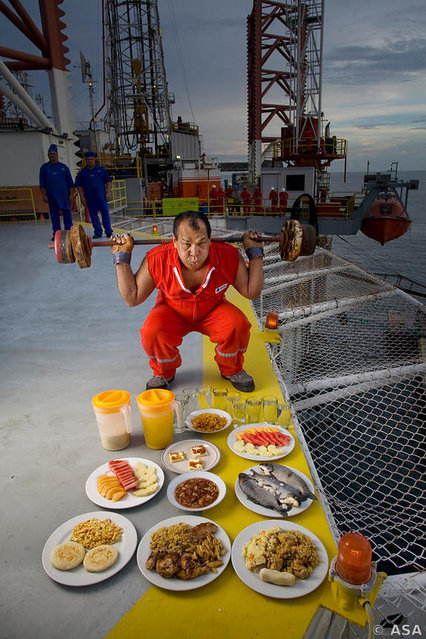
What the World Eats By Peter Menzel And Faith D'Aluisio Part 1

A stunning photographic collection featuring portraits of people from 30 countries and the food they eat in one day. In this fascinating study of people and their diets, 80 profiles are organized by the total number of calories each person puts away in a day. Featuring a Japanese sumo wrestler, a Massai herdswoman, world-renowned Spanish chef Ferran Adria, an American competitive eater, and more, these compulsively readable personal stories also include demographic particulars, including age, activity level, height, and weight. Essays from Harvard primatologist Richard Wrangham, journalist Michael Pollan, and others discuss the implications of our modern diets for our health and for the planet. This compelling blend of photography and investigative reportage expands our understanding of the complex relationships among individuals, culture, and food.
Details
23 Apr 2014 14:34:00
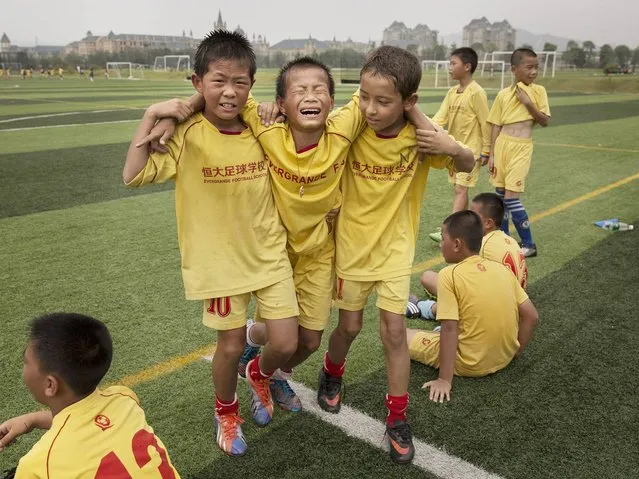
Football players help an injured player off the field during training at the Evergrande International Football School near Qingyuan in Guangdong Province. (Photo by Kevin Frayer/Getty Images)

Young Chinese football players help an injured player off the field during training at the Evergrande International Football School on June 12, 2014 near Qingyuan in Guangdong Province, China. The sprawling 167-acre campus is the brainchild of property tycoon Xu Jiayin, whose ambition is to train a generation of young athletes to establish China as a football powerhouse. The school is considered the largest football academy in the world with 2400 students, more than 50 pitches and a squad of Spanish coaches through a partnership with Real Madrid. (Photo by Kevin Frayer/Getty Images)
Details
18 Jun 2014 12:56:00
The best man in a wedding party, who all declined to be identified, holds an AR-10 rifle he was handed while the party was having their pre-wedding portraits taken on the steps of the capitol before a rally nearby by gun-rights advocates to protest a new expanded gun background check law in Washington state Saturday, December 13, 2014, in Olympia, Wash. (Photo by Elaine Thompson/AP Photo)

The best man in a wedding party, who all declined to be identified, stands near the bride and groom as he holds an AR-10 rifle he was handed while the party was having their pre-wedding portraits taken on the steps of the capitol before a rally nearby by gun-rights advocates to protest a new expanded gun background check law in Washington state Saturday, December 13, 2014, in Olympia, Wash. The wedding party was not part of the protest, but posed for pictures with it after being handed it by gun activist Brandon Lyons, who said “we've all just broken the law”, by handing the gun over. Saturday's protest was called the “I Will Not Comply” rally, and those attending said they will openly exchange firearms in opposition to the state's new voter-approved universal background check law, Initiative 594. The law, which took effect on December 4, requires background checks on all sales and transfers, including private transactions and many loans and gifts. (Photo by Elaine Thompson/AP Photo)
Details
15 Dec 2014 11:17:00
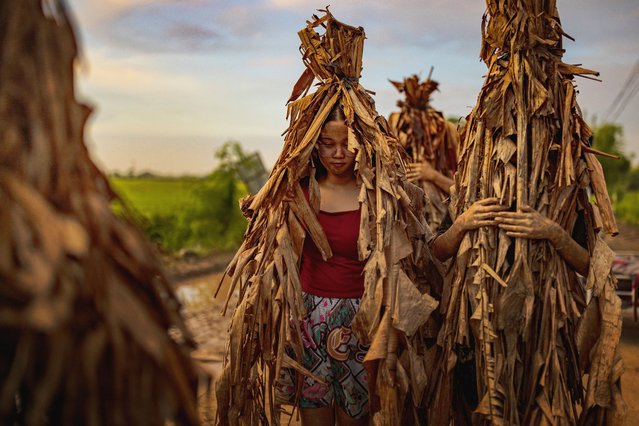
Devotees of the small farming village of Bibiclat celebrate the Feast of Saint John the Baptist while covered in banana leaves and mud on June 24, 2025 in Aliaga, Philippines. Known as the “Taong Putik” (mud people), the ritual happens yearly in this small farming village as their own version of expressing their faith and celebrating the feast of Saint John the Baptist whom the survivors of the Japanese occupation in 1944 in their area prayed to for rain to save their fellow villagers. A marker near the church entrance of the village tells a story of a heavy torrential rain that happened that day that forced the Japanese military to call off the execution of 14 villagers. The Philippines is the only predominantly Catholic country in Southeast Asia after more than 300 years of Spanish rule. (Photo by Ezra Acayan/Getty Images)

Devotees of the small farming village of Bibiclat celebrate the Feast of Saint John the Baptist while covered in banana leaves and mud on June 24, 2025 in Aliaga, Philippines. Known as the “Taong Putik” (mud people), the ritual happens yearly in this small farming village as their own version of expressing their faith and celebrating the feast of Saint John the Baptist whom the survivors of the Japanese occupation in 1944 in their area prayed to for rain to save their fellow villagers. (Photo by Ezra Acayan/Getty Images)
Details
29 Aug 2025 03:18:00
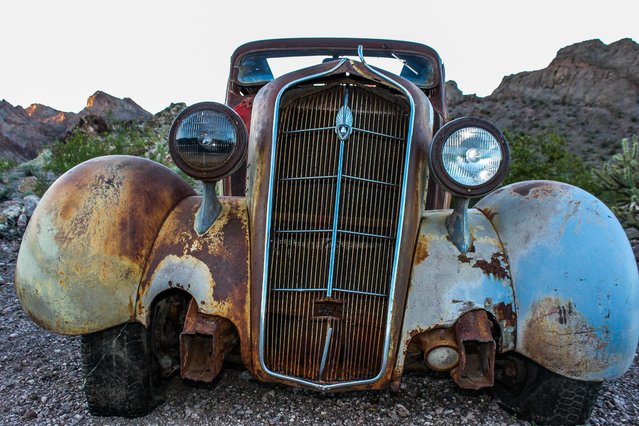
Images of an American ghost town that was home to gold mines and features a plane which crashed during the filming of 3000 Miles to Graceland starring Kevin Costner and Kurt Russell reveal the remnants of the once thriving location. An assortment of rusted vehicles which include a canary yellow bus, caravans and cars have all been left behind in the desert. Other pictures of Nelson, Nevada show its desolate surroundings with only a couple of houses and museums scattered around the area. In one shot, a derelict petrol pump stands still after making its final sale years ago. The stunning photographs were taken by an American photographer known as Abandoned Southeast on a visit to Nelson, Nevada. The area was called Eldorado by the Spaniards who made the original discoveries of gold in the town. The notorious Techatticup gold and silver mine which was associated with crime and murders ran in the area from 1861 to 1942. It was the richest mine in Southern Nevada. (Photo by Abandoned Southeast/Mediadrumworld.com)

Images of an American ghost town that was home to gold mines and features a plane which crashed during the filming of 3000 Miles to Graceland starring Kevin Costner and Kurt Russell reveal the remnants of the once thriving location. An assortment of rusted vehicles which include a canary yellow bus, caravans and cars have all been left behind in the desert. (Photo by Abandoned Southeast/Mediadrumworld.com)
Details
25 Dec 2016 09:25:00
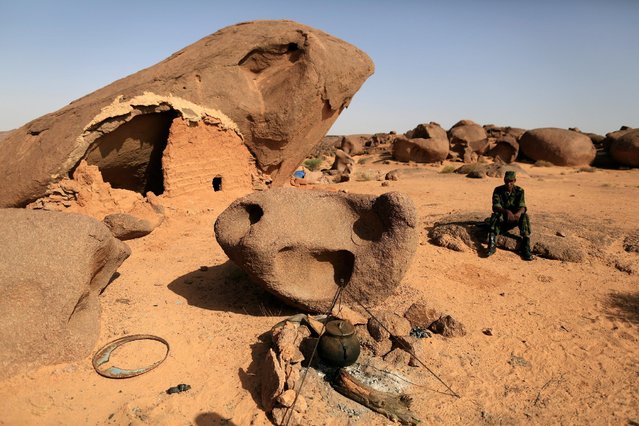
A Polisario fighter sits on a rock at a forward base on the outskirts of Tifariti, Western Sahara, September 9, 2016. At a rocky outpost in Western Sahara, a new generation of soldiers who have never known war are mobilising as tensions resurface in one of Africa's oldest disputes after a quarter century of uneasy peace. Young Sahrawi troops man new desert posts for the Polisario Front, which for more than 40 years has sought independence for the vast desert region - first in a guerrilla war against Morocco and then politically since a ceasefire deal in 1991. Now a standoff with Morocco, which controls the majority of Western Sahara, is renewing pressure for a diplomatic solution to ensure foot soldiers don't return to fighting as the last generation of commanders once did. The standoff since August has brought Moroccan and Polisario forces within 200 metres of each other in a narrow strip of land near the Mauritanian border. Rich in phosphate, Western Sahara has been contested since 1975 when Spanish colonial powers left. Morocco claimed the territory and fought the 16-year war with Polisario. (Photo by Zohra Bensemra/Reuters)

A Polisario fighter sits on a rock at a forward base on the outskirts of Tifariti, Western Sahara, September 9, 2016. At a rocky outpost in Western Sahara, a new generation of soldiers who have never known war are mobilising as tensions resurface in one of Africa's oldest disputes after a quarter century of uneasy peace. (Photo by Zohra Bensemra/Reuters)
Details
04 Nov 2016 12:09:00