Loading...
Done
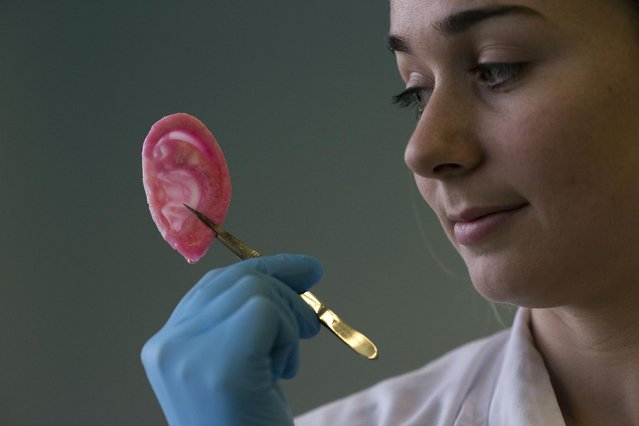
Dr Michelle Griffin, a plastic research fellow, poses for photographs with a synthetic polymer ear at her research facility in the Royal Free Hospital in London, Monday, March 31, 2014. (Photo by Matt Dunham/AP Photo)

In a north London hospital, scientists are growing noses, ears and blood vessels in the laboratory in a bold attempt to make body parts using stem cells. It is among several labs around the world, including in the U.S., that are working on the futuristic idea of growing custom-made organs in the lab. (Photo by Matt Dunham/AP Photo)
Details
10 Apr 2014 09:21:00


An image produced by the Hubble telescope of the perfectly “edge-on” galaxy, or NGC 4013, March 1, 2001. This new Hubble picture reveals, with great detail, huge clouds of dust and gas extending along, as well as far above, the galaxy's main disk. NGC 4013 is a spiral galaxy, similar to the Milky Way, lying some 55 million light-years from Earth in the direction of the constellation Ursa Major. Viewed face-on, it would look like a nearly circular pinwheel, but NGC 4013 happens to be seen edge-on from our vantage point. Even at 55 million light-years, the galaxy is larger than Hubble's field of view, and the image shows only a little more than half of the object, albeit with unprecedented detail. (Photo Courtesy of NASA/Newsmakers)
Details
28 Feb 2015 22:33:00
Undulatus asperatus Is A Cloud Formation

Undulatus asperatus (or alternately, asperatus) is a cloud formation, proposed in 2009 as a separate cloud classification by the founder of the Cloud Appreciation Society. If successful it will be the first cloud formation added since cirrus intortus in 1951 to the International Cloud Atlas of the World Meteorological Organization. The name translates approximately as “roughened or agitated waves”.
Details
18 Sep 2014 12:00:00
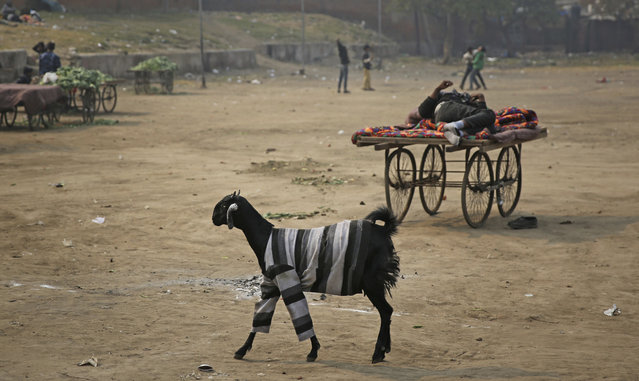
A goat wearing a sweater walks in a field in New Delhi, India, Thursday, January 17, 2019. (Photo by Altaf Qadri/AP Photo)

A goat wearing a sweater walks in a field in New Delhi, India, Thursday, January 17, 2019. (Photo by Altaf Qadri/AP Photo)
Details
20 Jan 2019 00:03:00
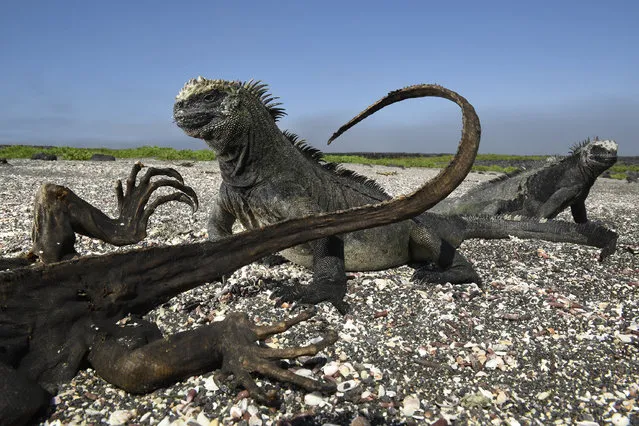
Galapagos – Rocking the Cradle: Four major ocean currents converge along the Galapagos archipelago, creating the conditions for an extraordinary diversity of animal life, April 25, 2016. The islands are home to at least 7,000 flora and fauna species, of which 97 percent of the reptiles, 80 percent of the land birds, 50 percent of the insects and 30 percent of the plants are endemic. The local ecosystem is highly sensitive to the changes in temperature, rainfall and ocean currents that characterize the climatic events known as El Niño and La Niña. These changes cause marked fluctuations in weather and food availability. Many scientists expect the frequency of El Niño and La Niña to increase as a result of climate change, making the Galapagos a possible early-warning location for its effects. (Photo by Thomas P. Peschak for National Geographic/World Press Photo)

Galapagos – Rocking the Cradle: Four major ocean currents converge along the Galapagos archipelago, creating the conditions for an extraordinary diversity of animal life, April 25, 2016. The islands are home to at least 7,000 flora and fauna species, of which 97 percent of the reptiles, 80 percent of the land birds, 50 percent of the insects and 30 percent of the plants are endemic. (Photo by Thomas P. Peschak for National Geographic/World Press Photo)
Details
16 Apr 2018 00:01:00
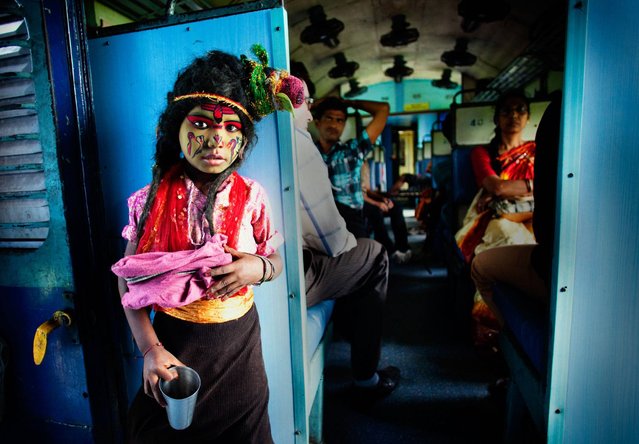
“I was on Durga Puja Festival vacation, travelling on a local train. A boy was singing devotional song and begging for alms. He was guised as a Hindu god, Lord Shiva. This is a common view in Indian trains but this boy was charming, bright and did have a melodious voice. My camera was ready hanging on my neck so I took a picture”. (Photo and caption by Arup Ghosh/2014 Sony World Photography Awards)

“I was on Durga Puja Festival vacation, travelling on a local train. A boy was singing devotional song and begging for alms. He was guised as a Hindu god, Lord Shiva. This is a common view in Indian trains but this boy was charming, bright and did have a melodious voice. My camera was ready hanging on my neck so I took a picture”. (Photo and caption by Arup Ghosh/2014 Sony World Photography Awards)
Details
18 Mar 2014 10:17:00
Tibetan Mastiff

“The Tibetan Mastiff also known as Do-khyi (variously translated as “home guard”, “door guard”, “dog which may be tied”, “dog which may be kept”), reflects its use as a guardian of herds, flocks, tents, villages, monasteries, and palaces, much as the old English ban-dog (also meaning tied dog) was a dog tied outside the home as a guardian. However, in nomad camps and in villages, the Do-khyi is traditionally allowed to run loose at night and woe be unto the stranger who walks abroad after dark”. – Wikipedia

Photo: A man displays a Tibetan Mastiff he raised during the Tibetan Mastiff exposition on April 7, 2007 in Langfang of Hebei Province, China. (Photo by China Photos/Getty Images)
Details
05 Oct 2011 14:27:00
Members of the audience sit in the centre of the catwalk as the watch models for the C/MEO Collective walk by at Fashion Week Australia in Sydney on May 17, 2017. (Photo by Jason Reed/Reuters)

Members of the audience sit in the centre of the catwalk as the watch models for the C/MEO Collective walk by at Fashion Week Australia in Sydney on May 17, 2017. (Photo by Jason Reed/Reuters)
Details
19 May 2017 08:39:00