Loading...
Done
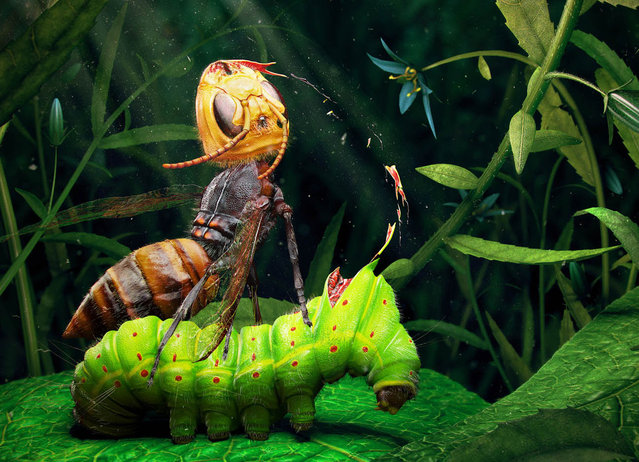
Deadly Insects Hornet

Hornets are insects that are the largest eusocial wasps. Some species can reach up to 5.5 cm (2.2 in) in length. The true hornets make up the genus Vespa and are distinguished from other vespines by the width of the vertex (part of the head behind the eyes), which is proportionally larger in Vespa and by the anteriorly rounded gasters (the section of the abdomen behind the wasp waist). The best known species is the European hornet (Vespa crabro), about 2–3.5 cm in length, widely distributed throughout Europe, Russia, North America and Northeast Asia.
Details
13 Oct 2014 10:17:00
Cordwood Construction - Natural Building

Cordwood construction is a method of natural building that originated roughly one thousand years ago in Greece and Siberia. This method involves using pieces of wood that slightly protrude from the mortar, giving the walls an attractive appearance. Usually, the walls are made 12 to 24 inches thick. However, in some parts of Canada, the walls can be as thick as 36 inches. This method appeals to many people due to its ease of construction economy of resources. Cordwood Construction can be separated into two main types: mortar-insulation-mortar (M-I-M) and Throughwall. M-I-M is a more preferable and widely used choice as it allows for better insulating properties.
Details
27 Nov 2014 15:10:00
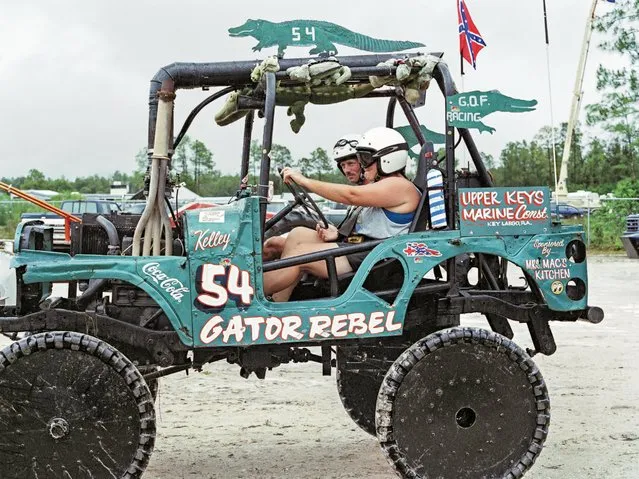
Kelley McMann, Gator Rebel, 2002. (Photo by Malcolm Lightner)

The Mile O' Mud is a 7/8-mile oval track with a 1/8-mile diagonal lane slashed through the center. The racing lanes are approximately 60 feet wide. On average, the muddy water is four to six feet deep, with three strategically placed holes. The largest hole, located in front of the grandstand, is the treacherous “Sippy Hole”, named for the legendary driver “Mississippi” Milton Morris, Swamp Buggy King 1955, who repeatedly got stuck in it. (Photo by Malcolm Lightner)
Details
19 May 2016 11:20:00
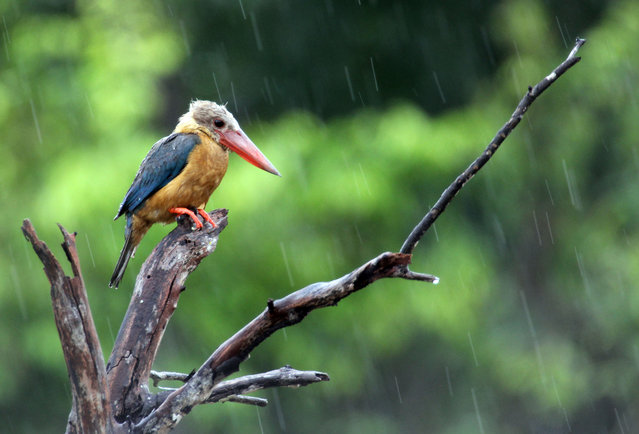
Stork-billed kingfisher during rain in Bintan, Indonesia. The tree species is sparsely distributed in the tropical Indian subcontinent and south-east Asia, from India to Indonesia. (Photo by Sijori Images/Barcroft Images)

A stork-billed kingfisher (Pelargopsis capensis) is seen perched on a tree during monsoon rain on July 25, 2016 in Bintan, Indonesia. The stork-billed kingfisher is a tree species which is widely but sparsely distributed in the tropical Indian subcontinent and Southeast Asia, from India to Indonesia. This kingfisher is resident throughout its range. It is very large, measuring 35 to 38 cm (14 to 15 in) in length. The adult has a green back, blue wings and tail, and grey head. (Photo by Sijori Images/Barcroft Images)
Details
27 May 2017 07:47:00
Staffie cross looks startled to get a lot of treats. (Photo by Christian Vieler/Caters News Agency)

This adorable gallery reveals the astonished expressions of dozens of puppies as they try to gobble up treats flying through the air toward them. Photographer Christian Vieler, 48, has been documenting pooches, with their eyes bulging, mouths wide open and looks of love on their faces, in his studio as part of the project “Dogs Catching Treats” since 2013. (Photo by Christian Vieler/Caters News Agency)
Details
12 Apr 2019 00:01:00
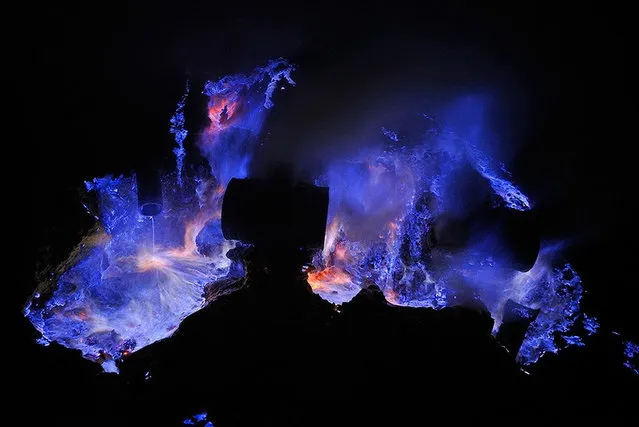
Sulfur mining in Kawah Ijen Lake

The Ijen volcano complex is a group of stratovolcanoes, in East Java, Indonesia. It is inside a larger caldera Ijen, which is about 20 kilometers wide. The Gunung Merapi stratovolcano is the highest point of that complex. The name of this volcano resembles that of a different volcano, Mount Merapi in central Java, also known as Gunung Merapi; there is also a third volcano named Marapi in Sumatra. The name "Merapi" means "fire" in the Indonesian language.
Details
03 Aug 2012 08:37:00
Tourists use a selfie stick on the Trocadero Square, with  the Eiffel Tower in background, in Paris, Tuesday, January 6, 2015. (Photo by Remy de la Mauviniere/AP Photo)

Tourists use a selfie stick on the Trocadero Square, with the Eiffel Tower in background, in Paris, Tuesday, January 6, 2015. Selfie sticks have become popular among tourists because you don't have to ask strangers to take your picture, and you can capture a wide view in a selfie without showing your arm. But some people find selfie sticks obnoxious, arguing that they detract from the travel experience. (Photo by Remy de la Mauviniere/AP Photo)
Details
09 Jan 2015 13:15:00
A competitor reacts as she emerges from the water during the Tough Guy event in Perton, central England, January 26, 2014. (Photo by Darren Staples/Reuters)

A competitor reacts as she emerges from the water during the Tough Guy event in Perton, central England, January 26, 2014. The annual Tough Guy race – “the toughest race in the world” – at Perton in Staffordshire. Tough Guy claims to be the world’s most demanding one-day survival ordeal. First staged in 1987, the Tough Guy Challenge has been widely described as one of the hardest races of it’s type with up to one-third of the starters failing to finish in a typical year. (Photo by Darren Staples/Reuters)
Details
29 Jan 2014 10:49:00